
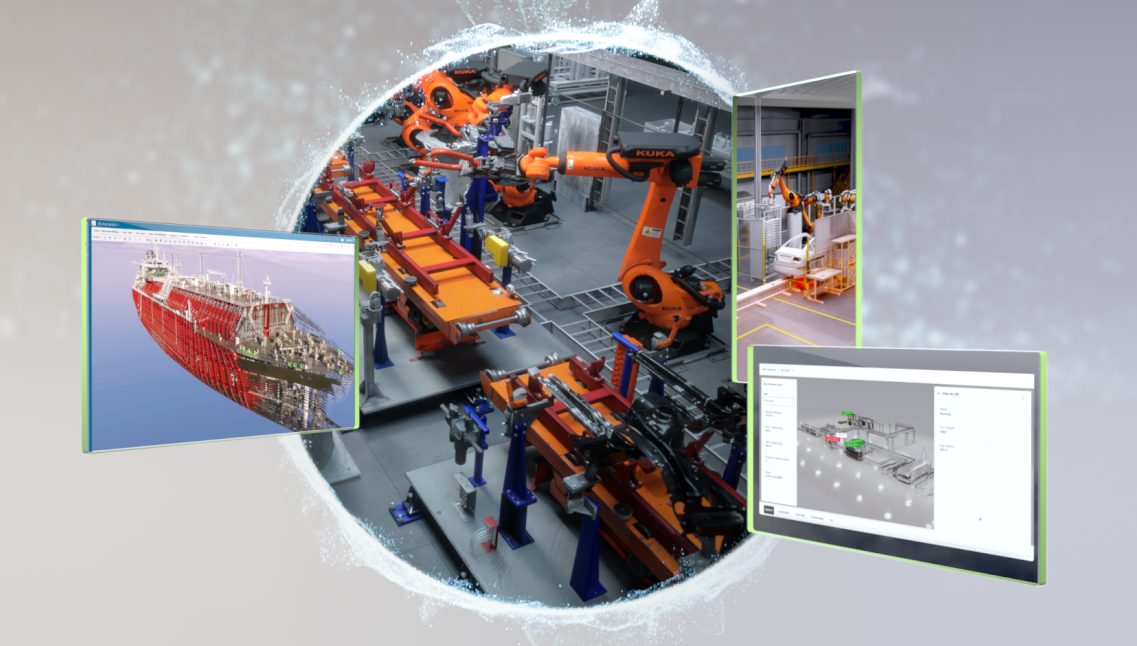
The industrial scenery is getting reshaped by digital twins and physical AI. These virtual replicas of factories, facilities, or even processes were once mainly conceived for planning purposes and now have become more operationally oriented, mainly concerned with training autonomous robots, AI-powered machinery, and operational systems to perform their tasks safely and efficiently in the real world. High-tech OpenUSD, immersive simulation tools, and AI-driven modeling are helping developers create high-fidelity digital twins at scale, removing most of their manual labor and fast-tracking industrial AI deployment.
Scaling Industrial AI and Physical AI with Digital Twins



Digital twins provide a virtual environment within which physical AI agents such as autonomous robots or smart factory systems can learn and adapt before deployment. Simulations of a finer quality came at the cost of much manual effort. Today, with advanced OpenUSD, neural reconstruction, and world foundation models (WFMs), developers can now set about constructing these complex digital replicas far more rapidly.
Key developments include:
SDKs bridging between simulators: They allow people to simulate robots and systems in diverse simulators, thus virtually providing access for robotics developers anywhere in the world.
- Neural rendering and 3D reconstruction libraries: These allow the capture and reconstruction of sensor data from the real world, simulation, and photorealistic rendering.
- Open-source robotics frameworks: Offer readymade environments and schemas for robots and sensors to help reduce the simulator-to-reality gap.
- World foundation models (WFMs): Used to create synthetic datasets and to carry out higher-order reasoning on these datasets for the benefit of physical AI applications.
- Advanced rendering and AI-assisted material modeling: Provide scalable ways to create industrial-grade digital twins.
OpenUSD: Powering the Future of Industrial 3D Innovation
OpenUSD constitutes the backbone of industrial 3D workflows, having become a standard for digital twin creation with interoperability between industrial and 3D data. By now, the Alliance for OpenUSD (AOUSD) has been extended to include Accenture, Esri, HCLTech, PTC, Renault, and Tech Soft 3D, thus showing great endorsement of OpenUSD and present objectives of uniting industrial 3D workflow.
To support this growing ecosystem, NVIDIA has introduced an industry-recognized OpenUSD development certification and a digital-twins learning path, helping developers gain the skills needed to build the factories and industrial systems of tomorrow.
Industry Applications Driving the Future:
Some of the global leaders use digital twins and OpenUSD for transforming industrial operations:
- Siemens: Teamcenter Digital Reality Viewer allows working with large-scale digital twins for visualization and collaboration, thereby reducing physical prototyping and faster time-to-market.
- Sight Machine: Operator Agent platform amalgamates live production data with AI-driven recommendations and digital twins for better plant visibility and faster decision-making.
- Rockwell Automation: Emulate3D Factory Test creates physics-based digital twins from simulation to optimize automation and autonomous systems.
- EDAG: Uses digital twin for project management, production layout optimization, worker training, and data-driven quality assurance.
- Amazon Devices & Services: Uses digital twin environments to train robot arms for assembly, testing, packaging, and auditing, all with no physical intervention.
- Vention: Offers plug-and-play digital twin and automation solutions so intelligent manufacturing systems can be deployed more speedily.
Conclusion:
The combination of OpenUSD, digital twins, and AI-driven simulation is transforming industrial operations on the ground. By proving the exact, scalable virtual environment, they allow manufacturers, robot developers, and physical AI engineers to innovate faster, cut down expenses, and systematize safer and smarter solutions faster than ever before.
(This article has been adapted and modified from content on NVIDIA.)

