

The mobility landscape across the globe is undergoing a paradigm shift towards connected technology, AI-enabled architecture, and acute software-reliance. Robert Schweiger, Sales Development Group Director, Cadence, in an exclusive interaction with Anwesh Koley of ELE Times, explained the myriad possibilities and challenges that the future of transportation holds and how Cadence is poised to address industry imperatives.
ELE Times: How is Cadence poised to make fully autonomous vehicles a reality today?



Robert Schweiger: Autonomous vehicles require much more than AI software. They need a complete ecosystem spanning sensors, high-performance computing, semiconductor design, software development, system verification, and safety validation. Cadence is uniquely positioned because we provide solutions across the entire stack, from silicon design and automotive IP to virtual platforms, software development, and Multiphysics system analysis.
Modern autonomous vehicles rely on cameras, radar, lidar, sensor fusion, AI accelerators, and centralised compute architectures. Cadence enables the development of highly complex SoCs by providing a fully customisable chiplet-based reference platform that helps customers to address challenges in functional safety, security, power efficiency, and early software validation.
ELE Times: Brief us about Cadence’s AI-driven DSPs and agentic design tools and how they enable engineers to handle complex neural workloads.
RS: Automotive AI workloads are growing exponentially, driven by perception, sensor fusion, driver monitoring, voice assistants, and automated driving functions. Cadence Tensilica DSPs and AI IP processor platform are designed specifically to process these workloads efficiently at the edge. Our Neo NPUs, and NeuroEdge AI Co-processor deliver scalable performance, from embedded sensing applications to high-performance autonomous driving platforms.
What differentiates Cadence is the combination of configurable DSP architectures, AI acceleration, and software development environments that allow customers to optimise performance, power, and latency for specific automotive workloads. Recent automotive audio and AI implementations also demonstrate how Tensilica architectures can accelerate neural-network processing directly on DSP platforms.
NeuroWeave is our unified AI Compiler Toolchain for all the IPs running AI. It enables customers to train any AI model in various open-source frameworks and targets any combination of processors, DSPs, and AI accelerators. This will help with faster model deployment and a better time to market.
ELE Times: Features like personalised audio zones, vital signs monitoring, and child presence detection are becoming standard. How does Cadence intend to address these consumer-facing demands through their offerings?
RS: The vehicle cabin is rapidly becoming an intelligent sensing environment. Consumers increasingly expect personalised experiences while regulators demand higher safety standards.
Cadence addresses these requirements through our Tensilica DSP portfolio, which enables advanced audio processing, voice recognition, occupant monitoring, radar processing, and AI-based sensing applications. Our solutions support applications such as personalised sound zones, active noise cancellation, immersive audio, voice assistants, vital-sign monitoring, driver monitoring, and child presence detection.
With Euro NCAP introducing stronger requirements around occupant monitoring and child presence detection, our DSP-based radar sensing solutions help OEMs and semiconductor providers deploy these capabilities efficiently while maintaining low power consumption and real-time performance.
ELE Times: The automotive industry is moving rapidly from domain-based architectures to SDVs and zonal E/E architectures. How is Cadence enabling technology proliferation in this domain?
RS: The shift to Software-Defined Vehicles is fundamentally changing vehicle electronics. Instead of more than a hundred distributed ECUs, OEMs are already transitioning to centralised computing platforms connected through zonal architectures. Cadence enables this transition through semiconductor IP, chiplet technologies, automotive networking solutions, virtual platforms, software development environments, and system-level design methodologies.
Zonal architectures require powerful centralised SoCs, high-bandwidth automotive Ethernet networks, robust safety and cybersecurity systems, and scalable software frameworks. Cadence provides a customisable chiplet-based reference platform that addresses all these areas. This platform includes a scalable architecture consisting of a base system chiplet that supports flexible configuration, a configurable AI accelerator, support for a CPU chiplet, and an optional domain-specific chiplet.
All chiplets communicate via a UCIe standards-based interface, enabling interoperability and connectivity with other chiplets. Our customers can design, verify, and optimise the complete system, from chip to package, board, and vehicle-level integration, allowing them to accelerate the adoption of zonal architectures and SDVs.
ELE Times: For SDVs, how do you bridge the gap between physical electromechanical automotive systems and software validation?
RS: One of the biggest challenges in SDVs is validating software against physical vehicle behaviour long before hardware becomes available. Cadence addresses this challenge through virtual prototyping, system simulation, and digital twin technologies. We enable software teams to develop and validate applications using highly accurate virtual representations of hardware and physical environments.
At the same time, our Multiphysics simulation portfolio allows engineers to model thermal, mechanical, multibody dynamics, electromagnetic, and fluid dynamics effects. With Hexagon MSC, one of our latest acquisitions, we can now connect software validation to physics-based system models, helping customers detect issues earlier, reduce physical prototyping costs, and significantly accelerate vehicle development schedules.
ELE Times: With automotive electronics shifting rapidly toward rigorous functional safety certifications and upcoming Euro NCAP requirements for in-cabin sensing, how is Cadence helping silicon vendors and Tier-1 suppliers accelerate market compliance?
RS: Functional safety has become a fundamental requirement for all automotive electronics. Cadence offers one of the industry’s most comprehensive automotive safety portfolios, covering safety-aware design flows, verification methodologies, FMEDA-driven design, safety analysis, and ISO 26262 compliance up to ASIL-D.
For in-cabin sensing, we leverage our ASIL-certified Tensilica processors for radar and AI-based solutions to enable vital-sign monitoring, occupancy detection, and child presence detection. These technologies help OEMs address emerging Euro NCAP requirements while maintaining scalability and cost efficiency. Our goal is to help customers achieve compliance earlier, reduce certification effort, and shorten time-to-market without compromising safety.
ELE Times: Please elaborate on the criticality of power electronics in the e-mobility sector. What are the initiatives from Cadence towards this end?
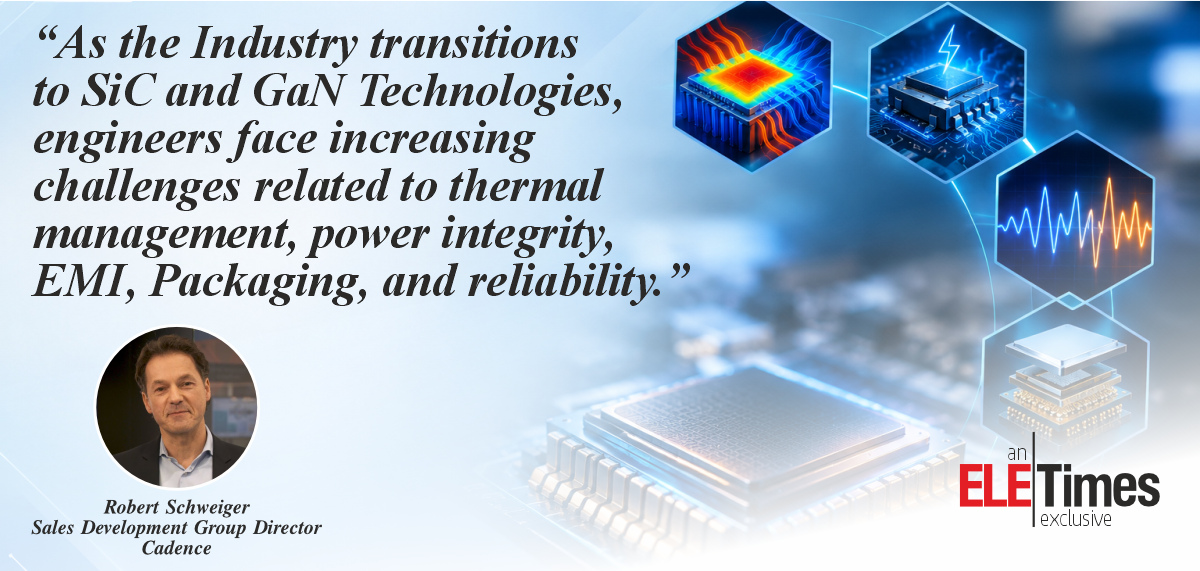
RS: Power electronics are the foundation of electrified mobility. They directly impact vehicle efficiency, driving range, charging performance, thermal behaviour, and overall reliability. As the industry transitions to silicon carbide (SiC) and gallium nitride (GaN) technologies, engineers face increasing challenges related to thermal management, power integrity, EMI, packaging, and reliability.
Cadence addresses these challenges through an integrated power-module design flow that combines circuit simulation, PCB design, packaging, thermal and warpage analysis, and system-level optimisation. Our Multiphysics approach helps designers optimise battery-management systems, inverters, power modules, and charging systems while improving efficiency and reducing development risk.
ELE Times: Any existing or upcoming challenges that you foresee in technology adoption and implementation across the automotive space?
RS: The challenges are no longer isolated to hardware or software. They span the entire vehicle ecosystem.
Key challenges include:
- Managing the complexity of SDV software stacks
- Scaling AI and autonomous computing platforms
- Accelerating validation of AI-driven systems
- Managing the transition to chiplets and advanced semiconductor nodes
- Ensuring functional safety and cybersecurity
- Handling thermal and power-density issues in centralised compute architectures
- Reducing development cost and time-to-market while maintaining quality standards
The companies that successfully master end-to-end system-level co-design across hardware, software, and physics domains will have a significant competitive advantage.
ELE Times: How does Cadence envision the evolution of technology in the automotive industry and what are the breakthroughs to watch out for?
RS: We believe four major trends will shape the next decade of automotive innovation:
- Software-Defined Vehicles becoming the dominant vehicle architecture.
- AI-powered vehicles, where perception, planning, diagnostics, and personalisation are enabled by advanced AI.
- Centralised and zonal computing architectures replacing traditional ECU-based designs.
- Vertical integration of OEMs to better master hardware-software development and optimisation
Breakthroughs to watch include a fully digital engineering and virtual validation, leveraging agentic AI workflows, which will dramatically reduce development cycles and enable continuous innovation. Cadence is investing across all these domains to help the industry deliver safer, smarter, and more sustainable vehicles.

