

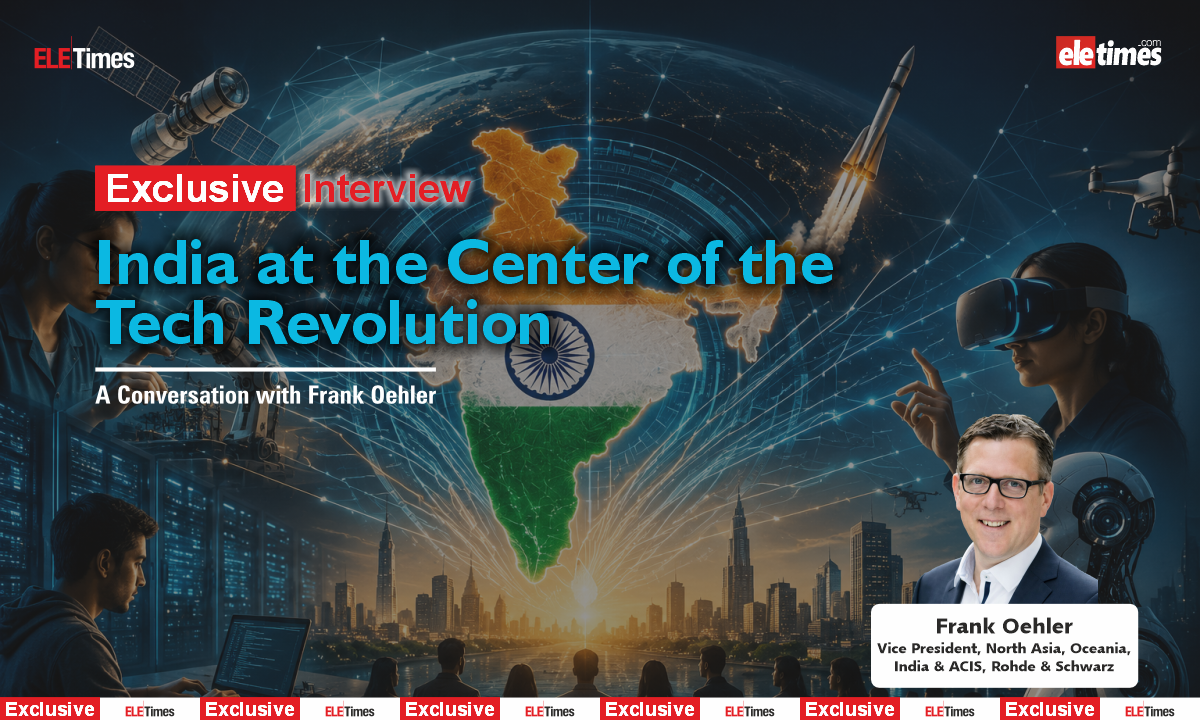
India at the Center of the Tech Revolution: A Conversation with Frank Oehler
At the Rohde & Schwarz Technology Symposium in Bangalore, India, Devendra Kumar, Editor of ELE Times magazine, interviewed Mr. Frank Oehler, Vice President for North Asia, Oceania, India, and ACIS at Rohde & Schwarz. In this insightful conversation, Mr. Oehler shared perspectives on his regional leadership role, the company’s strategic priorities, and the technologies expected to shape the future.



Q1. Could you please introduce yourself and tell us about your role and responsibilities?
Frank Oehler: My name is Frank Oehler, and I serve as Vice President for India, North Asia, Oceania, and Central Asia. I’m responsible for all business activities across these regions — sales, operations, and marketing — as well as expansion initiatives, particularly in India, where we are growing our R&D and engineering presence.
Q2. What is the R&S Technology Symposium, and how does it benefit participants?
Frank Oehler: It’s a highly professional event with strong participation from across the industry. It’s not just about showcasing products — it’s about networking, sharing knowledge, and discussing key trends like AI, next-generation communications, and defense technologies. The diversity of participants and the quality of discussions make it a genuinely valuable platform.
Q3. Rohde & Schwarz has been at the forefront of innovation — how do you see the current evolution of the global electronics and communications industry?
Frank Oehler: The industry is evolving at an incredible pace. Development cycles are becoming shorter, and innovation is accelerating rapidly, driven largely by artificial intelligence. We are still at the early stages of AI adoption, but it will significantly increase efficiency and speed. At the same time, technologies are evolving naturally — moving from 5G to 6G — but each generation brings greater complexity. Managing this complexity will require new tools and approaches, including advanced computing. These trends will have a major impact on the electronics and communications landscape globally.
Q4. What is your perspective on India within this global context?
Frank Oehler: India stands out as a major technology hotspot. It has a strong foundation in IT and programming, along with a rapidly growing ecosystem in communication technologies. The country benefits from a large pool of highly skilled graduates and the presence of global corporations with strong R&D hubs. We see India as a key part of our future and are committed to being actively involved in this growth.
Q5. What key technology trends are shaping the future of North Asia, particularly in sectors like telecom, defense, and aerospace?
Frank Oehler: Artificial intelligence is certainly one of the most important technologies. Another is quantum computing, which will help manage the increasing complexity and massive data volumes we face today. From a communications perspective, we are also seeing a shift beyond terrestrial networks toward space-based communication and applications such as signal intelligence — areas becoming increasingly important, especially in defense and advanced communications.
Q6. What are Rohde & Schwarz’s strategic priorities in India, particularly around the ‘Make in India’ initiative?
Frank Oehler: Our strategy in India is clear — we want to be part of the country’s growth story. “Make in India” covers a broad spectrum for us. It includes system integration, where components are assembled and integrated locally — both mechanically and through software — as well as strong R&D and engineering contributions. Given our portfolio of over 20,000 products, it doesn’t always make sense to manufacture everything locally, but we contribute significantly through integration, R&D, and customized automated testing solutions that customers need as end-to-end systems rather than individual instruments. We remain flexible, recognizing that today’s rapidly evolving environment has made India become increasingly important geopolitically as a key global technology hub.
Q7. What differentiates Rohde & Schwarz from competitors in this rapidly evolving market?
Frank Oehler: One key differentiator is that we are privately owned. This allows us to take a long-term view rather than focusing on short-term financial pressures. We invest heavily in technology and innovation, collaborating with universities and acquiring companies based on technological value rather than market segments. Our diversified portfolio and independence give us stability and flexibility, enabling us to stay ahead in a rapidly changing industry.
Q8. How is Rohde & Schwarz contributing to advancements in 5G and the upcoming 6G ecosystem?
Frank Oehler: 5G is still being rolled out globally, with its evolution increasingly focused on IoT, machine-to-machine communication, and edge computing. We are leaders in communication testing solutions that help companies design and validate these technologies. Looking ahead to 6G, we are already involved in early-stage development and standardization. Concepts like network sensing and advanced applications could transform user experiences in ways we can’t fully predict yet. We are also working on innovations like digital twins and software-based testing environments to accelerate development cycles.
Q9. When do you expect 6G to become reality?
Frank Oehler: We expect early demonstrations around 2028, possibly during major global events. However, widespread adoption will depend on real-world use cases and the speed at which compelling applications emerge for end users.
Q10. What role do AI and automation play in your current and future product offerings?
Frank Oehler: AI is a key focus area for us. It helps analyze large volumes of data, improve decision-making, and enhance product design. It’s deeply integrated into our innovation strategy, including areas like quantum computing. We see AI becoming an essential part of our daily operations and future growth.
Q11. With increasing geopolitical challenges, how is Rohde & Schwarz supporting defense and homeland security sectors?
Frank Oehler: We are actively involved in supporting defense and homeland security through technologies such as electronic warfare, signal intelligence, and secure communications. These capabilities extend beyond terrestrial systems into space-based applications. We work closely with governments, including India, to address these evolving requirements.
Q12. As a leader, what motivates you in such a dynamic and technology-driven industry?
Frank Oehler: Technology itself is my biggest motivation — I’ve always been fascinated by how it shapes our lives. This industry is constantly evolving, which means continuous learning. Working with talented teams, especially in regions like India, adds to that excitement. Being part of innovation and helping shape the future is incredibly rewarding.
Q13. How do you envision India’s long-term growth and strategic role in the global technology and industrial landscape?
Frank Oehler: India will continue its strong growth trajectory over the next decade. Education and talent will be key drivers, and India is already leading in this area. Cities like Bengaluru have the potential to become the next global technology hub, comparable to Silicon Valley. We are excited to be part of this journey.
Q14. What message would you like to share with participants and stakeholders?
Frank Oehler: Stay curious. The technologies we see today are just the beginning — there’s much more to come. Keep learning, keep networking, and keep engaging with the ecosystem. Collaboration and curiosity will drive the next wave of innovation.
Q15. Any final insight before we wrap up?
Frank Oehler: I truly enjoy being in India. The energy, talent, and decision-making capabilities here are impressive and growing stronger. It’s an exciting time to be part of this ecosystem, and I look forward to continued collaboration and growth.

