
India’s electronics and semiconductor sector is currently experiencing a significant turning point in its trajectory. This transformation is primarily fuelled by key government initiatives such as the Production Linked Incentive (PLI), Electronic Manufacturing Clusters Scheme (EMCS), and Design Linked Incentive (DLI) schemes. In addition, the sector is benefiting from the realignment of global supply chains towards India and the anticipated growth in domestic demand. As a result of these factors, industry projections indicate that the sector is on track to reach a market value of US$500 billion by the year 2030. This rapid evolution signifies India’s transition from being a consumption-driven market to emerging as a prominent global centre for innovation, manufacturing excellence, and intellectual property (IP) development.
At the core of this momentum are events such as Electronica India and Productronica India, which are organised by Messe Muenchen India. These platforms have transformed beyond mere trade shows and have become pivotal drivers of industry advancement. By bringing together policymakers, international investors, pioneers, suppliers, and producers in a single setting, these events facilitate more than just conversations. They lead to tangible results such as establishing new collaborations, transferring technology, integrating supply chains, and translating policies into market opportunities that enhance India’s electronics value chain.




In a highly insightful discussion, the President of IMEA (India, Middle East, Africa) at Messe München, along with the CEO of Messe München India, sheds light on India’s remarkable journey from a consumption-oriented market to a prominent global electronics manufacturing hub. As EPI 8-10 April, 2026 marks the inaugural edition of EPI’s biannual scheduling, unveiled in 2025, underlines the imperative need to keep pace with the swiftly evolving industry landscape. These cutting-edge platforms, revered as “decision-grade” marketplaces, are strategically designed to streamline the supply chain operations, showcasing over 400 exhibitors and fostering collaborative partnerships, technological advancements, and bolstering domestic production capabilities.
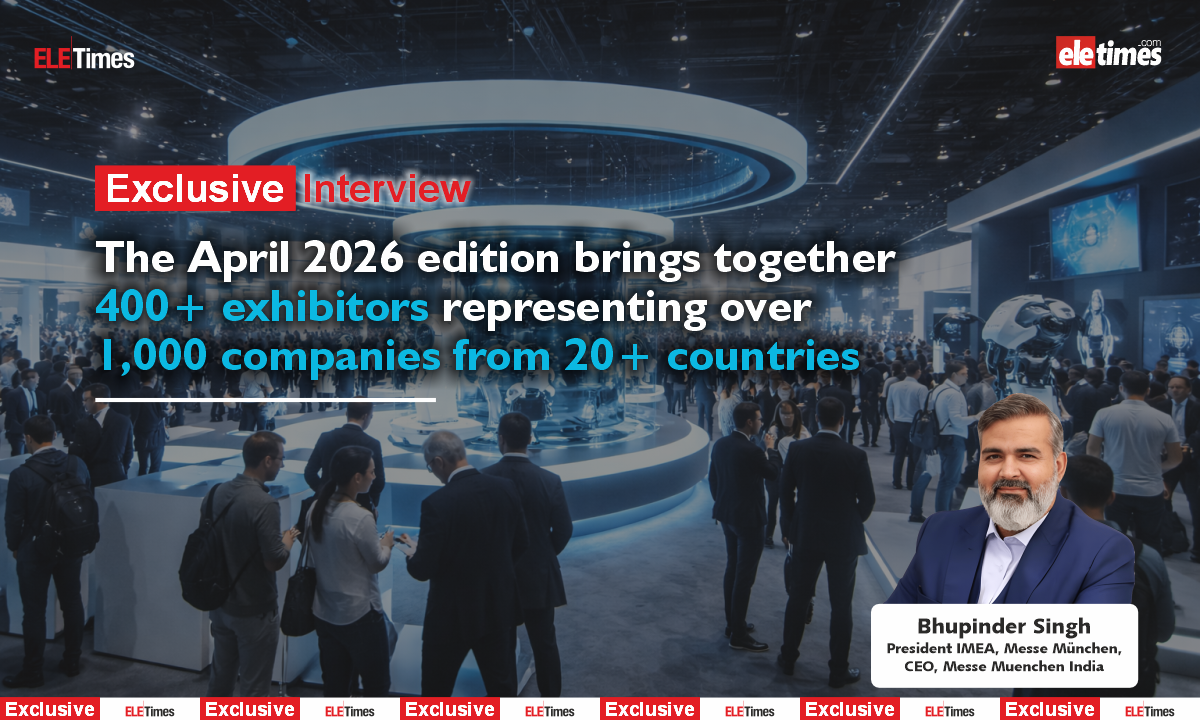
In a recent conversation with Bhupinder Singh, President of India, Middle East, and Africa at Messe München, as well as the Chief Executive Officer of Messe München India, we discussed…
ELETimes: India’s electronics landscape has evidently undergone a significant transformation. In your opinion, which pivotal shift do you believe is driving the market trends presently?
Bhupinder Singh: The crucial transition happening in the current landscape, shifting from intent to execution at a large scale. With capacity increasing, compliance becoming stricter, and decision-making processes becoming more efficient, the market must enhance its capability to assess technologies, validate partners, and smoothly progress from planning to implementation without delays caused by evaluating multiple vendors. In such a dynamic setting, business platforms should not only bring stakeholders together but also facilitate productive outcomes.
ELETimes: What sets electronica India and productronica India apart as marketplaces in 2026?
Bhupinder Singh: Our role is to simplify a complex supply chain by reducing friction. Given the deeply interconnected nature of electronics manufacturing, Electronica India and Productronica India bring the entire value chain into a single, focused environment—enabling companies to evaluate solutions end-to-end, align cross-functional stakeholders, and make more confident decisions. Ultimately, this is not just a showcase, but a purpose-built, decision-grade marketplace.
ELETimes: What level of scale and participation can the industry anticipate from the April 2026 editions?
Bhupinder Singh: Scale matters—but what truly drives outcomes is decision density. The April 2026 edition is built around high-intent engagement, bringing together 400+ exhibitors representing over 1,000 companies from 20+ countries, connecting with an expected 30,000+ trade attendees. Through live demonstrations, operational equipment, supplier interactions, and structured meetings, participants can evaluate solutions in a focused setting. With multiple options available in one place, teams can benchmark more efficiently, compare with greater accuracy, and accelerate decision-making. In effect, the event condenses months of fragmented vendor assessments into a few days of meaningful, high-value evaluation—because attendees don’t come to browse; they come to make decisions.
ELETimes: What prompted the shift to hosting two editions each year at this point?
Bhupinder Singh: The pace of the industry has fundamentally shifted. Product cycles are shorter, supplier qualification is more stringent, and project timelines leave far less room for delay. A single annual—or even biennial—touchpoint no longer reflects how companies make decisions, build, and scale today.
This transition also aligns with the momentum driven by India’s PLI and ECMS schemes, which are accelerating investments across electronics components, products, and systems manufacturing, while enabling faster capacity expansion across regions.
Taking all of this into account, from 2026 we are moving to a biannual format: Greater Noida in April and Bengaluru in September—two key markets, two distinct buying cycles, and two strategic opportunities each year to evaluate solutions, strengthen partnerships, and fast-track implementation.
ELETimes: What new opportunities does a biannual format create for exhibitors?
Bhupinder Singh: It creates three distinct advantages: speed, precision and responsiveness.
First, pipeline velocity improves—exhibitors can engage buyers more frequently, which directly supports conversion.
Second, regional precision—North and South are both high-opportunity, but they operate differently in procurement cycles and ecosystem density.
Third, market responsiveness—brands can launch updates, gather feedback and recalibrate strategy with far less lag. In electronics, speed is not a nice-to-have. It’s a competitive advantage.
And for visitors, it means access. If you’re sourcing, building, or scaling in India, you don’t have to wait for a single annual sourcing window. You can qualify suppliers, shortlist faster and keep projects moving with a six-month rhythm.
ELETimes: The April edition is being hosted in Uttar Pradesh—what new value or advantage does this bring to the event?
Bhupinder Singh: Hosting changes the quality of engagement. With Uttar Pradesh as host, the presence of relevant government departments and institutional stakeholders becomes structural—not optional. For international and domestic participants, a host state context brings sharper visibility on facilitation and readiness—so expansion conversations move from exploratory to executable
ELETimes: The event will be inaugurated by Hon’ble Chief Minister of Uttar Pradesh, Shri Yogi Adityanath—what message does this send to the broader industry?
Bhupinder Singh: It reflects a clear strategic commitment. Electronics sits at the core of national competitiveness and industrial growth, and the strength of state ecosystems increasingly determines the pace of progress. An inauguration led by the Chief Minister underscores electronics as a priority growth engine. For the market, this sends a strong signal—it boosts confidence and enhances the overall business environment surrounding the marketplace.
ELETimes: Uttar Pradesh has also unveiled targeted initiatives at Electronica India and Productronica India 2026. What makes these events the right platform for such announcements?
Bhupinder Singh: The aim is to elevate engagement beyond generic networking and create structured access. These initiatives are designed to raise the signal-to-noise ratio and make engagement more purposeful:
- UP Electronics Leadership Summit: A closed-door gathering of 100+ CEOs to accelerate top-level partnership and investment conversations
- CM-Meet: An invite-only leadership roundtable to align on priorities and collaboration themes
- 1: 1 meeting with international companies: To foster and accelerate alliances, JVs and market-entry conversations.
- Startup Showcase: 20+ startups to connect innovation with adoption and manufacturing capability
ELETimes: How international is the 2026 edition—practically speaking?
Bhupinder Singh: You’ll see a genuinely global footprint—strong participation across Asia, Europe and the US—bringing better benchmarking and more partnership options. As we progress toward the event, we are building toward the planned scale of 400+ exhibitors from 20+ countries.
For visitors and exhibitors alike, this matters because international presence improves benchmarking, expands partnership options, and raises the standard of technical and commercial discussions.
ELETimes: What does “end-to-end ecosystem” actually translate to on the show floor?
Bhupinder Singh: It translates to a complete, decision-ready view of electronics manufacturing—where stakeholders can assess both upstream and downstream implications and qualify partners with confidence. That includes components and modules, SMT and assembly, automation, test and inspection, embedded hardware and connectivity, EMS capabilities, and the factory disciplines that protect yield and reliability—cleanroom readiness, ESD control, safety systems and process consistency. The point isn’t variety. The point is readiness because electronics outcomes are not driven by one technology choice—they are driven by how choices perform together across the production flow.
ELETimes: You also announced a significant milestone for India’s PCB ecosystem—BPCA 2026 in collaboration with ELCINA. What shift does this represent?
Bhupinder Singh: We’ve formally launched the next phase of BPCA 2026—Bharat’s dedicated platform for Printed Circuit Boards and Assemblies—in partnership with ELCINA (Electronic Industries Association of India). As part of this transition, the India PCB Tech Conference will be rebranded as the Bharat PCB Tech Conference, creating a stronger national platform aligned with global standards and manufacturing readiness. With BPCA joining Electronica India and Productronica India 2026, we are shaping a more focused, future-ready PCB ecosystem under one roof.
ELETimes: Where does the Bharat Electronics Yatra fit into the larger strategy?
Bhupinder Singh: The Yatra is about building market readiness before the event and expanding engagement beyond the venue. It takes the conversation directly to the clusters and decision-makers, captures on-ground perspectives, and drives awareness across the broader production chain. The outcome is better participation quality: a more informed audience, sharper buyer intent and a show floor aligned to real needs. It’s a pipeline builder, pulling the ecosystem in—focused on relevance and ensuring this trade forum remains connected to the market between editions.
ELETimes: Final message—what makes the April 2026 editions of electronica India 2026 and productronica India 2026 essential fixtures on every serious industry calendar?
Bhupinder Singh: Because India is no longer “next”—it is now. Capacity is expanding, standards are sharpening, and scale is accelerating faster than most markets can track. In such a cycle, advantage belongs to those who evaluate rigorously and secure the right partners early. electronica India and productronica India are designed as decision-grade marketplaces—where technologies are benchmarked live, and partnerships move swiftly from discussion to commitment. And in April 2026, Greater Noida is where market leaders go not just to get ahead—but to stay ahead.

