

Courtesy: Yaksha Visual Technologies
The Digital Manufacturing Imperative
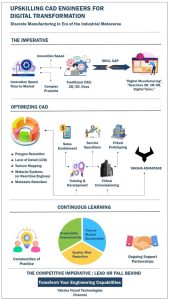
The landscape of discrete manufacturing is undergoing a seismic shift. Traditional CAD workflows that served manufacturing companies for decades are no longer sufficient in an era where digital manufacturing demands real-time collaboration, immersive visualisation, and seamless integration across the entire product lifecycle.




For companies in manufacturing hubs like Chennai and beyond, the question isn’t whether to embrace digital transformation—it’s how quickly they can prepare their engineering teams for this inevitable evolution.
Discrete manufacturing companies face unprecedented pressure to innovate faster, reduce time-to-market, and deliver more complex products with greater efficiency. The convergence of CAD design, real-time 3D visualisation, and the emerging industrial metaverse has created both tremendous opportunities and significant challenges for engineering teams.
Consider this reality: your competitors are already exploring how to optimise CAD assets for immersive collaboration environments. They’re training their engineers to create digital twins, interactive prototypes, and virtual factory simulations that transform how products move from concept to production floor.
The gap between companies that invest in upskilling their CAD engineers and those that don’t is widening rapidly—and it directly impacts competitive positioning in the global marketplace.
Digital transformation in manufacturing isn’t just about adopting new software tools. It’s about fundamentally reimagining how engineering teams work, collaborate, and deliver value across the product development lifecycle. Companies that recognise this distinction and invest accordingly will lead their industries. Those who treat digital transformation as merely a technology upgrade risk falling behind irreversibly.
Understanding the Skills Gap in Discrete Manufacturing
The traditional CAD engineer’s skillset—creating precise 2D drawings, developing 3D models, and managing technical documentation—remains foundational. However, these skills alone no longer suffice in modern discrete manufacturing environments where interactive visualization, real-time collaboration, and immersive technologies have become business-critical capabilities.
Most engineering teams face a significant skills gap when transitioning to digital manufacturing workflows. They excel at technical design but lack experience with real-time rendering engines, optimisation techniques for interactive 3D environments, and the workflows required to prepare CAD assets for the industrial metaverse. This gap creates bottlenecks that slow innovation, increase reliance on external vendors, and limit a company’s ability to leverage emerging technologies.
The Multi-Dimensional Challenge
The challenge extends beyond individual technical skills to encompass collaborative workflows and new ways of communicating design intent. Engineers accustomed to traditional review cycles must adapt to real-time, immersive design reviews where stakeholders can explore and manipulate digital prototypes. This shift requires both technical competency and a fundamental change in how engineers approach client communication and cross-functional collaboration.
Manufacturing companies in regions like Chennai—a major hub for automotive, aerospace, and industrial equipment production—face additional competitive pressures. As global manufacturers increasingly prioritise digital capabilities, local companies must ensure their engineering teams can compete on this new playing field. The cost of inaction isn’t just missed opportunities; it’s the risk of becoming obsolete in a rapidly digitising industry.
Optimising CAD Assets for the Industrial Metaverse
The concept of the industrial metaverse represents more than just virtual reality headsets and 3D visualisation. It’s an interconnected ecosystem where digital twins, real-time simulations, and collaborative virtual environments fundamentally transform how products are designed, manufactured, and maintained throughout their lifecycle. For this vision to become reality, companies must optimise their CAD assets for real-time interactive environments—a process that requires specialised knowledge and structured training.
Beyond Polygon Reduction
Traditional CAD models, created primarily for manufacturing and documentation purposes, often contain far too much geometric detail for real-time rendering. A single assembly might include millions of polygons, complex surface definitions, and detailed features that, while necessary for machining, create performance bottlenecks in interactive environments. Optimising CAD assets involves strategic simplification that preserves visual fidelity and critical dimensions while dramatically improving performance in immersive applications.
This optimisation process isn’t simply about polygon reduction. Engineers must understand level-of-detail strategies, texture mapping techniques, material system workflows, and the technical constraints of different deployment platforms. For a deeper technical breakdown of this workflow, review our engineering guide on mastering 3D modelling for AR/VR. They need to know which features matter for interactive visualisation versus manufacturing, how to structure assemblies for efficient loading and manipulation, and how to maintain links between optimised visualisation assets and master CAD data.
Business Value Across Use Cases
The business value of properly optimised CAD assets extends across multiple use cases:
- Sales enablement: Immersive presentations that clients can manipulate and configure in real-time
- Training & development: Interactive simulations of complex assemblies for technician education
- Service operations: Augmented reality maintenance guides that overlay instructions onto physical equipment
- Manufacturing engineering: Virtual commissioning of production lines before physical installation
Each of these applications requires CAD assets optimised specifically for their intended purpose—and engineers trained to create them.
Strategic Implementation for Manufacturing Companies
Successfully upskilling CAD engineers requires more than just sending teams to training sessions. Companies need a strategic approach that aligns training initiatives with business objectives, provides adequate time for skill development, and creates opportunities for engineers to apply new knowledge on real projects. The most successful implementations follow a phased approach that builds capabilities progressively while delivering tangible business value at each stage.
Start with Pilot Projects
Begin by identifying pilot projects that offer high visibility and clear business value while remaining manageable in scope. Perhaps a key product line needs an interactive sales demonstration, or a complex manufacturing process would benefit from a training simulation. These initial projects provide focused contexts for applying new skills while generating artefacts that justify continued investment in digital transformation initiatives. To accelerate this phase, many organisations partner with Immersive Skills Academy for a specialised Extended Reality Bootcamp for Enterprises, which trains teams directly on these pilot workflows.
Build Cross-Functional Teams
Form dedicated teams that combine CAD engineers receiving training with cross-functional stakeholders from sales, marketing, training, and operations. This collaborative structure ensures that optimisation efforts address actual business needs rather than just technical possibilities. It also helps engineers understand how their work fits into broader business objectives, increasing engagement and commitment to skill development.
Leverage Regional Advantages
Manufacturing companies in Chennai and other industrial centres have unique advantages when pursuing digital transformation. Proximity to suppliers, customers, and ecosystem partners creates opportunities for collaborative learning and shared resource development. Regional manufacturing associations and technology communities provide forums for sharing best practices and lessons learned. Forward-thinking companies leverage these networks to accelerate their digital transformation journeys.
Measuring Return on Investment in Engineer Upskilling
CFOs and business leaders rightfully demand clear ROI justification for training investments. The returns from upskilling CAD engineers for digital manufacturing manifest across multiple dimensions, from direct cost savings to competitive differentiation and new revenue opportunities. Understanding and tracking these varied benefits helps build the business case for sustained investment in workforce development.
Direct Productivity Improvements
Direct productivity improvements often provide the most immediate and measurable returns. Engineers proficient in optimisation workflows can repurpose existing CAD assets for multiple applications—sales presentations, training materials, marketing content, virtual commissioning—without requiring specialised external vendors for each use case. This capability alone can generate six-figure annual savings for mid-sized manufacturing companies with active product development pipelines.
Time-to-Market Acceleration
Time-to-market acceleration represents another significant value driver. Real-time visualisation enables faster design iteration, more effective design reviews, and earlier identification of potential manufacturing issues. When engineers can create interactive prototypes quickly, design validation cycles compress from weeks to days. For companies competing in fast-moving markets, this acceleration can mean the difference between leading with innovative products and playing catch-up to competitors.
New Business Opportunities
New business opportunities emerge when manufacturing companies can offer clients immersive product experiences and interactive customisation tools. B2B buyers increasingly expect sophisticated digital interactions throughout their purchasing journey. Companies whose engineers can create these experiences in-house maintain greater control over customer experience quality while capturing more value from each customer relationship.
Risk Reduction and Quality Improvement
Risk reduction and quality improvement, while harder to quantify precisely, deliver substantial value over time:
- Virtual commissioning of production lines reduces costly rework during physical installation
- Interactive training simulations improve technician competency while reducing training costs and equipment downtime
- Digital twins enable predictive maintenance strategies that prevent failures before they occur
Each of these applications reduces risk and improves operational excellence.
Building a Culture of Continuous Learning
Digital transformation isn’t a one-time event with a defined endpoint. Technologies continue evolving, customer expectations keep rising, and new applications for real-time 3D and immersive technologies emerge regularly. Manufacturing companies that succeed long-term don’t just upskill their engineers once; they build cultures of continuous learning where staying current with emerging technologies becomes part of every engineer’s professional identity.
Leadership Commitment
This cultural transformation starts with leadership commitment. When executives prioritise learning and development, allocate adequate resources for training, and celebrate employees who develop new capabilities, they signal that continuous improvement matters to the organisation. Engineers need time to experiment with new approaches, permission to make mistakes while learning, and recognition when they successfully apply new skills to deliver business value.
Communities of Practice
Create internal communities of practice where engineers share knowledge, troubleshoot challenges collectively, and showcase successful projects to peers. These communities accelerate learning by allowing engineers to benefit from colleagues’ experiences and discoveries. They also help identify emerging best practices specific to your company’s products, processes, and customer requirements.
Ongoing Support Partnerships
Partner with training providers like Immersive Skills Academy that offer not just initial training but ongoing support as your teams tackle increasingly sophisticated projects. Access to experienced mentors who can answer specific questions and provide guidance on complex challenges helps engineers maintain momentum as they apply new skills to real-world scenarios.
The Competitive Imperative
The window for gaining a competitive advantage through proactive digital transformation is narrowing. Early adopters in discrete manufacturing have already demonstrated the possibilities—immersive product configurators that increase sales conversion, virtual factories that accelerate production planning, and digital twins that optimise equipment performance throughout its lifecycle. These applications aren’t experimental anymore; they’re becoming baseline expectations in increasingly digitised supply chains.
Lead or Follow?
Manufacturing companies must ask themselves: do we want to lead this transformation or merely react to it? Leaders invest now in upskilling their CAD engineers, establishing digital manufacturing capabilities, and optimising CAD assets for the industrial metaverse before competitive pressure forces reactive responses. They gain experience while the stakes are lower, develop expertise that compounds over time, and position themselves as innovation partners to their customers.
Regional Competitiveness
For companies in manufacturing centres like Chennai, the stakes include regional competitiveness in addition to company-level concerns. As global manufacturing evolves toward digital-first workflows, regions that develop strong digital manufacturing capabilities will attract investment and retain high-value manufacturing operations. Individual companies that contribute to this regional capability development benefit from skilled talent pools, collaborative ecosystems, and recognition as innovation leaders.
The Real Choice
The choice facing manufacturing companies isn’t whether digital transformation will reshape their industry—that’s already happening. The choice is whether to invest proactively in preparing their teams or to scramble reactively when clients demand capabilities the company can’t deliver. Companies that choose the proactive path consistently report better outcomes, lower costs, and stronger competitive positions.

