
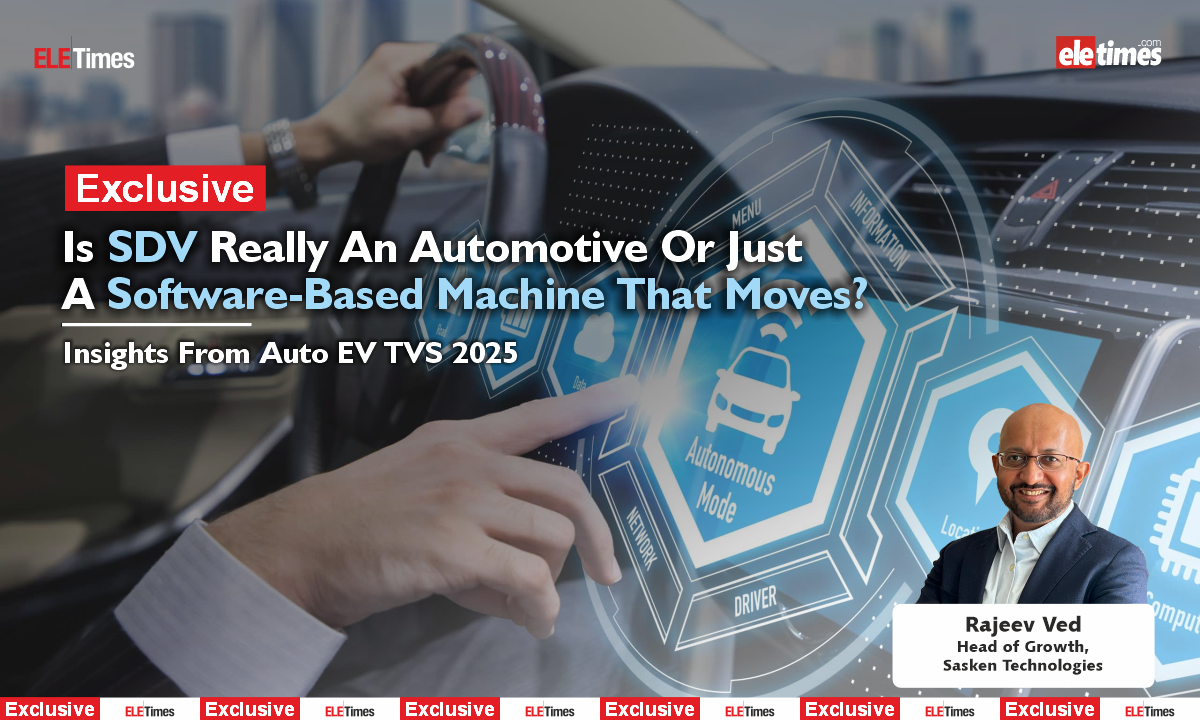
Speaking at the Auto EV Tech Vision Summit 2025, Rajeev Ved, Chief Growth Officer at Sasken Technologies Limited, took the Software-Defined Vehicle conversation away from surface-level features and into something far more foundational. While much of the industry debate revolves around autonomy levels, over-the-air updates, or larger infotainment screens, Ved stepped back and asked a more fundamental question: What does a car even mean in an SDV world?
For decades, automobiles have been sold through emotion. Freedom of mobility. Control over one’s journey. Aspiration for safety, performance, and status. These emotional anchors have shaped marketing, engineering priorities, and customer expectations alike. According to Ved, the SDV does not erase these emotions—it amplifies them. Adaptive driving systems increase control, predictive maintenance enhances reliability, and connected ecosystems elevate convenience. The “joy of driving” becomes algorithmically refined.




Software that Happens to Move
But beneath that emotional amplification lies a deeper transformation. An SDV is no longer merely a car with software added on. It is software orchestrating a machine, continuously connected to cloud systems, infrastructure, homes, offices, and other vehicles. At that point, the question shifts: is it a car enhanced by software, or is it a rolling software platform that happens to move from point A to point B?
Building such a vehicle, Ved argued, cannot be achieved by layering code over legacy architectures. It requires constructing the stack from the ground up. He described four foundational layers that together define a true SDV architecture.
The 4 Layers of SDV Architecture
In his address, Rajeev outlines what he described as the four architectural layers required to build a true Software-Defined Vehicle. At the foundation sits the Operational Foundation Layer—the tightly integrated hardware–software core that governs the vehicle’s mechanical systems. Here, distributed ECUs are consolidated into centralized domain controllers, allowing braking, propulsion, safety, and powertrain functions to operate as coordinated software-driven systems. Built above this is the Data & Intelligence Layer, where the vehicle continuously ingests sensor data, processes it at the edge, connects through V2X ecosystems, and interacts with cloud backends—transforming the car into a connected computational platform rather than an isolated machine.
Layered on top is the Services & Monetization Layer, where connectivity enables feature-on-demand models, adaptive insurance, predictive maintenance, and new lifecycle revenue streams. In this framework, the vehicle evolves from a one-time hardware product into a dynamic digital platform. At the apex lies the UI/UX & Infotainment Layer—the digital cockpit that defines the customer interface through immersive screens, augmented experiences, and ecosystem integrations. According to Ved, control of this layer will determine who ultimately owns the user relationship in the SDV era, making it one of the most strategically contested fronts in automotive transformation.
Cross-sectoral Expertise
Yet Ved cautioned that while the architecture evolves, foundational disciplines remain non-negotiable. Mission-critical standards, safety validation frameworks, and robust embedded software practices continue to underpin the stack. What changes is the scale of data pipelines, edge compute capabilities, cloud APIs, and monetization frameworks layered on top. Building for the SDV era requires expertise not only in automotive systems but in distributed computing, AI integration, and scalable digital services.
Conclusion
The larger implication of his address was clear. The SDV shift is not a feature race. It is a structural redesign of how vehicles are conceived, built, monetized, and experienced. Cars are evolving into distributed compute nodes, data platforms, and service ecosystems. The industry’s challenge is not merely to digitize the automobile, but to architect it as a layered, interoperable, and continuously evolving system.
The Software-Defined Vehicle is not an upgrade cycle. It is the redefinition of mobility itself.

