
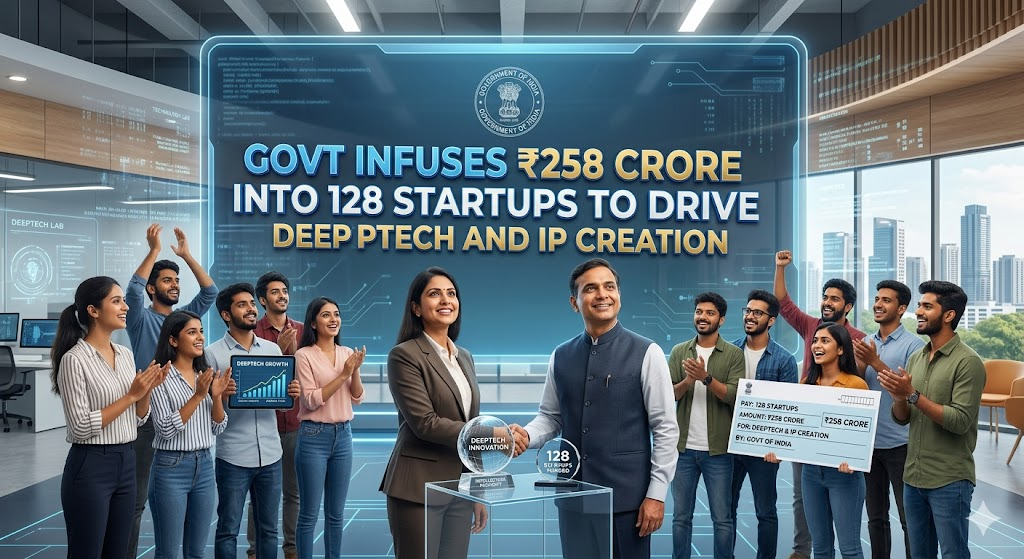
In a major move to solidify India’s standing as a global high-tech hardware hub, the Union Government has announced a strategic investment of ₹257.77 crore (approximately $31 million) into 128 technology startups.
The announcement, shared by Minister of State for Electronics and IT, Jitin Prasada, in a written reply to the Rajya Sabha on Friday, March 27, 2026, highlights a shift toward “risk capital” for sectors critical to national security and economic self-reliance.




The “Fund of Funds” Mechanism
The investment was executed through the Electronics Development Fund (EDF), which operates under a “Fund of Funds” model. Instead of direct equity, the EDF acts as an anchor investor in eight professionally managed “Daughter Funds” (early-stage venture and angel funds).
These Daughter Funds have leveraged the government’s initial contribution to mobilise a total of ₹1,335.77 crore in follow-on investments for startups specialising in:
-
Semiconductor Design & Nano-electronics
-
Cybersecurity & AI/ML
-
Robotics & IoT
-
Medical Electronics (HealthTech)
Impact by the Numbers
As of late February 2026, the ripple effect of this capital injection has already yielded significant socio-economic returns:
-
Job Creation: Over 22,700 high-skilled jobs have been generated within the supported startups.
-
Intellectual Property: The companies have successfully filed or acquired more than 300 IPs, reinforcing India’s domestic design capabilities.
-
Profitable Exits: The government has already realised ₹173.88 crore from 37 successful exits, proving that DeepTech ventures are becoming increasingly viable for investors.
Geographic Distribution: Bangalore Leads the Charge
While the government aims for pan-India growth, the current investment data shows a strong concentration in existing tech corridors. Bangalore remains the undisputed leader, housing 88 of the 128 funded startups.
A Strategic Pivot Toward Self-Reliance
This news comes on the heels of the Ministry of Electronics and IT (MeitY) approving 29 additional projects under the Electronics Component Manufacturing Scheme, involving a cumulative investment of ₹7,104 crore.
By focusing on the “Daughter Fund” model, the government ensures that capital is managed by industry experts while maintaining a minority stake—a move designed to encourage private venture capital to take more “brave” bets on hardware and indigenous R&D rather than just consumer-facing software apps.
“The goal is to build a self-sustaining electronics ecosystem,” stated the Ministry. “We aren’t just looking for the next ‘unicorn’; we are looking for the next breakthrough in Indian-owned IP.”
By: Shreya Bansal, Sub-Editor

