

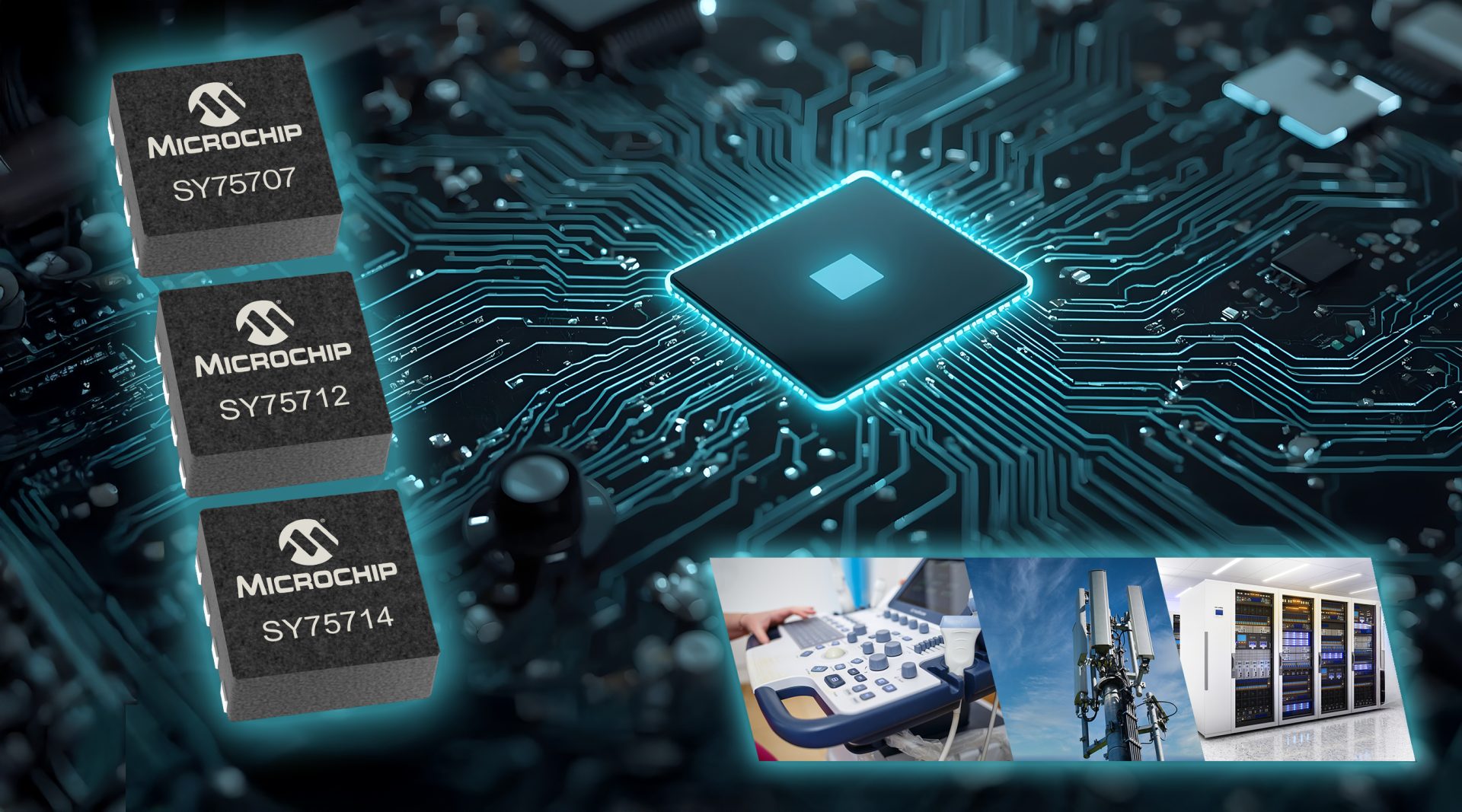
The demand for low-voltage clock drivers continues to grow with the rapid adoption of advanced FinFET process nodes used in high-performance FPGAs, SoCs, AI accelerators and next-generation CPUs. Printed circuit board designers face increasing challenges due to the limited availability of standard 1.2V LVCMOS clock buffers and level-translating buffers capable of converting higher-voltage clock signals to the lower-voltage levels required by these advanced devices. Conventional approaches that rely on discrete components and voltage-divider techniques can compromise signal integrity and clock duty cycle accuracy while increasing board complexity and component count.
Microchip Technology has introduced the SY757xx family, a comprehensive portfolio of 1.2V-output LVCMOS clock buffers, designed to address these challenges. The new devices simplify system design by eliminating the need for traditional discrete component implementations while delivering ultra-low additive jitter performance. To provide flexibility for supporting legacy board power supplies and different clock-source voltage levels, the devices support a broad range of supply voltage (VDD) and a wide operating frequency range. The SY757xx family enables ultra-low additive jitter clock distribution while maintaining the high clock resolution and signal integrity required for today’s high-speed FPGA, SoC and CPU platforms.



“Our SY757xx family of clock buffers helps customers overcome the growing clock distribution challenges associated with next generation high-performance FPGA, SoC and CPU platforms,” said Maamoun Abou Seido, appointed vice president of Microchip’s timing and communications business unit. “By combining ultra-low additive jitter performance with broad VDD and wide frequency support in a single-chip solution, the SY757xx devices simplify board design, reduce component count and help customers maintain the signal integrity and timing accuracy required in today’s high-performance computing applications.”
Microchip’s SY757xx family strengthens the clock buffer’s role as a critically important SoC and FPGA interface for clock distribution and clock fanout functionality in application platforms where signal integrity is paramount. These platforms demand high-speed parallel processing, hardware reconfigurability, low latency and efficient real-time computing. These capabilities are required for applications ranging from embedded vision and video processing to AI/ML acceleration, industrial control and IoT, networking and communications, and signal processing and embedded systems.
Launching three products in production and eight that are sampling in limited volumes, the family spans a wide array of configurations in three space-saving packaging options. The devices protect against clock distortion across a 0 Hz to 250 MHz frequency spectrum while also offering a broad range of power supply input and output options across the 1.2V to 3.3V voltage-translation input range. This includes a single-chip option that reliably interconnects 3.3V components to FPGAs and SoCs with a 1.2V clock signal requirement. Additive jitter is as low as 26 femtoseconds (fs).
Compared to traditional discrete component solutions for these FPGA and SoC applications, the Microchip buffers simplify design and reduce bill-of-materials costs while helping to optimize AC coupling and biasing and maintain signal integrity. Voltage dividers using discrete components may not provide adequate design margin and can degrade signal integrity by causing duty-cycle distortion.
Microchip clock buffers complement the company’s comprehensive range of flash-based FPGAs and SoC FPGAs spanning ultra low density to mid-range density devices. These and other Microchip products that range from microcontrollers and analog components to power management, timing, connectivity and memory devices are pre-engineered and validated to enable a simplified, lower-risk and more holistic approach to system design.

