
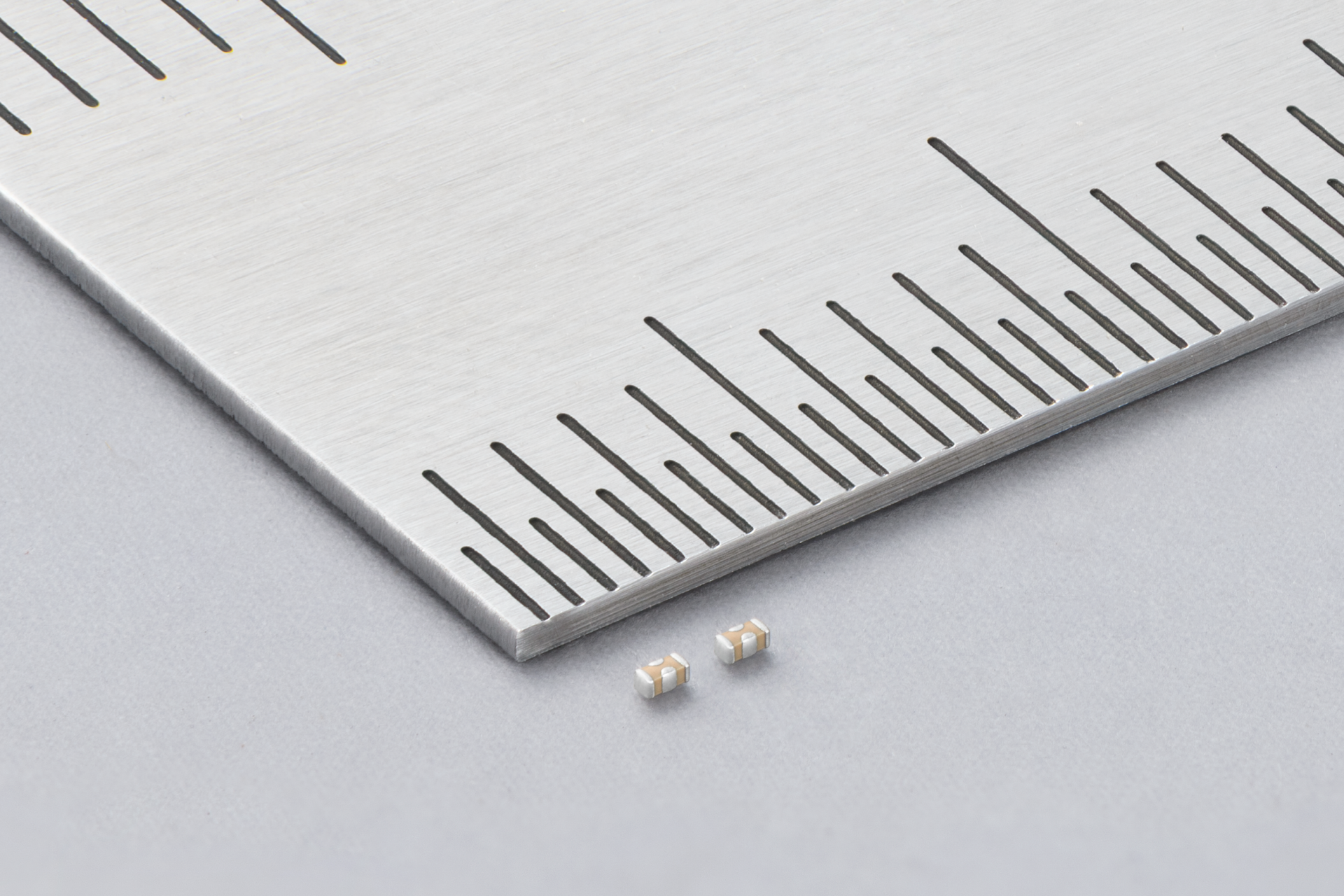
Murata Manufacturing, a Japanese global leader in electronic components and communication modules has begun mass production of the LLD series, the world’s smallest line of three-terminal, low equivalent series inductance (ESL) multilayer ceramic capacitors (MLCC). Measuring just 0201-inch size (0.6 × 0.3 mm), the new products reduce mounting area by approximately 64% compared with Murata’s previous smallest 0402-inch size (1.0 × 0.5 mm), freeing up valuable PCB space in compact devices such as smartphones and wearables.
Today, as the use of powerful ICs is embedded into smartphones and wearables, providing a stable power source is difficult. During high speed operation, the current fluctuates very fast, resulting in fluctuations in voltage to the IC. Reducing this instability to the lowest possible level is critical. Three-terminal capacitors with their four current paths are shorter than two-terminal devices and exhibit a lower ESL than traditional two-terminal components.




At the same time, thinner and smaller electronic devices require efficient use of limited PCB space. However, miniaturizing three-terminal capacitors has been difficult because their internal and external electrode structures are more complex than those of conventional two-terminal types.
Murata overcame this challenge by optimizing the electrode design and advancing its manufacturing processes. The resulting 0201-inch products enable high-density mounting while stabilizing the power supply voltage near ICs, even at high frequencies. This gives designers greater flexibility in component placement and circuit design around ICs, supporting higher performance in space-constrained electronic devices.
Two models are available. LLD033R60G105ME01 has a capacitance of 1 µF, a rated voltage of 4 Vdc, and an operating temperature range of -55 to +85°C. LLD033D80E105ME01 has a capacitance of 1 µF, a rated voltage of 2.5 Vdc, and an operating temperature range of -55 to +105°C.
Murata will continue developing compact, high-performance MLCCs for mobile and wearable devices, contributing to further miniaturization and enhanced performance of electronic equipment.

