

The rapid expansion of AI and its multifaceted applications have opened myriad avenues, while posing critical challenges that must be addressed in real time. Anwesh Koley of ELE Times, caught up with Sanjay Wadhwa, Chairman & Managing Director, NASH Group of Companies, to decode the latest technological advancements and India’s role in this growth story.
ELE Times: Share your thoughts on the increasing role of Smart Vision technologies in quality inspection, predictive maintenance, and operational efficiency.



Sanjay Wadhwa: Smart Vision is becoming central to the next phase of industrial transformation because it addresses four priorities that every manufacturer is focused on today: consistency, repeatability, speed, and traceability. As production environments become more complex and volumes rise, manual inspection alone cannot deliver the level of repeatability and real-time assurance that modern manufacturing demands.
AI-enabled vision systems bring intelligence directly into the production process. They can analyse visual data in real time, identify defects, recognise deviations, and support faster corrective action. More importantly, they provide a highly repeatable method of inspection, reducing the dependence on individual inspector judgement, fatigue, or differences in interpretation. This creates a much more consistent quality standard across shifts, operators, and production lines.
At NASH, we see Smart Vision not simply as an inspection tool, but as a broader capability across quality, security, monitoring and process intelligence. The ability to capture and analyse the same parameters consistently over time also creates a valuable digital record that can be used for traceability and continuous improvement.
Its value also extends beyond defect detection. When visual data is integrated with machine, process, and enterprise systems, it helps leadership identify weak points, understand recurring issues, and improve decision-making. In predictive maintenance, continuous monitoring can reveal early signs of deterioration, enabling teams to intervene before failures affect productivity.
The larger opportunity is to convert visual information into repeatable, reliable, and actionable intelligence. That is where Smart Vision will play a defining role – not only in improving operational efficiency but also in strengthening quality systems enabling predictive intervention, reducing process variation and ultimately building more efficient and resilient manufacturing operations.
ELE Times: How are Indian engineering and manufacturing companies building globally competitive Industry 4.0 solutions?
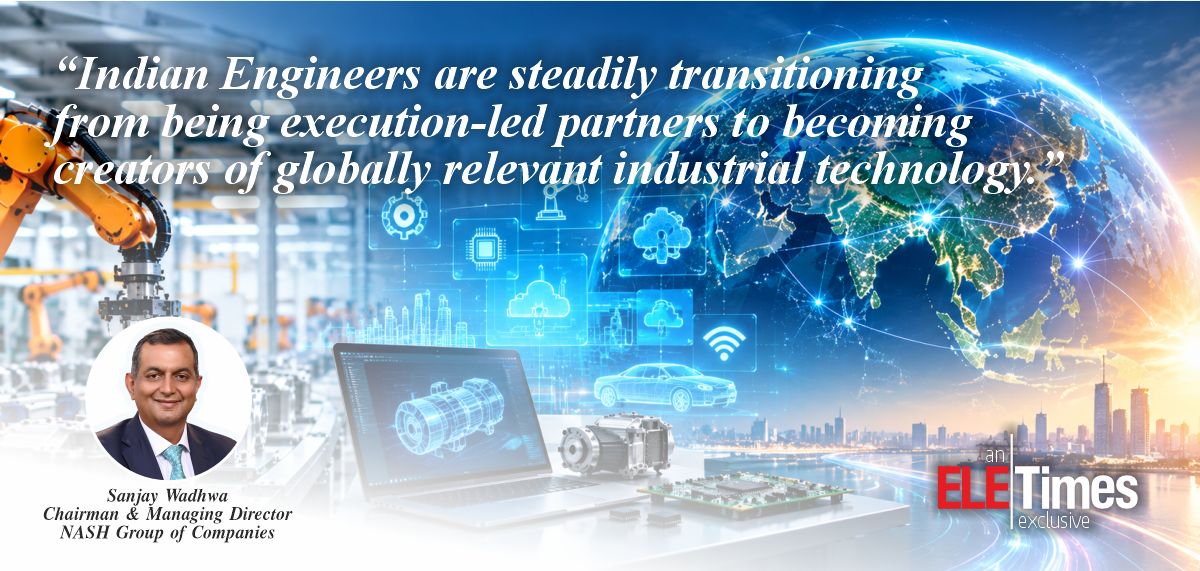
SW: Indian engineering and manufacturing companies are steadily moving from being execution-led partners to becoming creators of globally relevant industrial technology. This shift is being driven by strong engineering talent, deeper manufacturing experience, and growing collaboration with global technology ecosystems. The real transition is from “Make in India” to “Engineer in India, Innovate in India & Scale for the World.”
At NASH, our focus has been to build capability across the full product lifecycle — from design and engineering to embedded systems, Artificial Intelligence of Things (AIoT), Smart Vision, industrial computing and advanced manufacturing. This end-to-end capability allows us to develop solutions that are relevant to Indian operating conditions while meeting global expectations on quality, reliability, repeatability and scalability.
A strong example is the development of India’s first Industrial Motherboard, which reflects how Indian engineering strengths can translate into specialised platforms for industrial applications. Alongside this, our vertically integrated Design-to-Manufacturing approach enables us to customise solutions for specific customer needs without compromising robustness, repeatability, or scale.
For Indian companies, the opportunity is much larger than manufacturing for the world. India has the engineering depth, industrial base and entrepreneurial mindset to design, develop and manufacture competitive technology solutions for global markets. The ability to combine cost-effective engineering with global standards, interoperability, and long-term lifecycle support can become an important competitive advantage.
The next phase will depend on how effectively organisations combine engineering excellence, technology innovation, manufacturing discipline, and customer understanding. Equally important will be the ability to build solutions that are repeatable, scalable, secure, and capable of integrating with global industrial ecosystems. Companies that bring these together will be well positioned to shape Industry 4.0 solutions not only for India, but for global industry.
ELE Times: What are the existing opportunities and key challenges for manufacturers adopting AI-led industrial technologies at scale?
SW: The opportunity for AI-led industrial technologies is significant because manufacturers are under pressure to improve uptime, quality, productivity, and planning accuracy at the same time. AI can help organisations make sense of large volumes of operational data and convert that data into faster, more informed decisions. Predictive maintenance can shift teams from reacting to breakdowns to preventing them. AI-led vision systems can improve inspection consistency, and intelligent planning tools can support capacity decisions during new program ramp-ups.
However, scaling AI is not only a technology deployment exercise. The real challenge is moving from successful pilots to solutions that can be deployed repeatedly and economically across machines, lines, and plants. The challenge lies in the foundation. Data must be reliable, standardised and available at the right level of detail. Machines must be connected, processes must be consistent, and teams must have the ability to interpret insights and act on them quickly.
Cybersecurity is another critical consideration. As operational technology, enterprise systems and external ecosystems become increasingly connected, manufacturers must ensure that digital transformation does not compromise operational resilience or data security.
Therefore, the core challenge is not access to AI tools. It is building the digital, organisational, and engineering maturity required to move from pilot to scale and implement AI sustainably, securely and with measurable business value.
ELE Times: How do you foresee the future of intelligent factories? What are the technologies that will define the next decade of industrial innovation?
SW: The intelligent factory of the future will be connected, adaptive, and increasingly self-aware. We will see AIoT, Smart Vision, edge computing, advanced automation, and intelligent analytics working together as one integrated operating layer rather than isolated technology investments.
AIoT will provide real-time visibility across machines, utilities and production lines. Smart Vision will support autonomous quality inspection, safety monitoring, and process intelligence. Edge computing will enable faster decisions at the point where data is generated, while Digital Twins will enable manufacturers to simulate and optimise processes, capacity and changes before implementing them in the physical factory. AI will help manufacturers move from monitoring operations to predicting, optimising and continuously improving them.
The next evolution will be from connected factories to learning and increasingly autonomous factories. Digital twins and simulation will allow manufacturers to test changes before implementing them, while AI will increasingly move from providing insights to recommending and, within defined boundaries, executing decisions. The ability of different systems to communicate and learn from each other will be critical to achieving this at scale.
ELE Times: How is the “Make in India” initiative progressing and what role is NASH playing in this initiative?
SW: The Make in India initiative has evolved from a manufacturing-led movement into a larger national capability-building programme, and NASH is proud to be contributing to that transition. For us, Make in India is not only about assembling products locally; it is about creating end-to-end ownership across design, engineering, embedded electronics, software, testing, validation and manufacturing.
This is where NASH has become a preferred partner for customers who are looking for long-term value, reliability, and technology depth. We continue to evolve with industry requirements and have built strong capabilities to support sectors that demand high-quality, mission-critical hardware. A significant example is the movement of complete banking hardware programmes from China to India, where NASH has enabled local design-to-manufacture execution with the required scale, quality and responsiveness.
Our strength lies in combining product engineering, embedded systems, AIoT, industrial computing, smart vision, and advanced manufacturing under one integrated ecosystem. With a strong R&D foundation and over 180+ engineers, we are able to innovate faster, customise solutions for Indian and global customers, and add value at every stage of the product life cycle.
As the country builds deeper capabilities in electronics, industrial technology, EV, renewable energy and automation, NASH is focused on strengthening indigenous technology creation rather than depending on external ecosystems. Our work on industrial motherboards, LFP battery technology, and embedded platforms reflects this commitment. We believe the next phase of Make in India will be driven by companies that can design in India, manufacture in India and deliver globally competitive products. NASH is aligned to that vision, and we see our role as enabling customers to localise critical technologies while maintaining global standards of performance, quality and innovation.
ELE Times: Brief us about the current state of Lithium-ion technology for EVs in India and how NASH Energy is poised to deliver the required technology.
SW: Lithium-ion technology today is at an important inflection point in India’s EV journey. While the initial phase of adoption was largely driven by battery availability and cost, the market is now maturing towards a stronger focus on safety, reliability, lifecycle performance, thermal stability and localisation of critical materials & technologies. For Indian operating conditions, especially in mobility and energy storage applications, LFP chemistry is gaining strong relevance because of its inherent safety, durability and suitability for long-term use. At the same time, as applications evolve, there is a need to remain chemistry-agnostic and continuously evaluate other cell chemistries that can serve specific performance, energy density and use-case requirements.
At NASH Energy, our focus is to build deep technology and manufacturing capabilities across the battery value chain. We are working on LFP cell manufacturing along with advanced battery packs, battery management systems, power electronics and integrated energy storage solutions, while also exploring adjacent chemistries that may be relevant for future mobility and energy storage applications. This approach allows us to address not just the cell requirement, but the complete technology stack needed for reliable and scalable EV and industrial applications.
India has a significant opportunity to move beyond battery assembly and establish itself as a strong hub for cell technology, engineering and manufacturing. NASH Energy is well-positioned to contribute to this transition by combining technology expertise, manufacturing capability and application-level understanding to deliver safe, dependable and Made-in-India energy solutions for the evolving EV ecosystem.
ELE Times: How are AIoT, edge computing and intelligent automation reshaping modern manufacturing techniques?
SW: The convergence of the Artificial Intelligence of Things (AIoT), edge computing, and intelligent automation is transforming manufacturing from rigid, centrally scheduled assembly lines into adaptive, decentralised, and autonomous production ecosystems. This is possible by moving intelligence closer to machines, processes, and operators, instead of delayed action/analysis.
Primary decision drivers for the transformations on the Factory Floor:
- Ultra-Low Latency Quality Control
- Condition-Based & Prescriptive Maintenance
- Dynamic Shop-Floor Orchestration
- Live Digital Twins & Closed-Loop Tuning
- Adaptive Resource & Energy Optimisation
At NASH, we see these technologies as the foundation of smarter, more responsive industrial ecosystems. By integrating embedded electronics, industrial computing, AI and software, our solutions support applications such as predictive maintenance, process monitoring, machine vision, OEE analysis and industrial automation. These capabilities also help similar manufacturers reduce downtime, improve quality consistency, enhance traceability, and optimise resource utilisation.
For us, the value of AIoT and automation lies in solving real operational challenges, not in adopting technology for its own sake. When implemented with the right hardware, software and manufacturing expertise, these technologies enable faster decision-making, higher reliability, and more flexible production. This is how modern manufacturing is evolving from reactive operations to intelligent, data-driven and future-ready factories.

