
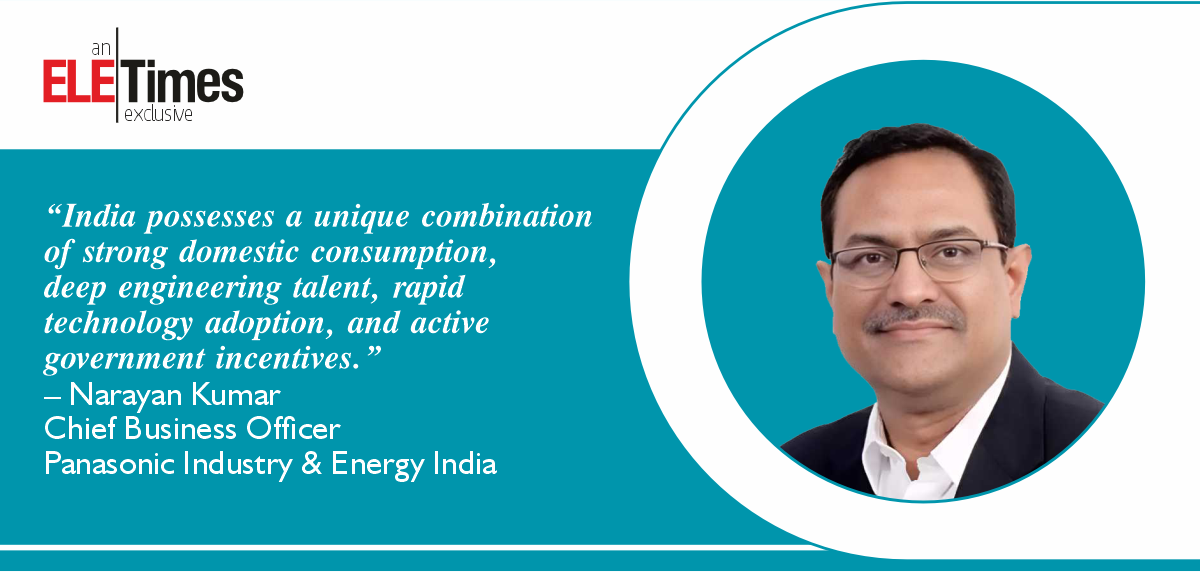
Panasonic Industry has returned to Electronica India this year with its broadest showcase yet for the Indian market comprising of new-to-India technologies focusing on performance, safety and reliability. Anwesh Koley of ELE Times, caught up with Narayan Kumar, Chief Business Office, Panasonic Industry & Energy India, to understand the company’s automotive trajectory and future trends.
ELE Times: Brief us about what all Panasonic is displaying this year and how important Electronica is for your company?




Narayan Kumar: We all know Electronica is a leading platform for the entire electronic ecosystem, and so we have been continuously participating in the Electronica event. Largely, from our point of view, we are looking at how we increase our participation in the total electronic ecosystem. If you look at the last few years, the movement has shifted from pure assembly to many organisations now doing local design and development.
That is a very big change because we can engage directly with the R&D and engineering teams of many of our customers across almost all segments to look at the future products they want to make, and determine how we can participate through our device solutions.
More importantly, it’s not only for the Indian market alone. We can now see many companies doing design and development for global markets. That’s a big shift. Being here in the city of Bangalore, we can see many Global Capability Centres (GCCs) coming up in India. It’s a very exciting time—the overall market is growing rapidly, and so are we with high double-digit growth, a momentum we would like to continue.
ELE Times: In terms of the current market—the Indian market vis-à-vis other Asian markets—how does Panasonic perceive the Indian market? What are the growth opportunities you have identified, and what is the way forward?
Narayan Kumar: The Indian market has become super important, not only from a Panasonic point of view, but also from the perspective of the total electronic ecosystem.
If you look at one big example of growth in Electronic Manufacturing Services (EMS), a few years back we primarily saw global EMS companies. Now, we see the rapid rise of Indian EMS companies growing at high double-digit rates. Again, this is not just for local Indian consumption; they are actively engaging in global exports. From a policy standpoint, the government is actively looking at signing Free Trade Agreements (FTAs), which will further boost the “Make in India” program.
A lot of organisations we are in touch with would like to diversify their production to India. That is where Panasonic Industry India would like to participate with those customers—not only from a supply standpoint, but also from a development perspective.
ELE Times: The government currently has been quite optimistic about the electronic and semiconductor sectors, backed by significant incoming investments. What is your take on these government and policy initiatives backing the sector?
Narayan Kumar: We need to look at current progress through the lens of where we were before. We started off largely on the assembly of mobile phones, but now almost all sectors in the economy involving electronic hardware are growing.
India remains very strong on the automotive side, with a high contribution to manufacturing GDP coming from automotive. Besides traditional automotive, we see rapid electrification happening across two-wheeler and four-wheeler EV markets.
Looking at non-automotive industrial markets, smart infrastructure and smart metering are expanding as part of government programs, driving action to produce meters locally and increase local content. In renewables and solar power, we are looking at the localisation of inverters. Every single component of the manufacturing value chain for electronics has initiated action, which is great news for companies like us to participate and offer our device solutions.
ELE Times: You mentioned the growth of electric vehicles in the automotive sector. How do you see EV technology developing in India, and what are your key takeaways from the current government push for EVs?
Narayan Kumar: India’s automotive sector is a massive market. Almost all global players are physically present here—not only with manufacturing powerhouses, but also with design and development centres.
Given the sheer volume of the Indian market, we won’t look at just one part of the powertrain; multiple powertrain options will emerge in parallel. In the two-wheeler segment, we are the largest globally. The EV market is definitely growing, and three-wheeler EV penetration is already very high because customers see a quick return on investment (ROI), a trend likely following into two-wheelers as well. As the economy progresses, multiple technology options will grow side-by-side.
ELE Times: How do you see the current state of localisation in India regarding technology and ancillary equipment sectors, and what is your perspective on the “Make in India” initiative today?
Narayan Kumar: That is a very pertinent question regarding the flagship government program, and I would break it down into three parts:
- Local Design Support: While localisation usually refers to local manufacturing, the piece that comes before it is local design. Global Capability Centres in India are expanding their workforce to design for global platforms. The world recognises that Indian designs are becoming global platforms, which is a major starting point where we actively participate.
- EMS & Manufacturing Content: Electronic Manufacturing Services are continuously increasing their localisation content and expanding local production capabilities.
- Component-Level Localisation: The third part involves going deeper into the supply chain to evaluate localised manufacturing for a wide variety of electronic components based on volume feasibility and product combinations.
ELE Times: At Panasonic, how do you balance quality and cost—a key factor the Indian market is known for—without compromising on reliability or impacting margins?
Narayan Kumar: The best way to look at this is not to separate quality and cost. They are deeply integrated because the consumer ultimately makes the buying decision. Across product roadmaps in all sectors, there is a constant focus on building long-lasting, reliable solutions. Many modern programs demand strong, long-term warranties. For instance, smart meter manufacturers are required to provide a 10-year warranty on maintenance and supply. Naturally, this demands selecting high-performance components built to last a decade.
Simultaneously, high manufacturing volumes help make pricing competitive. India is at a point where high volumes justify competitive pricing. Ultimately, reliability is the factor that beats everything—urbanisation means consumers want premium, durable products rather than spending time replacing items.
ELE Times: How does Panasonic foresee the future of technology in India, and how is the company poised to address upcoming opportunities and challenges?
Narayan Kumar: I would answer this from the perspective of how our headquarters and global customers view India:
- High-Value Consumption: India has always been a massive consumption market, but that consumption is shifting toward high-urban, premium categories. Launching high-quality products creates growing opportunities for our industrial devices.
- Export Expansion: Local EMS companies are expanding exports. As local manufacturing scales, imports will decline and exports will grow.
- Engineering & Design Leadership: We are very excited about the growth of local design and development that serves both India and global markets.
India possesses a unique combination that few other markets can claim: strong domestic consumption, deep engineering talent, rapid technology adoption, and active government incentives, such as electronics manufacturing clusters and talent upskilling. This combination makes the entire ecosystem more robust, durable, and long-lasting.

