

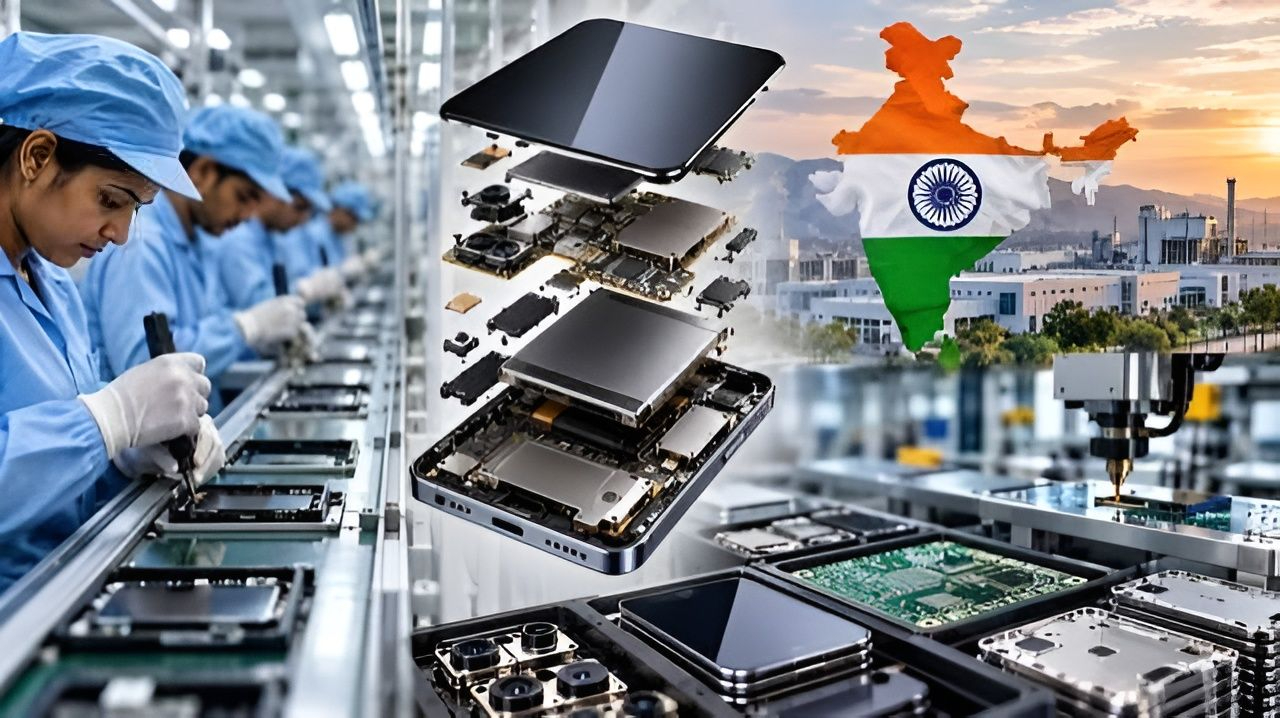
India continues to focus on raising domestic value addition and further deepening domestic manufacturing in electronics industry. Moving beyond large-scale assembly towards deeper manufacturing and stronger local supply chains, S. Krishnan, the Secretary of the Ministry of Electronics and Information Technology (MeitY) made the statement that India is targeting 35-40% domestic value addition in mobile-phone manufacturing, up from the current level of about 22-23%. To achieve this number, different government schemes are giving support such as India Semiconductor Mission (ISM), mobile manufacturing, the Production Linked Incentive (PLI) for electronics hardware and the Electronics Component Manufacturing Scheme (ECMS).
The Electronics Component and Manufacturing Scheme (ECMS) is expected to play a major role by focusing on deep component-level manufacturing rather than basic assembly. Key areas include printed circuit boards, passive components, electrochemical components, subassemblies, camera module, optical transceivers, and critical equipment.



The government aims to wider the development of India’s semiconductor ecosystem by expanding capabilities across components, semiconductor manufacturing and other parts of electronics value chain. ECMS is designed to integrate Indian manufactures with global value chains and ISM supports semiconductor design, fabrication, advanced packaging, equipment and materials.
The 40% target in domestic manufacturing does not means that forty percent of the electronic devices to be made in India. It means if a device is selling in India, then its forty percent value must be manufactured within the country. This target reflect India’s deepen participation in global value chains by moving beyond final assembly, creating a deeper supplier ecosystem, reduce dependence on imported components, and moving towards complete manufacturing location. This will allow Indian factories to source more inputs locally while maintaining competitive cost, quality and scale.

