

Prominent semiconductor technology supplier Microchip has been working steadily on streamlining deployment, reducing total cost of ownership and addressing signal integrity and latency challenges in large-scale AI infrastructure. Anwesh Koley of ELE Times caught up with Tam Do, Technical Engineer, Product Marketing for Microchip’s Data Center Solutions Business Unit, to gain a detailed perspective on how the company is augmenting innovations across the globe.
ELE Times: With PCIe 6.0 pushing data rates to 64 GT/s, signal transmission distance and latency have emerged as core design-level challenges. Could you elaborate on the specific performance and resource waste issues caused by signal integrity limitations in actual large-scale GPU cluster deployments? What role does the XpressConnect retiming product line play in the company’s overall data centre strategy?



Tam Do: In large GPU clusters, PCIe signal‑integrity limitations don’t just cause link errors—they translate into down‑trained links, higher latency, wasted GPU cycles, and expensive over‑engineering of boards and layouts. At scale, this becomes a real performance and cost problem.
XpressConnect retimers address this by restoring full PCIe Gen6/CXL3.1 margin with extremely low added latency, enabling longer reach, flexible topologies, and modular GPU architectures without sacrificing performance. Strategically, they are a key enabler of scalable, cost‑efficient, disaggregated data centre designs and a central part of the company’s end‑to‑end data centre connectivity portfolio.
ELE Times: The XpressConnect retimers achieve pin-to-pin latency of less than 12 nanoseconds, representing a reduction of approximately 80% compared to the PCIe 6.0 standard. How is this ultra-low latency achieved through architectural design? In AI training scenarios, how much of a performance improvement does this latency reduction specifically deliver in terms of GPU utilisation and data bottleneck mitigation?
Tam Do: XpressConnect achieves sub‑12 ns pin‑to‑pin latency through a deliberately minimal, PHY‑only architecture—Minimal Clock and Data Recovery stage, shallow equalisation pipelines, and no protocol‑layer buffering. It regenerates the signal without becoming a pipeline stage. In AI training systems, this translates directly into higher GPU utilisation by reducing synchronisation stalls and PCIe‑induced wait states.
At scale, customers typically see mid‑single‑digit percentage improvements in effective GPU utilisation and materially better multi‑GPU scaling efficiency. The value isn’t peak bandwidth; it’s eliminating latency accumulation that silently wastes compute cycles.
ELE Times: The XpressConnect retimers support CXL 3.1, enabling memory expansion and resource pooling for large-scale AI computing networks. What stage is the implementation of CXL 3.1 currently in the AI sector? How does the XpressConnect retimer enable and facilitate memory pooling deployments?
Tam Do: CXL 3.1 in the AI sector is currently in advanced pilots and early production, driven by hyperscalers and system architects preparing for rack‑scale memory pooling and composable infrastructure. CXL implementation is still in the crawling stage, while CXL 1.1 and 2.0 are shipping broadly today, CXL 3.1 is where large‑scale AI memory disaggregation is heading. XpressConnect retimers are a key enabler of this transition.
They don’t implement the CXL protocol, but they make memory pooling physically possible by extending reach, restoring signal integrity, and doing so with sub‑12‑nanosecond latency. This is because CXL and PCIe share the same physical interface. This allows CXL memory devices to be placed at the chassis or rack level without breaking CXL.mem latency requirements, enabling practical, scalable memory pooling for next‑generation AI systems.
ELE Times: As hyperscale data centre operators become increasingly concerned about vendor lock-in, what specific TCO (Total Cost of Ownership) reductions can a “plug-and-play” standard solution like the XpressConnect retimer bring to customers? How does Microchip help customers shorten their time-to-market from initial design to mass production?
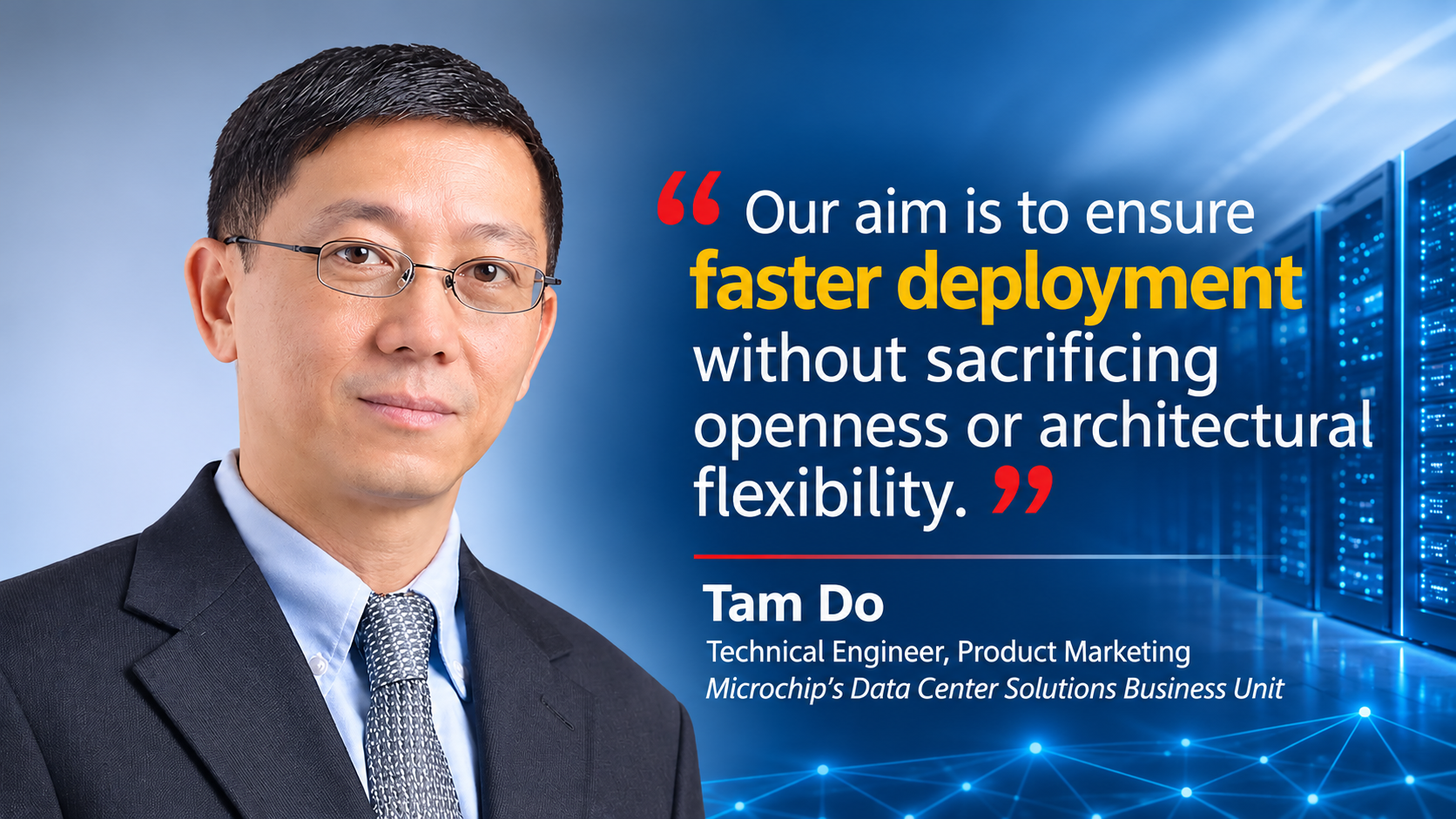
Tam Do: XpressConnect retimers directly reduce TCO by lowering engineering NRE, simplifying validation, and enabling lower‑cost boards, cables, and system topologies. At scale, this translates into fewer SKUs, higher yields, and lower operational risk. Microchip accelerates time‑to‑market through validated reference designs, deep ecosystem interoperability, and the ChipLink tool suite, which significantly shortens bring‑up, debug, and pre‑production cycles. The result is faster deployment without sacrificing openness or architectural flexibility.
ELE Times: As competition in the PCIe 6.0 retimer market intensifies, what sets XpressConnect retimer apart? Furthermore, how does Microchip plan to sustain its leadership position over the medium to long term?
Tam Do: The PCIe standard is the primary interface standard used on components deployed in the data centre for storage, server, and network infrastructure. As PCIe 6.0 retimers become more competitive, XpressConnect stands apart through architectural latency leadership, not just standards compliance. Its sub‑12‑nanosecond pin‑to‑pin latency, CXL‑optimised design, and deterministic behaviour make it uniquely suited for AI and memory‑centric fabrics, where latency compounds quickly.
Microchip sustains this leadership through early standards engagement, a coherent multi‑generation PCIe connectivity roadmap, and system‑level enablement that reduces customer risk and TCO with a total system solution. The result is not just a faster retimer, but a platform that scales with the future of AI infrastructure.
ELE Times: The next-generation PCIe 7.0 is expected to further compress the physical layer transmission window, posing greater challenges for retimer chips in terms of latency control and power efficiency. How do you view the evolution path from PCIe 6.0 to 7.0? Does the XpressConnect product line have a clear roadmap to address these challenges?
Tam Do: The move from PCIe 6.0 to 7.0 fundamentally compresses the physical‑layer timing window, making latency and power architectural problems rather than tuning problems. At 128 GT/s, retimers must deliver extreme jitter tolerance and signal recovery without becoming latency or thermal bottlenecks.
XpressConnect is well positioned for this transition because its design philosophy—minimal pipeline depth, deterministic ultra‑low latency, and PHY‑only signal regeneration—scales directly into PCIe 7.0 requirements from the current PCIe 6.0 design. While specific Gen7 products will follow the standard’s maturity, Microchip’s roadmap is clearly aligned around system‑level co‑design, ensuring that future XpressConnect devices continue to enable scalable, low‑latency PCIe and CXL fabrics for next‑generation AI infrastructure.
ELE Times: How does Microchip address the increase in high-performance computing demands of data centre workloads?
Tam Do: New ultra-low-latency signal transmission technology is required to advance the performance in AI, ML, ADAS and other computational workload applications. XpressConnect retimers triple the reach of PCIe Gen 5 electrical signals, which enables data centre equipment providers to harness the next generational advancement in compute IO performance.
Simultaneously, this provides the required flexibility and connectivity for advanced hardware architectures. XpressConnect retimers deliver ultra-low-latency signal transmission that enables the most demanding computational workloads in AI, ML, communication systems and high-performance computing applications.

