

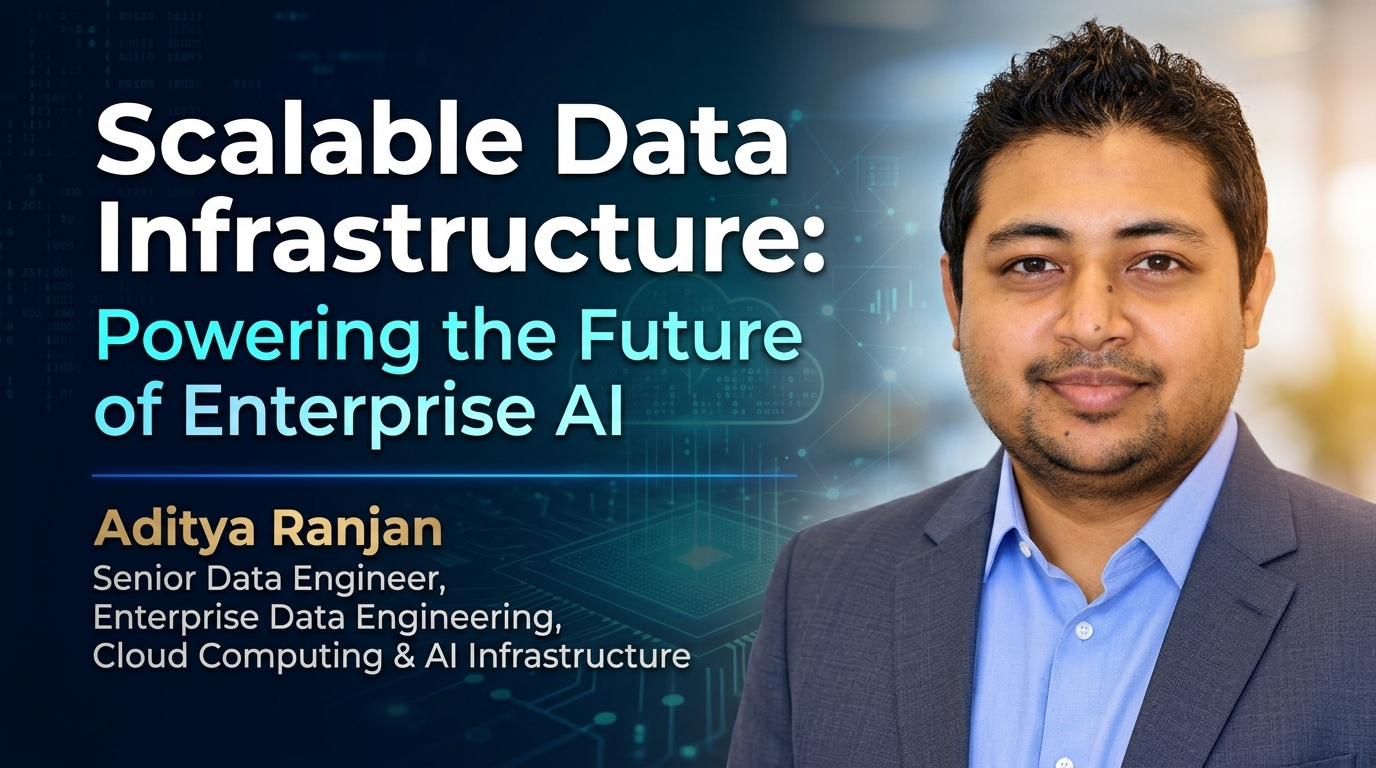
Scaling cloud-native data platforms supports growing workloads, though operating costs tend to soar as well. In an exclusive interaction with Anwesh Koley of ELE Times, Aditya Ranjan, Senior Data Engineer, Enterprise Data Engineering, Cloud Computing & AI Infrastructure, talks about large-scale data architecture, improving platform efficiency, and the need to address data reliability challenges.
ELE Times: When companies create and process growing data sets, what are some of the technical challenges in building a scalable data platform? How do you make architectural trade-offs regarding performance, dependability, and future scalability?



Aditya Ranjan: Scale exposes assumptions that seemed harmless at smaller volumes. A pipeline that reads an entire table each night may be fine initially, then become costly and miss its delivery window. A partitioning scheme that looks tidy can create thousands of tiny files. One busy customer or key can overwhelm a distributed task while the rest of the cluster waits.
My starting point is to write down the actual service expectations: data freshness, recovery time, acceptable cost, query latency and how quickly a new source must be onboarded. Then I look at the access pattern. Is the workload mostly appending-only, or does it contain frequent updates? Are consumers running a few predictable queries or many unpredictable ones? I prefer designs that are observable and recoverable over designs that win a single benchmark. I also avoid building for a hypothetical tenfold increase without evidence. A useful architecture should have a clear path to scale, but it should remain understandable and affordable at today’s load.
ELE Times: Most organisations can prove the potential of AI pilots but then fail to deploy them consistently at an enterprise scale. What are the typical data infrastructure choke points that cause this implementation gap, and how can engineering teams work through them?
Aditya Ranjan: A pilot often runs on a clean sample with one enthusiastic team watching it closely. Production is different. Source records arrive late, identifiers do not match, permissions vary by user, and the same business term means different things across departments. Retrieval-augmented generation adds another problem: an AI application may retrieve a plausible document that is outdated or not authoritative. I would address this before tuning prompts endlessly.
First, identify the decisions the application will support and the data sources behind them. Assign ownership, define freshness and quality targets, and test what happens when those targets are missed. Then add lineage, access controls, evaluation datasets and monitoring that measures the full system rather than only the model response. For higher-risk actions, I would require a human approval path or a tightly scoped action policy. The lesson is straightforward: an impressive demonstration does not establish operational reliability. That requires repeatable evidence under real-world conditions.
ELE Times: What is the impact of data quality, consistency, freshness, and lineage on the accuracy and reliability of enterprise AI applications? What actions can organisations take to ensure AI systems work with trustworthy and identifiable data?
Aditya Ranjan: These four qualities are connected, but they are not interchangeable. A record may be accurate when written and still be too old for a current decision. Two systems may each contain valid data yet disagree because they apply different business rules. Lineage tells us where information came from and which transformations shaped it; without that context, even a correct-looking answer can be difficult to trust. I encourage teams to move beyond a single ‘data quality score.’
Define checks that reflect the decision being made: completeness of required fields, acceptable update delay, consistency of identifiers, referential integrity and source authority. Put those checks close to ingestion and transformation, and make failures visible to the people who own the data. For AI, carry source identifiers and timestamps into retrieval where feasible. When a system cannot establish a trustworthy source, it should be able to say so or defer the action. Reliability is partly the ability to recognize uncertainty.
ELE Times: Apache Spark is a widely used platform for big data analytics. Which considerations should engineers keep in mind for optimizing Spark workloads in enterprise settings, and how can they uncover bottlenecks and anomalies caused by data skew, excessive memory use, and inefficient processing?
Aditya Ranjan: With Spark, I begin with the execution plan and the actual workload, not a list of configuration settings. The Spark UI can show whether a few tasks run much longer than the others, whether shuffles dominate execution, and whether tasks are spilling data to disk. Those clues often point to skewed keys, expensive joins or poor partitioning. If one key represents a disproportionate share of records, adding more executors may not solve the imbalance. I would examine join strategies, filter placement, partition sizes, file layout and whether unnecessary columns are being read.
I also look for repeated scans, excessive small files and expensive user-defined functions. Memory tuning has a place, but it should follow a diagnosis. In my technical writing, I have emphasized that architectural choices can matter more than simply increasing compute. A credible optimization compares equivalent workloads, records runtime and cost, and checks that the output remains correct. Faster is not better if it silently changes the result.
ELE Times: Cloud-native data platforms have the potential to scale as workloads grow, but operating costs will likely also grow. How can organisations architect and operate data platforms to optimise processing, infrastructure costs, resource utilisation, and reliability?
Aditya Ranjan: Cloud elasticity is useful, but it can hide inefficient habits. A job that runs twice as fast on twice the compute may cost the same or more, especially when startup time, retries, storage requests and data transfer are included. I recommend measuring cost per useful outcome, such as cost per processed record, per refreshed dataset or per successful query, alongside latency and reliability. That gives engineers a more meaningful basis for trade-offs.
From there, practical improvements include incremental processing instead of full reloads, right-sizing compute, reducing unnecessary data movement, compacting files where appropriate, and separating workloads with different service requirements. I would also set budgets and alerts at the pipeline or data-product level, not only at the cloud-account level. An important discipline is to compare a baseline and a proposed change over representative data volumes. Cloud cost optimization is not a one-time cleanup exercise; it belongs in normal engineering review.
ELE Times: How are current ETL/ELT pipelines and lakehouse architecture changing how businesses manage structured and unstructured data? How is a lakehouse solution advantageous to a data warehouse or data lake in some cases?
Aditya Ranjan: ETL and ELT are no longer rigid camps. Many teams ingest data quickly into scalable storage, then apply transformations where governance, query engines and workloads make the most sense. Lakehouse designs have made this more practical by adding table-level capabilities—such as transactional updates and schema evolution—to object storage. That can be attractive when an organization needs both analytics and large-scale data preparation over shared datasets. But a lakehouse is not automatically the right answer.
A well-run warehouse can be simpler for predictable business intelligence workloads, and a plain data lake may be sufficient for archival or exploratory use. I ask what kinds of updates, concurrency, governance and query performance the business actually needs. I also pay close attention to metadata, file sizes and table maintenance. The storage format alone does not create a reliable platform; operating practices and ownership still determine whether it succeeds.
ELE Times: The distributed data ecosystem presents a new challenge for maintaining visibility and control. How can an organisation introduce metadata management, data lineage, governance, and observability to increase data reliability while safeguarding security, privacy, and compliance?
Aditya Ranjan: Governance becomes useful when it is part of the engineering workflow, not a document that teams consult once a year. I would start by identifying critical datasets, their owners and the decisions they support. Then capture metadata automatically where possible: schema changes, pipeline runs, source-to-target relationships, quality checks and access events. Lineage helps answer practical questions such as ‘Which reports will be affected if this field changes?’
Observability helps us notice that a pipeline technically succeeded but produced an unusually small or delayed dataset. Security and privacy need the same operational treatment. Classify sensitive fields, enforce least-privilege access and make retention and audit expectations explicit. I am cautious about governance programs that try to catalogue everything before solving a single business problem. Start with the highest-impact data flows, prove that the controls help engineers and consumers, and expand from there. Good governance should reduce uncertainty and rework, not simply add approvals.
ELE Times: As agentic AI systems evolve, they will be able to plan tasks and employ multi-step workflows. How do AI agents change the data infrastructure needs, and how crucial are live data access, contextual accuracy, access controls, and traceability to a dependable system?
Aditya Ranjan: An AI agent is different from a chatbot because it may take a sequence of actions: look up a record, decide what to do next, call a service and update another system. Each step creates an opportunity for error to compound. That changes the infrastructure requirements. The agent needs data that is current enough for the task, but it also needs to know which source is authoritative and which actions are permitted. I would treat tool access as a controlled interface, with narrow permissions, validation of inputs and outputs, and records of the actions taken.
For important workflows, an agent should be able to pause, request approval or recover safely after a partial failure. Real-time access is not always necessary; the required freshness depends on the decision. A policy lookup and an inventory update have different tolerances. The central design question is not ‘Can the agent complete the task?’ It is ‘Can we explain, constrain and recover what the agent did?’
ELE Times: Distributed data platforms must deal with failures, workload variations, and inconsistent data sources for multiple services. As an engineer, what principles do you think are most critical for maintaining fault tolerance, data consistency, and the resilience of large enterprise applications?
Aditya Ranjan: I put idempotency, explicit contracts and recovery testing near the top of the list. In a distributed system, messages can be duplicated, services can time out after completing an operation, and different components can observe changes at different times. Assuming exactly-once behaviour everywhere is usually a mistake. Instead, I design processing so a retry does not corrupt the result, and I make the expected consistency model clear to consumers.
Checkpoints, dead-letter handling, bounded retries and replay mechanisms help, but they must be tested. I also want engineers to know the difference between a temporary delay and data loss. That means monitoring backlog, late events, failed records and end-to-end completeness—not just whether a server is running. Finally, resilience is an organizational habit. Run failure scenarios, document ownership and rehearse recovery before a real incident. A system is resilient when people can understand its failure and restore trustworthy service, not merely when it has redundant components.
ELE Times: In your career, you’ve worked on data platforms at scale, performance optimization, and cloud architecture. Without sharing any confidential information, could you describe an engineering problem where you faced a large architectural decision? What solutions did you consider, what trade-offs did you make, and what advice can you share with other engineers?
Aditya Ranjan: One recurring architectural decision in large data environments is whether to keep a familiar full-refresh process or redesign it around incremental change. Full refreshes are easy to reason about at first, but as data grows, they can create longer processing windows, repeated reads and unnecessary storage and compute costs. An incremental approach can improve efficiency, yet it introduces its own complexity: late-arriving records, deletes, duplicate events, ordering and recovery after missed changes.
In evaluating this kind of decision, I focus on the business freshness requirement and the correctness of the resulting state. I compare a baseline against alternatives, examine the failure cases and ask how an operator would replay or reconcile the data. I have worked on enterprise platform efficiency and architectural consolidation, but I cannot share proprietary implementation details or confidential measurements. My advice is to make the trade-offs explicit. A redesign is worthwhile only when the performance benefit can be demonstrated without weakening data correctness or recoverability.
ELE Times: As AI adoption increases and autonomous systems grow ever more sophisticated, where do you see data engineers’ careers heading in five years? What technical skills, architecture trends, and disruptive innovations should data engineers focus on for enterprise AI for tomorrow?
Aditya Ranjan: I expect data engineers to become more closely involved in how AI systems behave, not less relevant. As models become easier to access, the differentiator will often be the quality and operational discipline of the systems around them. Engineers will need a strong foundation in distributed systems, SQL, data modelling, streaming and cloud economics. On top of that, I would add metadata, access control, retrieval architecture, evaluation and observability for AI-enabled workflows.
The most important skill may be learning to define a measurable contract between data producers, applications and automated agents. I would not advise young engineers to chase every new framework. Learn why systems fail, how to measure a bottleneck, how to verify a result and how to explain a design decision to people outside engineering. Those abilities remain valuable even as tools change. In five years, I think the strongest data engineers will be those who can connect infrastructure choices to trustworthy business outcomes.
ELE Times: Looking back at your engineering work, what original approaches or problem-solving methods have you developed to improve the efficiency and reliability of large-scale data platforms?
Aditya Ranjan: The contribution I care most about is making architectural decisions measurable instead of relying on intuition. In enterprise data work, it is easy to mistake a bigger cluster or a new platform for progress. I have worked on improving processing efficiency and on bringing fragmented reporting and data flows into more coherent architectures. The underlying approach is to establish a reproducible baseline, isolate the dominant cost or reliability problem, compare realistic alternatives and verify the outcome against the same functional requirements.
That approach also shapes my published writing on Apache Spark: the point is not that one setting fixes every workload, but that partitioning, shuffles, storage organization and execution patterns should be examined as a system. I would not describe an internal project as a field-wide breakthrough without independent evidence. What I can offer is a practitioner’s method for making difficult trade-offs transparent, testable and useful to other engineering teams.
ELE Times: What evidence should engineers and technology leaders look for before describing a data architecture or AI infrastructure approach as a meaningful industry contribution?
Aditya Ranjan: If I were assessing whether a data engineering innovation mattered beyond its original project, I would look for evidence that another team could understand, reproduce and benefit from it. First, the problem and baseline must be clear. Second, the proposed method should be described precisely enough to test. Third, the outcome should include more than one attractive number: correctness, operating cost, latency and failure recovery may all matter.
Finally, I would look for independent signals—external adoption, technical feedback, published discussion or measurable reuse. This is particularly important in AI infrastructure, where impressive demonstrations can hide weak operational assumptions. In my own work, I try to separate what I have personally observed from what the broader industry has independently validated. That distinction makes technical claims more credible. My aim is to share engineering approaches that invite examination rather than asking readers to take results on trust.
ELE Times: How have you shared your engineering knowledge with the wider technology community, and why is independent technical scrutiny important to you?
Aditya Ranjan: I publish technical articles because I have seen how often teams repeat the same avoidable mistakes. A useful article should do more than declare that performance or governance matters. It should explain the mechanism, show what to measure and make the limitations clear. My article, ‘The Hidden Costs of Apache Spark: Why Architecture Matters More Than Compute,’ is one example. It discusses why inefficient execution and data layout can persist even when more resources are available.
I also take part in technical reviewing and educational outreach, where the value comes from testing ideas, asking precise questions and helping others understand difficult concepts. I see these as different ways to contribute to the engineering community. Publication by itself does not establish that an approach has been widely adopted; that requires citations, external implementations, independent evaluations or other evidence. I welcome that scrutiny, because it is how a practical idea becomes a contribution others can trust.
ELE Times: With over 16 years of enterprise data engineering, cloud computing, and distributed systems expertise, how has your career contributed to your approach to deep technical challenges in engineering? Over the years, what are some significant shifts that you have seen in enterprise data architecture?
Aditya Ranjan: Sixteen years in data engineering have changed the way I define a good solution. Early in my career, the question was often, ‘Can we move the data and finish the job?’ Today, I ask what happens when the source changes, a job fails halfway through, a customer needs an answer immediately, or an AI system relies on that data to make a decision. Those are different engineering problems. I have worked across traditional integration, distributed processing, cloud platforms and modern data architectures, and each stage taught me to pay attention to failure modes rather than only successful runs.
The biggest architectural shift, in my view, has been from centrally managed, batch-oriented warehouses toward a mix of streaming systems, cloud storage, lakehouse tables and governed data products. That flexibility is valuable, but it creates more places for definitions and ownership to drift. The challenge is no longer simply moving data at scale. It is keeping the data understandable, dependable and economical as the number of systems and users grows.

