

HomeNewsIndia NewsSystem tests up to PAM4 56Gbaud signals for 400GbE

System tests up to PAM4 56Gbaud signals for 400GbE

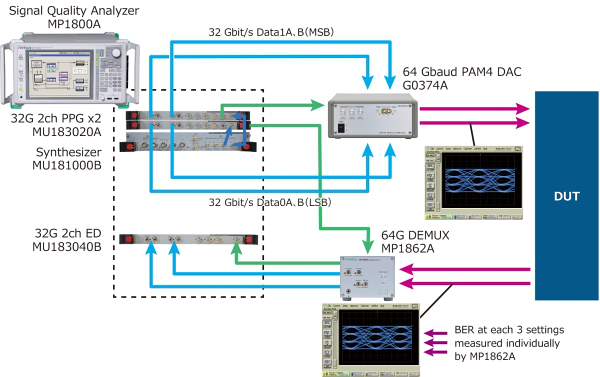
The MP1800A is the system mainframe that consists of an MU183020A 2x32Gbps pulse-pattern generator module and two MU181000B synthesiser module for generating PAM4 signals. The 4×32 or 4x28Gbaud streams combine in the G0374A to form a single 64Gbaud or 56Gbaud signal for testing receivers or backplanes. Signals from the DUT are demultiplexed by the MP1862A and go to the MU183040B, an error-detector module in the signal analyser for BER (bit-error-rate) measurements. Although the system is capable of generating 64Gbaud PAM4 signals, its BER capabilities are limited to 56Gbaud. But, that’s all you need for testing today’s 400GbE data streams.

The system will generate a clean three-eye PAM4 signal so you can see how it degrades when passing through the DUT (connectors, cables and PCB traces). The MP1800A lets you adjust signal skew. For testing receivers, you might need to add jitter. Anritsu product manager Hiroshi Goto explained to me in a phone call that you can add a jitter module to the system that will let you add random jitter, sinusoidal jitter, deterministic jitter and bounded uncorrelated jitter to transmitted signals, but that requires a second mainframe.


Although PAM4 is gaining ground, not everyone is using it. Some systems use 56Gbaud (56Gbps) NRZ (non-return-to-zero) modulation. Thus, the system also supports NRZ.

ELE Times Bureau
ELE Times Bureauhttps://www.eletimes.ai/
ELE Times provides a comprehensive global coverage of Electronics, Technology and the Market. In addition to providing in depth articles, ELE Times attracts the industry’s largest, qualified and highly engaged audiences, who appreciate our timely, relevant content and popular formats. ELE Times helps you build awareness, drive traffic, communicate your offerings to right audience, generate leads and sell your products better.

Related News

Must Read

AI Training vs AI Inference: The War for Faster, Cheaper, and More Efficient AI Computing

Abhishek Pandey/Sub-Editor/ELE Times  Learn how next-generation chip architecture, new hardware,...

Microchip Achieves QML Class V Qualification for RT PolarFire FPGA for Space Applications

Microchip Technology has expanded its radiation-tolerant (RT) PolarFire FPGA...

Vishay Extends Safety-Certified MLCC Portfolio with New 305 VAC Capacitors

Vishay Intertechnology has expanded its VJ Safety Certified Capacitors...

Infineon Partners with Megmeet to Develop 800 VDC Power Solutions for AI Data Centres

Infineon Technologies is working with Shenzhen Megmeet Electrical Co.,...

STMicroelectronics Unveils STM32G5 Microcontrollers for AI Data Centres, Robotics and Real-Time Power Control

STMicroelectronics, a global semiconductor company, has introduced its new...

AutoEV Bharat 2026, Bengaluru: A Must-Visit Show for Automotive OEMs

From intelligent vehicles and automotive semiconductors to advanced batteries...

ASMPT Introduces SIPLACE V L to Expand SMT Placement Platform Capabilities

ASMPT SMT Solutions has expanded its SIPLACE V placement...
