

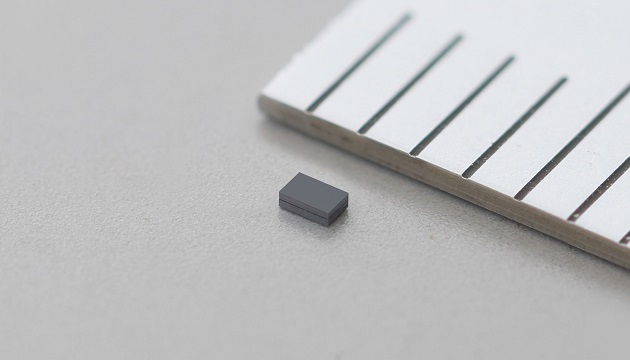
Murata claims to have developed the world’s smallest 32.768kHz MEMS resonator, which is expected to make a significant contribution to reducing the size and power consumption of IoT devices, wearables, and healthcare devices.
IoT, wearable, and healthcare related applications where small size, long operating times, and longer battery life are essential are increasing demand for compact electronic components that reduce the power consumption. 32.768kHz resonators are used extensively in power sensitive applications to keep accurate time while allowing power hungry resources to be put into a deep sleep mode, thereby saving system level power and extending overall battery life.



The new MEMS resonator is more than 50% smaller than competing solutions, while featuring a low ESR, excellent frequency accuracy, and low power consumption. This is due to the use of MEMS, a technology that was developed by Murata Electronics Oy (formerly VTI Technologies) which has a proven track record of unique and innovative MEMS used in a wide variety of applications originating with the automotive industry.
Main Features
While achieving miniaturization through MEMS technology, the new MEMS resonator exhibits frequency temperature characteristics of less than 160ppm (Operating temperature: -30 to 85°C ) with an initial frequency accuracy (25°C ) that is comparable to or better than that of a quartz tuning fork crystal resonator.
Key features are as follows:
Over 50% smaller than conventional tuning fork quartz crystal resonators
With dimensions measuring 0.9 x 0.6 x 0.3mm (width, length, height), the new MEMS resonator is more than 50% smaller than a conventional 32.768kHz tuning fork crystal resonator.
Built-in load capacitors
A typical pierce-type oscillator circuit design uses two external multilayer ceramic load capacitors. The new MEMS resonator is equipped with built in load capacitors, which makes possible a reduction in external parasitic capacitance, mounting space, and further contributes to more flexible circuit design.
Reduced power consumption by realizing a low ESR
With crystal resonators in general, the ESR tends to rise as the device becomes smaller in size. However, with a low ESR (75kΩ) the MEMS resonator can generate a stable reference clock signal by reducing the IC gain while also cutting power consumption by 13% compared to a conventional quartz crystal. (Based on internal tests)
Can be built into an IC package
With silicon-based wafer-level chip scale packaging (WLCSP), the resonator can be co-packaged with an IC, eliminating the need for any external low-frequency clock references.
Availability
Mass production of the new resonator is scheduled to begin in December 2018 as the WMRAG Series.
The new resonator will be showcased at the Murata booth at CEATEC JAPAN 2018, which will be held at Makuhari Messe from October 16 to 19, 2018.

