

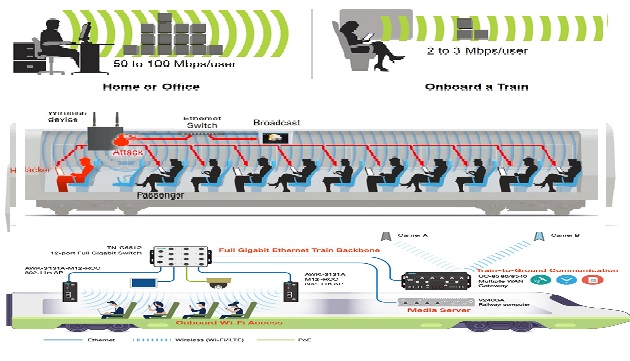
In recent years, the widespread use of mobile devices for information and communication has changed passengers’ expectations about rail travel. In addition to expecting a comfortable journey, passengers are increasingly demanding Internet access and the ability to work onboard a train to make efficient use of their travel time.
Beyond simple Internet access, railway operators have also begun to recognize that they can leverage onboard Wi-Fi networks to support a variety of operational and passenger infotainment applications. A digitally connected fleet enables real-time system status reporting and better information flow. These services increase operational efficiency, reduce costs, improve service quality, and improve customer satisfaction.



Five Keys to Successful High-Density Wi-Fi Deployment
Here are the top five factors to consider when choosing a Wi-Fi solution for high-density Wi-Fi deployments in industrial applications—beyond supporting the same standard features as a general-purpose access point (AP).
- Reliability
An AP plays a central role in connecting passengers to the onboard Wi-Fi network on a train. Although many enterprise solutions already provide such connectivity, only a few can meet the requirements of rolling-stock operations. Access points that are suitable for use on trains must include the following characteristics:
- Wide operating temperature range
- Anti-vibration and anti-shock connector design
- Dual isolation protection (RF and power)
- Versatile power input
- High Throughput
It is difficult to predict how much bandwidth each passenger needs to enjoy seamless network connectivity while travelling. Estimates are usually based on studies that consider user behavior and the bandwidth used by various onboard applications.
- High-Density Connectivity
If a conventional wireless network is deployed in a high-density user environment, it is not hard to predict the result, poor user experience. This is more evident at live events and on trains where hundreds of users are trying to simultaneously access a Wi-Fi network.
- Client-Load Balancing
When too many client devices try to connect to an AP, the bandwidth available for each client device decreases, eventually resulting in poor connectivity. With client-load balancing, railway operators can limit the number of client devices that can connect to an AP. When this limit is reached, the AP can deny any new connection requests, forcing client devices to connect to other APs, thereby sharing the available radio channels evenly among client devices in the area.
- Wireless Client Isolation
Railway operators must implement client isolation in a public Wi-Fi network to prevent client devices from communicating with one another; they should be allowed to only access the Internet. This serves two purposes: it increases network security and limits broadcast traffic. Every device that connects to onboard APs belongs to the same network, which includes onboard systems such as broadcast or other control systems.

