

HomeNewsIndia NewsResearchers succeed in rolling out a new synthesis mechanism of semiconductor atomic...

Researchers succeed in rolling out a new synthesis mechanism of semiconductor atomic sheet

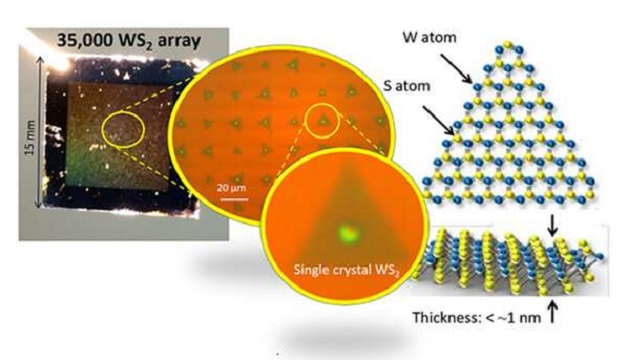
A new synthesis mechanism regarding transition metal dichalcogenides (TMD) has been clarified by the researchers of Japan Science and Technology Agency. TMDs are the semiconductor atomic sheets having thickness in atomic order. Because it is difficult to directly observe the aspect of the growing process of TMD in a special environment, the initial growth process remained unclear, and it has been desirable to elucidate a detailed mechanism of synthesis to obtain high-quality TMD.

An in-situ observing synthesis method has been developed by our research group to examine the growth aspect of TMD as a real-time optical image in a special high-temperature atmosphere of about 800°C in the presence of corrosive gases. In addition, a synthesis substrate, which is a mechanism to control diffusion during the crystal growth of a precursor, has been developed in advance; further, it has been clarified that the growing precursor diffuses a distance about 100 times larger than in conventional semiconductor materials. It was also demonstrated that nucleation occurs due to the involvement of the precursor in a droplet state. Furthermore, by utilizing this method, a large-scale integration of more than 35,000 monolayer single crystal atomic sheets has been achieved on a substrate in a practical scale.


Utilizing the results of the present research, the large-scale integration of atomic-order thick semiconductor atomic sheets can be fabricated and is expected to be put into practical use in the field of next-generation flexible electronics.

ELE Times Research Desk
ELE Times Research Deskhttps://www.eletimes.ai
ELE Times provides a comprehensive global coverage of Electronics, Technology and the Market. In addition to providing in depth articles, ELE Times attracts the industry’s largest, qualified and highly engaged audiences, who appreciate our timely, relevant content and popular formats. ELE Times helps you build awareness, drive traffic, communicate your offerings to right audience, generate leads and sell your products better.

Related News

Must Read

Overcoming Next-Gen AI Data Centre Bottlenecks: The Role of Precision Timing and 800 VDC Architectures

Anwesh Koley, Executive Editor, ELE Times As artificial intelligence workloads...

Vishay’s New LoRa-Based WLMO Module Enables Wireless Position Monitoring Up to 2 km

Vishay Intertechnology has introduced a new LoRa-based machine-to-machine (M2M)...

DigiKey AIoT Design Challenge 2026 Recognises 18 Winning AI and IoT Projects

DigiKey, a global distributor of electronic components and automation...

L&T Technology Services Introduces SDVault.ai, an AI-Powered Toolchain for Software-Defined Vehicles

L&T Technology Services announced the launch of SDVault.ai on...

AI Training vs AI Inference: The War for Faster, Cheaper, and More Efficient AI Computing

Abhishek Pandey/Sub-Editor/ELE Times  Learn how next-generation chip architecture, new hardware,...

Microchip Achieves QML Class V Qualification for RT PolarFire FPGA for Space Applications

Microchip Technology has expanded its radiation-tolerant (RT) PolarFire FPGA...

Vishay Extends Safety-Certified MLCC Portfolio with New 305 VAC Capacitors

Vishay Intertechnology has expanded its VJ Safety Certified Capacitors...

Infineon Partners with Megmeet to Develop 800 VDC Power Solutions for AI Data Centres

Infineon Technologies is working with Shenzhen Megmeet Electrical Co.,...

STMicroelectronics Unveils STM32G5 Microcontrollers for AI Data Centres, Robotics and Real-Time Power Control

STMicroelectronics, a global semiconductor company, has introduced its new...
