

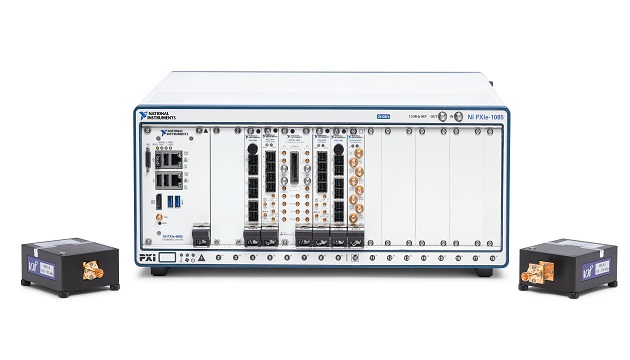
NI, the provider of a software-defined platform that helps accelerate the development and performance of automated test and automated measurement systems, announced a real-time sub THz software-defined radio (SDR) for 6G research built on NI’s mmWave Transceiver System (MTS) and Virginia Diodes’ (VDI) radio heads.
Using VDI radio heads, the frequency range of the MTS can extend into the sub THz range. Because this testbed is built using SDRs and FPGAs, the software can be upgraded and customized to meet a wide range of research needs and applications. Users can leverage existing software reference designs for channel sounding or wireless communications protocols to create a real-time testbed for 6G research.



The development cycle of a typical wireless standard is approximately 10 years. As the commercial rollout of 5G begins in 2019, wireless communications researchers are already investigating the technology and ideas that will serve as the foundation of 6G. The use of sub THz and THz frequencies has numerous applications for communications and is likely to be a major area of 6G research in the foreseeable future.
“Now that 5G is becoming mainstream, communications research must move deeper into the millimeter and submillimeter wavebands. It seems D-Band is now the new E-Band,” said Gerhard Schoenthal, COO, VDI.
“Researchers need access to sub THz testbeds to prototype multiple wireless use cases. These testbeds must be highly flexible but also offer cutting edge performance in order to explore the boundaries of wireless performance at these very high frequencies,” said James Kimery, director of wireless research, NI. “NI’s MTS when combined with the VDI radio heads create an excellent platform for exploring sub THz and THz spectrum and associated applications to spur innovation on the way toward 6G.”
- NI’s MTS offers modular baseband and IF components that can be combined with FPGAs to build the most basic over-the-air system and expanded to create complex MIMO systems with extensive digital signal processing capabilities. VDI radio heads cover a wide variety of frequency bands in the sub THz range. The two combined create a powerful testbed to meet the needs of 6G research, both today and in the future.
- The NI and VDI sub THz testbed provides up to 2 GHz instantaneous bandwidth and frequency ranges between 110–170 GHz. NI offers two software reference designs built around the NI MTS—one for channel sounding and one for a single carrier physical layer communications link. The channel sounding reference design is intended for a single transmitter, single receiver configuration and enables users to take basic channel sounding measurements, such as channel impulse response, time of arrival and path loss. The single carrier physical layer is designed for systems in SISO configurations up to 4×4 MIMO configurations with 2 GHz of real-time bandwidth. All signal processing, including coding, occurs in real-time on FPGAs added to the base MTS system. The total system throughput is dependent on the frame structure and the number of channels used. A typical expected throughput is 7.2 Gbps/channel using the default frame structure. For each reference design, the software front panel gives users a real-time visualization of system level performance.
For more information, visit: www.ni.com

