
Researchers at Drexel University are using MXene, a 2D transition metal carbide (Ti3C2), to fabricate photodetectors with improved sensitivity for substantially less cost. The researchers replaced gold, typically used in the fabrication of photodetectors because of its high conductivity, with a thin, transparent layer of MXene.
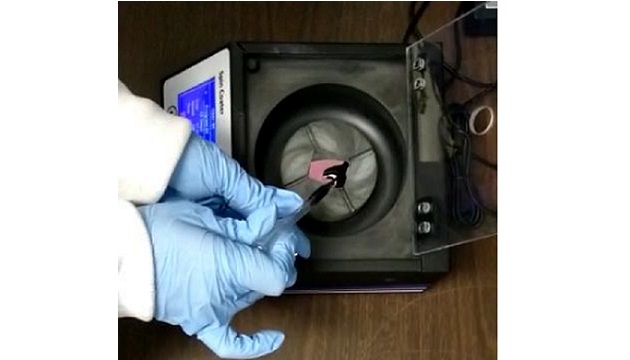
“One of the greatest challenges of fabricating photodetectors is the deposition of gold contacts. In addition to the cost of the gold itself, the fabrication process must be performed at a high-temperature and in vacuum chamber, which is also quite costly,” researcher Kiana Montazeri said. “We are replacing gold with MXenes, which are less costly materials, and producing the photodetector components by depositing it in ambient conditions using a table-top spinner.”




The researchers spin-coated transparent Ti3C2-based MXene electrodes from aqueous suspensions onto gallium arsenide (GaAs) patterned with a photoresist and lifted off with acetone. This thin-film deposition process, performed in normal atmospheric conditions, could be easily scaled up to mass-produce MXene photodetectors, the researchers said.
The researchers reported that the MXene film photodetectors they created performed about four times better, in terms of sensitivity, than current devices made with gold. When tested, both the gold- and MXene-based devices showed rectifying contacts with comparable Schottky barrier heights and internal electric fields. However, the MXene-based detectors exhibited higher responsivities and quantum efficiencies, with similar dark currents, hence showing better dynamic range and detectivity. The MXene-based detectors showed similar subnanosecond response speeds compared to the gold-based devices.
The fabrication process used by the team could be integrated into microelectronic, photonic-integrated circuits, and silicon photonics processes with a wide range of potential applications, from optical sensing to lidar to telecommunications.
“This is an important development because worldwide demand for photodetectors is expected to reach $2 billion by the year 2024, so there is a pressing need to scale up the process and find more sustainable materials to use as components,” professor Pouya Dianat said.
MXenes remain highly conductive when applied in a variety of forms. Because they are conductive, MXene films could be used in multiple components of the sensors, turning nearly the entire surface of the photodetector into a sensing area, without diminishing its energy efficiency or performance. “Interest in MXenes has exploded recently for a number of reasons, chief among them is that they can be mixed with water to make sprays and inks while remaining quite conductive,” professor Bahram Nabet said. “Using transparent MXene film as the contacts in photodetectors offers an obvious advantage in that it mitigates the trade-off between carrier transit distance and responsivity.”
The team will continue to standardize its production process and plans to develop methods for stabilizing MXene components for use in a variety of environments and conditions. “We expect that this discovery will open the door for using MXene in a wide variety of optoelectronic devices, such as photodiodes and phototransistors as well as in enabling technologies,” professor Michel Barsoum said.

