
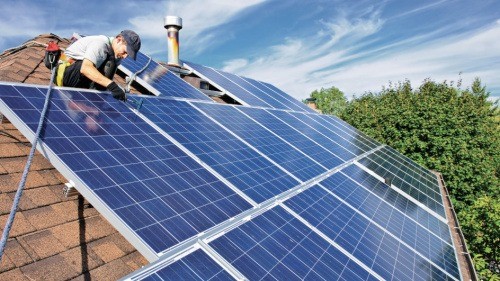
As electric vehicle (EV) sales pick up across markets, more and more EV-drivers are powering their cars with electricity sourced locally, on their rooftops. This shift towards solar power, and the CO2 emissions saved by replacing gas guzzlers with electric vehicles, spell great news for the planet.
For end users, however, the move from sourcing power and fuel externally to managing its generation, storage, and distribution on their own adds complexity and new responsibilities to their daily lives. Ensuring that all solar panels are operational and that sufficient power is stored to top up the EV’s battery adds new chores (such as a daily trip to the basement to check the solar inverter’s display) that can dissuade potential customers from transitioning to these new solutions.




The technological fix to improve user experience is obvious. Using an app running on a smartphone, on a tablet, or in a web browser, users should be able to check on the status of their solar panels, their domestic power storage, and their EV’s charging station and battery. The app can help users monitor how much they are saving, notify them when something goes wrong, and let them know when their EV battery is fully charged.
Running such an app requires a data channel that connects the solar inverter and the EV charging infrastructure to the domestic power management solution.
Dual-band Wi-Fi 4: The smart choice for connected solar inverters…
Its ease of installation, absence of wires, and flexibility make wireless communication a strong choice for connecting solar inverters to the home’s power management platform and, potentially, to a range of other backend services. And because of the prevalence of residential and commercial Wi-Fi installations and the zero-cost connectivity it provides, Wi-Fi stands out as the wireless technology of first resort for these installations, with cellular technology often built-in as a fallback technology to bridge gaps in Wi-Fi service.
Because of the proliferation of connected devices in our homes, signal congestion in the 2.4 GHz band used by Wi-Fi can no longer be ignored. Dual-band Wi-Fi reliably connects end devices and access points even when the bandwidth is scarce by selecting Wi-Fi channels from the entire 2.4 GHz and 5 GHz Wi-Fi spectrum.
Today, and well into the future, most solar inverters will see their needs met using dual-band Wi-Fi 4, enabled, for example, by our recent u‑blox MAYA-W1 dual-band Wi-Fi 4 and Bluetooth 5 module. It’s true that more recent generations of Wi-Fi offer higher throughput, increased capacity, and more robust coexistence, in particular in crowded environments. But for most solar inverters, their cost outweighs the benefits they bring.
… and for domestic EV charging poles
Like solar inverters, electric vehicle charging stations increasingly require a channel to exchange data with the domestic power management solution and other backend services. The same features that make dual-band Wi-Fi 4 a smart choice for solar inverters – its ease of installation, absence of wires, and flexibility, make the technology a strong candidate for domestic electric vehicle charging boxes.
A quick and simple path to market for power management solutions
By establishing a robust and secure wireless backend communication channel for power management solutions, the compact MAYA-W1 dual-band Wi-Fi 4 and Bluetooth 5 module offers a quick path to market at an attractive price point. MAYA-W1’s drivers are fully integrated into NXP’s MCUXpresso IDE (Integrated Development Environment), allowing seamless software integration and reducing testing efforts. And thanks to rigorous testing and careful qualification, MAYA-W1 is designed to perform reliably for years on end in rough environments.

