
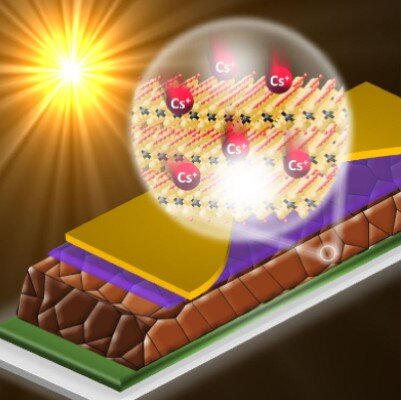
A new generation of cheap, sustainable and efficient solar cells is a step closer, thanks to scientists at The University of Queensland.
Researchers at UQ’s Australian Institute for Bioengineering and Nanotechnology (AIBN) modified a nanomaterial to make solar cells as efficient as silicon-based cells, but without their high cost and complex manufacturing.




Professor Joe Shapter said the finding addressed an urgent need for alternative environmentally friendly energy sources capable of providing efficient and reliable energy production.
“Silicon-based solar cells remain the dominant first-generation product making up 90 percent of the market, but demand was high for cells that could be manufactured without their high prices and complexity,” Professor Shapter said.
“Among the next-generation technologies, perovskite solar cells (PSCs) have attracted enormous attention because of their high efficiency and ease of fabrication.
“The technology has undergone unprecedented rapid development in recent years.
“But the new generation of solar cells still have some drawbacks such as poor long-term stability, lead toxicity and high material costs.”
Professor Shapter said his team studied a nanomaterial that showed great promise in overcoming some of the new cell’s drawbacks and used doping, a common method of modifying the new cell’s nanomaterial to enhance its electrical properties.
The researchers found that the efficiency and thermal stability of the doped cells significantly outperformed those that were not doped.
“The PSCs that had doped cells showed a remarkable solar conversion efficiency that exceeded 21 percent,” Professor Shapter said.
Solar cell efficiency is the rate at which a solar panel transfers the sunlight into electricity, with the average silicon cell efficiency presently between 15 and 22 percent.
“This gives us hope that solar energy can continue to develop and improve as one of the most effective renewable and sustainable energy technologies,” Professor Shapter said.
The research involved collaboration with Professor Mohammad Nazeeruddin from École polytechnique fédérale de Lausanne in Switzerland.
Associate Professor Yun Wang from Griffith University contributed modeling to understand the interaction between doped cell layers and materials used in light absorption.
“Our results explain how doped cells can greatly improve the energy conversion efficiency and lifetime of solar cells observed from the AIBN experiments,” Dr. Wang said.
Professor Shapter said the research was part of a global push towards advanced and sustainable solar cell technology.
“Our research contributes to intensive efforts to develop various types of solar cells with the aim of realizing efficient, stable and low-cost replacements for present silicon-based technology.”

