

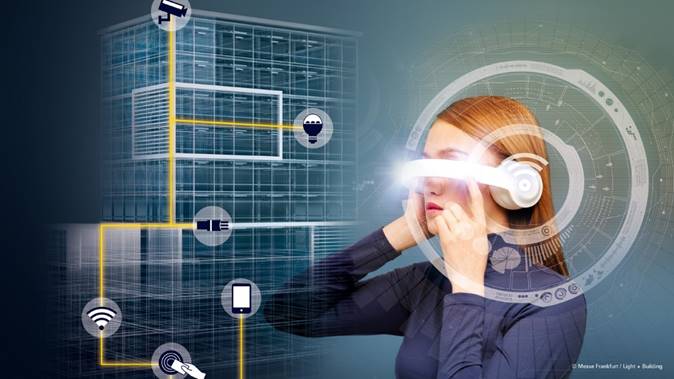
Whether in the healthcare, elevator and escalator or heating sectors, regular checks promise early detection of defects or impending failures. In the lighting and building sector, new technologies enable components to connect with each other and data to be collected continuously. This can be achieved through predictive maintenance – one of the top themes at Light + Building 2022. For instance, regular monitoring helps to estimate when hardware components need to be replaced or energy efficiencies are not being used optimally.
The sustainability and climate debates entail higher technological and energy efficiency requirements for the systems in buildings. Zero-emission buildings are a proclaimed goal of the EU and already stipulated in the European EPBD (Energy Performance of Building Directives). In addition, the political will for sector coupling of heat, energy supply and e-mobility is shaping the trend towards energy and condition monitoring. Increasingly complex technical building equipment (TBE) will make “Predictive Maintenance” economical.



At the upcoming Light + Building – the world’s leading trade fair for lighting and building technology – the topic of energy and condition monitoring as well as Predictive Maintenance will shape the application innovations and classic EIS products just like building automation components in many ways. After all, sustainable and climate-neutral buildings are ultimately plus-energy buildings. These generate more energy than they need themselves, either to store the energy in the building or to share the surplus energy with others in the neighbourhood. This causes a need for an intelligent network using smart meters and flexible tariffs to control energy flows in buildings in line with network demand. The basis is the exchange of data between the various technical domains. However, this requires detailed measurement and control technology to be implemented in the building. In the future, a central meter for billing in the building will no longer be sufficient, because modern buildings require sub-metering structures and measured value recording for all energy flows and media in the building. These are, among other things, the prerequisites for energy management in accordance with ISO 50001 in functional buildings with then diverse savings potentials.
A fundamental component of energy management is energy monitoring with the monitoring of energy resources. The detailed data acquisition, combined with self-learning algorithms, creates a real-time analysis of energy flows and consumption. This allows correlations of different measured values to be analysed, visualised and configured. A dashboard is then used to operate the property in a user-oriented and energy-efficient manner.
Condition monitoring also makes traditional maintenance approaches obsolete. The regular maintenance of heating, ventilation and air conditioning systems specified by manufacturers, or even the building automation components with their fixed cycles, rarely reflect the actual condition of the systems. This is due to the fact that the different room and environmental situations and also usage behaviour of systems have a considerable effect on their service life. Thus, maintenance is either too early or too late. While the cost of premature maintenance on the service life of the equipment is still acceptable, the failure of components can have consequences.
The advantages of condition monitoring are that plant or equipment problems can be detected and remedied as they arise, as well as an accurate prediction of the remaining service life of monitored components. In addition, service life is extended through data-based individual maintenance plans and maintenance costs are reduced through pinpoint maintenance. This results in high customer satisfaction and improved competitiveness. This requires that hardware components are equipped with additional measurement technology and radio transmission technology. Process data can then be used for predictive maintenance via a data bus (wired or wireless). For example, a circuit breaker protects a circuit from overcurrent loads.

