
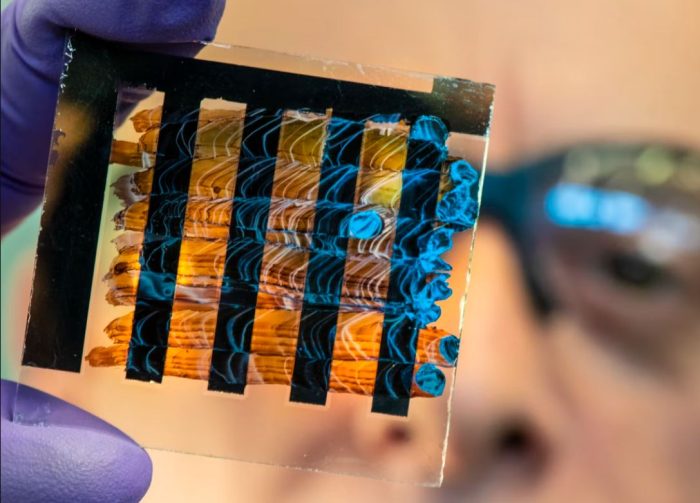
Electro-optic modulators, which control aspects of light in response to electrical signals, are essential for everything from sensing to metrology and telecommunications. Today, most research into these modulators is focused on applications that take place on chips or within fiber optic systems. But what about optical applications outside the wire and off the chip, like distance sensing in vehicles?
Current technologies to modulate light in free space are bulky, slow, static, or inefficient. Now, researchers at the Harvard John A. Paulson School of Engineering and Applied Sciences (SEAS), in collaboration with researchers at the Department of Chemistry at the University of Washington, have developed a compact and tunable electro-optic modulator for free-space applications that can modulate light at gigahertz speed.




“Our work is the first step toward a class of free-space electro-optic modulators that provide compact and efficient intensity modulation at gigahertz speed of free-space beams at telecom wavelengths,” said Federico Capasso, Robert L. Wallace Professor of Applied Physics and Vinton Hayes Senior Research Fellow in Electrical Engineering.
Flat, compact metasurfaces are ideal platforms for controlling light in free space but most are static, meaning they can’t switch on and off—a key functionality for modulators. Some active metasurfaces can effectively modulate light, but only at low speeds, just a few megahertz.
For applications such as sensing or free-space communications, you need short, fast bursts of light, on the scale of gigahertz.
The high-speed modulator developed by Capasso and his team brings together metasurface resonators with high-performance organic electro-optical materials and high-frequency electronic design to efficiently modulate the intensity of light in free space.
The modulator consists of a thin layer of an organic electro-optic material deposited on top of a metasurface etched with sub-wavelength resonators integrated with microwave electronics. When a microwave field is applied to the electro-optical material, its refractive index changes, changing the intensity of light that is being transmitted by the metasurface in mere nanoseconds.
“With this design, we now can modulate light 100 to 1,000 times faster than previously,” said Ileana-Cristina Benea-Chelmus, a research associate in the Capasso Lab. “This speed advance opens new possibilities in computing or communications and the tunability of the metasurface opens up a vast application space for custom-tailored, ultracompact photonics that may in the future be deposited onto any nanoscale free-space optical product.”
Next, the researchers aim to see if they can modulate light even faster and, by changing the design of the metasurface, modulate other aspects of light such as phase or polarization.

