
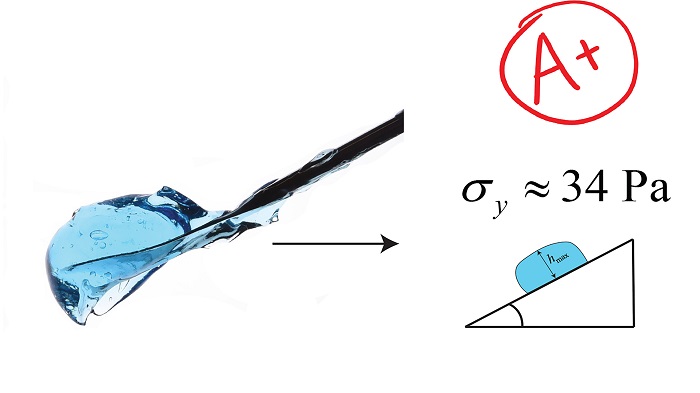
Although the COVID-19 pandemic caused many disruptions in the educational system, it also led to some surprising benefits. The University of Illinois at Urbana-Champaign describe their work with students on an at-home study of complex fluid behavior. The course covers a type of physics known as rheology, which is used to study the way non-Newtonian liquids or semisolid substances flow.
Newtonian fluid has a constant viscosity, but non-Newtonian fluid can deform when force is applied. Sometimes, they respond with the plastic flow. Simple rheometric measurements can be carried out in anyone’s home to measure quantities such as viscoelasticity, shear-thinning, and other rheological properties.




“We initially called the project Shelter-in-Place Rheometry due to the acute nature of the COVID-19 pandemic and shelter-in-place rules,” said Randy Ewoldt, the professor involved in developing the course. “But we realized that the idea is more general and have since taken to calling it do-it-yourself rheometry.”
The projects assigned to the students had two parts: gathering qualitative visual evidence of rheological properties and taking quantitative measurements. The students checked for four behaviors: shear-thinning viscosity, viscoelasticity, shear normal stress difference, and extensional viscosity.
Even without access to laboratory rheometers, the students developed creative and unique ways to carry out their measurements. They studied a variety of common substances, including buttercream frosting, toothpaste, yogurt, peanut butter, mayonnaise, egg whites, and many other substances available in their homes.
One student, Ignasius Anugraha, developed a compression squeeze flow analysis to study buttercream frosting. Anugraha placed the frosting between two cardboard discs and subjected it to a force by stacking ramekins filled with water atop the discs.
The frosting was able to support the weight of the water until a critical value was reached, at which point the frosting collapsed on one side and squeezed out. Using equations involving the weight of the water, Anugraha was able to measure a quantity known as yield stress.
Another student, Max Friestad, devised an experiment to study a behavior known as gravity-driven filament stretching. Friestad suspended a tube of toothpaste vertically and gently squeezed it, expelling a dollop of toothpaste that slowly extended, stretching downward. Using a cellphone with a high-speed frame-rate camera, Friestad was able to take measurements and calculate the extensional viscosity.
The course was so successful that the faculty continue to offer it, both in-person and online.
“We are currently working on a review of methods which we believe will be useful not only for coursework and instruction but also for research and technical communication,” said M. Tanver Hossain.

