

Fujitsu has developed a technology to learn the actual characteristics of an optical network, and accurately estimate the supported transmission speed of new paths.
Transmission speed are usually set at a safe operation level, based on design specifications of optical fibres and communication devices, whenever communication paths are added to existing optical network using new wavelengths. This is because it is difficult to accurately determine the actual transmission performance of the optical fibres and communication devices that make up specific communication paths, which is why networks are operated under more restrictive conditions that lead to lower network throughput than the network should be able to support.




Fujitsu said it has developed a technology to learn the actual characteristics of an optical network, and accurately estimate the supported transmission speed of newly added communication paths by observing the bit error ratio (BER) of the optical signals of communication paths already in operation.
The technology was experimentally evaluated on a testbed simulating an optical network in which the largest transmission distance was about 1,000km, and it was confirmed that the estimates erred by less than 15%, Fujitsu said. In addition, in network simulations carried out based on the results of this experimental evaluation, it was confirmed that the throughput of the network could be improved by about 20%.
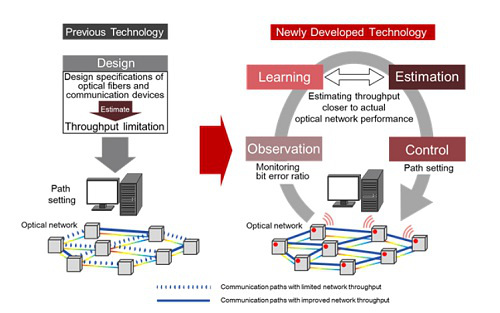
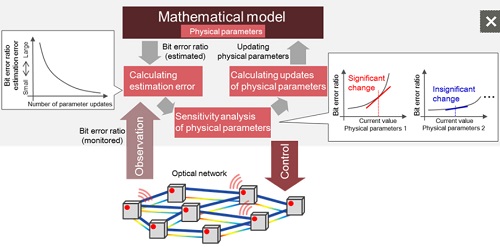
With this technology, the BER calculated from a mathematical model based on the physical characteristics of the optical network is compared with the BER obtained from optical receivers in operation, and machine learning is used on the mathematical model to minimise the difference. With newly developed sensitivity analysis technology that analyses each BER’s responsiveness to the physical parameters of the numerous optical fibres and communications devices, such as loss in optical fibers or the amount of noise in amplifiers, the system can automatically calculate an appropriate amount of parameter value adjustment just from the BER data in response to physical parameters, providing efficient machine learning.
Fujitsu Laboratories and Fujitsu Laboratories of America will continue to test the accuracy of the technology, with the goal of commercialization in fiscal 2018, applying it to the Fujitsu Network 1FINITY series of Fujitsu Limited’s optical transmission system and to the Fujitsu Network Virtuora series of wide area network virtualization solutions.

