
HomeElectronicsIndia Targets 40% Domestic Value Addition in Electronics Manufacturing

India Targets 40% Domestic Value Addition in Electronics Manufacturing

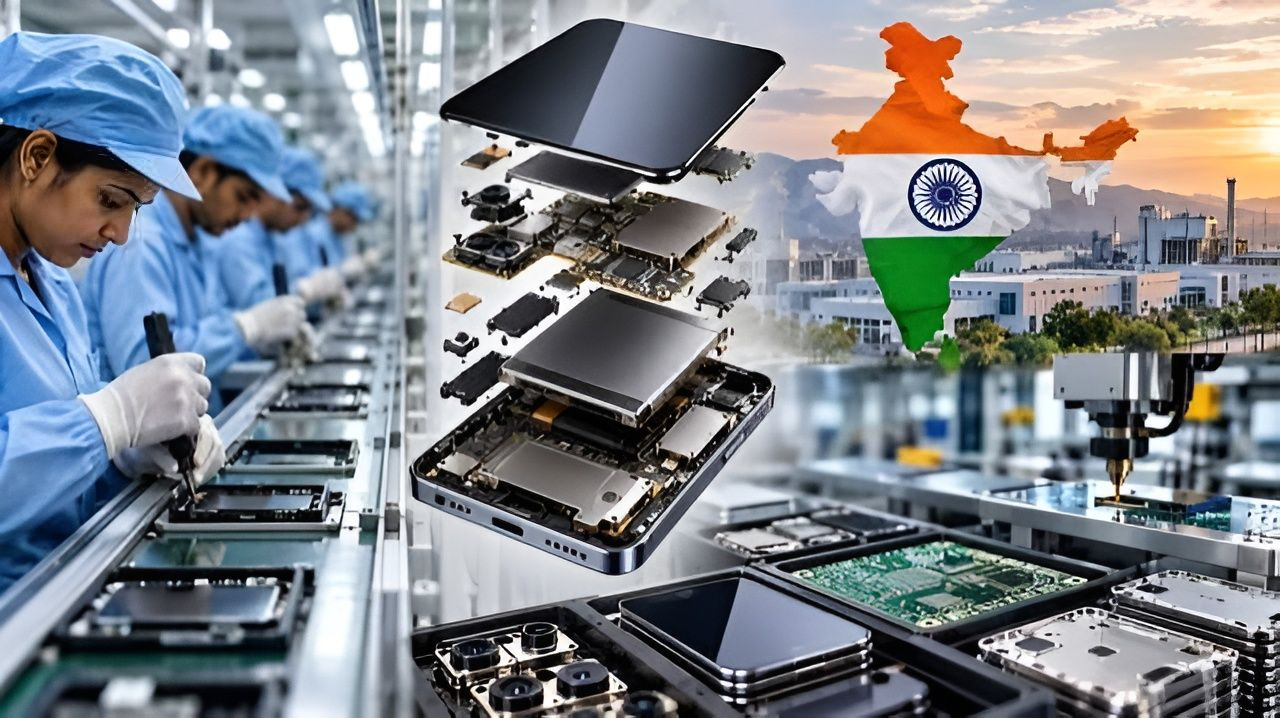
India continues to focus on raising domestic value addition and further deepening domestic manufacturing in electronics industry. Moving beyond large-scale assembly towards deeper manufacturing and stronger local supply chains, S. Krishnan, the Secretary of the Ministry of Electronics and Information Technology (MeitY) made the statement that India is targeting 35-40% domestic value addition in mobile-phone manufacturing, up from the current level of about 22-23%. To achieve this number, different government schemes are giving support such as India Semiconductor Mission (ISM), mobile manufacturing, the Production Linked Incentive (PLI) for electronics hardware and the Electronics Component Manufacturing Scheme (ECMS).

The Electronics Component and Manufacturing Scheme (ECMS) is expected to play a major role by focusing on deep component-level manufacturing rather than basic assembly. Key areas include printed circuit boards, passive components, electrochemical components, subassemblies, camera module, optical transceivers, and critical equipment.


The government aims to wider the development of India’s semiconductor ecosystem by expanding capabilities across components, semiconductor manufacturing and other parts of electronics value chain. ECMS is designed to integrate Indian manufactures with global value chains and ISM supports semiconductor design, fabrication, advanced packaging, equipment and materials.

The 40% target in domestic manufacturing does not means that forty percent of the electronic devices to be made in India. It means if a device is selling in India, then its forty percent value must be manufactured within the country. This target reflect India’s deepen participation in global value chains by moving beyond final assembly, creating a deeper supplier ecosystem, reduce dependence on imported components, and moving towards complete manufacturing location. This will allow Indian factories to source more inputs locally while maintaining competitive cost, quality and scale.

ELE Times Research Desk
ELE Times Research Deskhttps://www.eletimes.ai
ELE Times provides extensive global coverage of Electronics, Technology and the Market. In addition to providing in-depth articles, ELE Times attracts the industry’s largest, qualified and highly engaged audiences, who appreciate our timely, relevant content and popular formats. ELE Times helps you build experience, drive traffic, communicate your contributions to the right audience, generate leads and market your products favourably.

Related News

Must Read

India’s Semiconductor Market Projected to Reach $200 Billion by 2035: EY-IESA Report

​A new analysis report presented by EY-IESA estimates that...

Vaishnaw Warns India’s Semiconductor Industry of Cyberattacks and Disruptions

​As India emerges as a global supplier in the...

Vishay D2TO35S: 35 W Automotive Thick Film Power Resistor with Top-Side Cooling in TO-263 Package

Vishay Intertechnology has introduced a new Automotive Grade, top-side...

Microchip Launches 65V Digital Power Monitors for Smarter 48V Power Systems

As automotive, AI/data centre, networking and industrial systems rapidly...

Battery Swapping for E-Trucks Gains Momentum: India Builds Heavy-Duty EV Infrastructure

Battery-swapping technology allows electric heavy trucks to replace a...

EV Charging in India: Reliability and Interoperability Emerge as Key Challenges

​The demand for electric vehicles is continuously rising in...

Silicon-Carbon Anodes Move Toward EV-Scale Production for Higher Energy Density

As manufactures and battery material companies are searching for...

Software-Defined Vehicles and Edge AI Reshape Next-Generation EV Architecture

With the rise in the implementation of software technologies...

SEMICON India 2026 Concludes at Yashobhoomi, Showcasing India’s Growing Semiconductor Ecosystem

SEMICON India 2026, the fifth edition of India’s flagship...

