
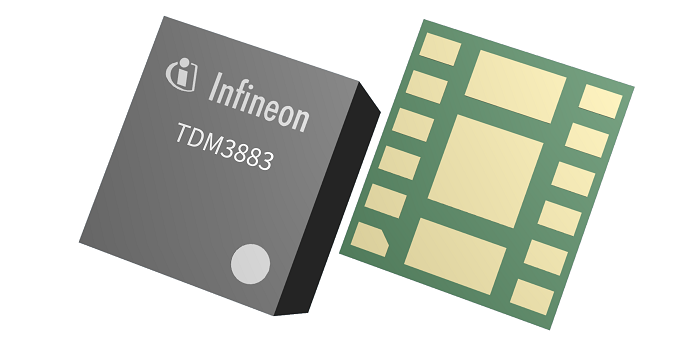
Contemporary server, communication, and network storage applications struggle to minimize power losses and solution size. Meanwhile, the rapidly changing market also requires system solution providers to address market needs faster than usual. Therefore, Infineon Technologies AG now introduces highly efficient and reliable step-down DC-DC converter modules. Adding to the point of load (POL) family, these modules are ideal for system designers looking for a compact, fully integrated, and easy-to-design POL products to help them expedite time-to-market. They primarily address space and thermally constrained applications, telecom and datacom applications, servers, and network storage.
TDM3883 and 3885 IPOL are fully integrated single-output buck converters, offering a high-efficiency continuous 3A/4A load capability and line regulation over a wide input supply range (4.5 – 14 V). The integrated inductor and capacitors reduce external components and allow easier designs with much higher power density. The integration offers improved performance compared to discrete solutions due to the low parasitic parameters by minimizing the PCB wiring trace needed. At the same time, thanks to their tiny package size, the modules can fit into the restricted PCB space offering up to 80 per cent area saving on the customer solution. In both optimized modules, Infineon excessively tests the integrated inductor and capacitors in reliability and final test (FT), eliminating the effort of passive components selection and test.




Both modules feature a low supply current (10 μA) at shutdown resulting in longer battery life for portable applications. Also, due to their tight reference voltage VREF tolerance (0.5 V±1.0 per cent) and low ripple, they provide accurate power delivery and contribute to system stability and reliability. To further support this, they employ an Enhanced Stability COT (constant on time) engine with ceramic capacitors without external compensation as well as a forced continuous conduction mode (FCCM) option. In addition, the modules come with thermally-compensated internal over-current protection (OCP), enhanced light load efficiency with reduced switching frequency and diode emulation mode (DEM). With ultra-light loads, they can enter a low quiescent current mode making it ideal for standby power supplies. Other features include internal soft-start, enable input, pre-bias start-up, thermal shut down, a power-good output, over-voltage protection (OVP), and UVLO.
For more information, visit www.infineon.com

