

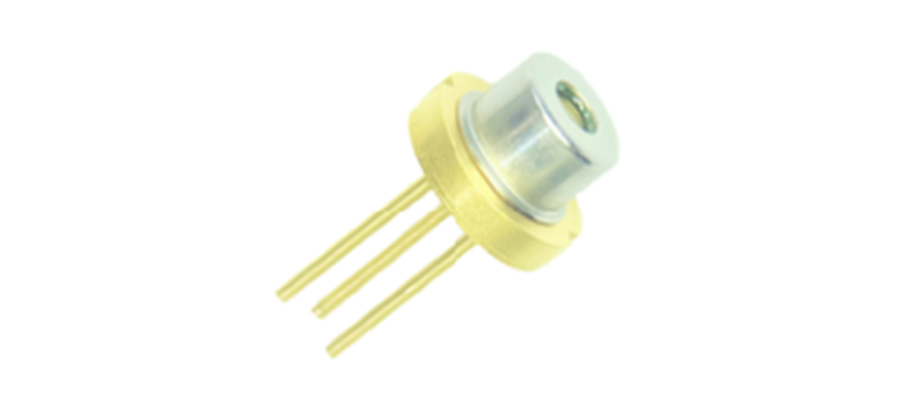
Nuvoton Technology Corporation Japan (NTCJ) announced today the launch of its industry-leading(*) indigo semiconductor laser, which emits an optical output power of 1.7 W and a wavelength of 420 nm. This product contributes to the miniaturization and cost reduction of optical systems. Additionally, when combined with our mass-produced ultraviolet semiconductor lasers (378 nm) and violet semiconductor lasers (402 nm), it serves as an alternative light source solution to mercury lamps, contributing to the realization of a sustainable society.
(*) As of January 15, 2025, based on our research of semiconductor lasers emitting at a wavelength of 420 nm.


Achievements:
- Achieves industry-leading optical output power of 1.7 W at a wavelength of 420 nm, contributing to increased design flexibility and miniaturization of optical systems.
- Realizes high efficiency and long-term reliability through proprietary optical design and heat dissipation technology, reducing the running costs of optical systems.
- By combining this product with existing mass-produced products, it is possible to provide alternative light source solutions to mercury lamps.
Mercury lamps emit bright lines of light such as the i-line (365 nm), h-line (405 nm), and g-line (436 nm) [2], and are used as industrial light sources for applications such as resin curing and exposure. However, the mercury lamps have technical challenges including large light source size and high power consumption. Additionally, since they use mercury, mercury lamps are subject to regulations in Japan and other countries because of health and environmental concerns. Therefore, alternative light sources are expected to be developed.
Aiming to replace the mercury lamps, we have been developing high-efficiency and long-term reliability semiconductor lasers. We have now started mass production of an industry-leading indigo semiconductor laser with an optical output power of 1.7 W at a wavelength of 420 nm, close to the g-line of the mercury lamps. This new product achieves both high efficiency and long-term reliability through proprietary optical design and heat dissipation technology. Furthermore, by combining it with our already mass-produced ultraviolet semiconductor lasers (378 nm) and violet semiconductor lasers (402 nm), we can provide alternative light source solutions to the mercury lamps, contributing to the realization of a sustainable society.
Details of the new product and alternative light source solutions to the mercury lamps will be exhibited at our booth at SPIE Photonics West 2025 in San Francisco, USA, and LASER World of PHOTONICS 2025 in Munich, Germany. We look forward to welcoming you.
Features:
- Achieves industry-leading optical output power of 1.7 W at a wavelength of 420 nm, contributing to increased design flexibility and miniaturization of optical systems.
This product achieves an industry-leading optical output power of 1.7 W at a wavelength of 420 nm, close to the g-line of mercury lamps, in a compact TO-56 CAN package [3]. Using this high-output, compact product enhances the design flexibility of light source devices, enabling the development of smaller light source devices compared to the mercury lamps.
- Realizes high efficiency and long-term reliability through proprietary optical design and heat dissipation technology, reducing the running costs of optical systems.
With over 40 years of experience and more than 3 billion semiconductor lasers shipped for optical discs, we have developed extensive design and manufacturing expertise in semiconductor lasers. Our newly developed indigo semiconductor laser integrates proprietary optical design and heat dissipation technology, achieving both high efficiency and long-term reliability. Compared to the mercury lamps, this reduces power consumption and the frequency of light source replacements, thereby lowering the running costs of light sources.
- By combining this product with existing mass-produced products, it is possible to provide alternative light source solutions to mercury lamps.
This product, which emits laser light at a wavelength of 420 nm close to the g-line of mercury lamps, can be combined with our mass-produced ultraviolet semiconductor lasers (378 nm) and violet semiconductor lasers (402 nm) to serve as alternative light sources for the i-line (365 nm), h-line (405 nm), and g-line (436 nm) of mercury lamps. Additionally, by adjusting the output power ratio of each semiconductor laser according to the application, it is possible to achieve highly flexible optical designs that were not possible with the mercury lamps.
Applications:
Alternative light sources for mercury lamps, Laser Direct Imaging (LDI) light sources [4], laser welding processing light sources, 3D printer light sources, etc.
Product name: KLC420FS01WW
Specification:
| Part number | KLC420FS01WW |
| Wavelength | 420 nm |
| Output power | 1.7 W |
| Package type | TO-56 CAN |
Alternative light source solution to mercury lamps
Definitions:
[1] Indigo Semiconductor Laser:
Our term for semiconductor lasers that emit laser light with a peak wavelength approximately in the range of 420 nm to 440 nm.
[2] i-line, h-line, g-line:
Names of the bright lines of mercury lamps, with emission peaks at 365 nm, 405 nm, and 436 nm, respectively.
[3] TO-56 CAN:
An industry-standard CAN-type package with a diameter of 5.6 mm.
[4] Laser Direct Imaging (LDI):
A technology that uses lasers to directly expose circuit patterns onto substrates.
SPIE Photonics West 2025
The world’s largest optics and photonics exhibition, organized by the international society for optics and photonics, SPIE, will be held in San Francisco, USA, from Tuesday, January 28 to Thursday, January 30, 2025. This event will showcase the latest optical technologies, including lasers and optical devices.

