

Courtesy: Infineon Technologies
Microsoft, OpenAI, Google, Amazon, NVIDIA, etc. are racing against each other, and it is for good reasons: to build massive data centres with billions of dollars in investments.




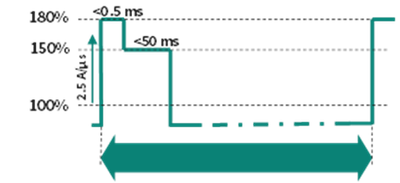
Imagine a data centre humming with thousands of AI GPUs, each demanding bursts of power like a Formula 1 car accelerating out of a corner. Now imagine trying to feed that power without blowing out the grid.
That is the challenge modern AI server racks face, and Infineon’s Power Pulsation Buffer (PPB) might just be the pit crew solution you need.
Why AI server power supply needs a rethink
As artificial intelligence continues to scale, so does the power appetite of data centres. Tech giants are building AI clusters that push rack power levels beyond 1 MW. These AI PSUs (power supply units) are not just hungry. They are unpredictable, with GPUs demanding sudden spikes in power that traditional grid infrastructure struggles to handle.
These spikes, or peak power events, can cause serious stress on the grid, especially when multiple GPUs fire up simultaneously. The result? Voltage drops, current overshoots, and a grid scrambling to keep up.
Rethinking PSU architecture for AI racks
To tackle this, next-gen server racks are evolving. Enter the power sidecar, a dedicated module housing PSUs, battery backup units (BBUs), and capacitor backup units (CBUs). This setup separates power components from IT components, allowing racks to scale up to 1.3 MW.
But CBUs, while effective, come with trade-offs:
- Require extra shelf space
- Need communication with PSU shelves
- Add complexity to the rack design
This is where PPBs come in.
What is a Power Pulsation Buffer?
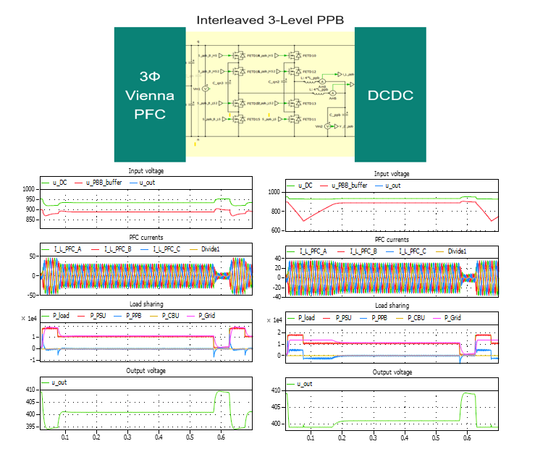
Think of PPB as a smart energy sponge. It sits between the PFC voltage controller and the DC-DC converter inside the PSU, soaking up energy during idle times and releasing it during peak loads. This smooths out power demands and keeps the grid happy.
PPBs can be integrated directly into single-phase or three-phase PSUs, eliminating the need for bulky CBUs. They use SiC bridge circuits rated up to 1200 V and can be configured in 2-level or 3-level designs, either in series or parallel.
PPB vs. traditional PSU
In simulations comparing traditional PSUs with PPB-enhanced designs, the difference is striking. Without PPB, the grid sees a sharp current overshoot during peak load. With PPB, the PSU handles the surge internally, keeping grid power limited to just 110% of rated capacity.
This means:
- Reduced grid stress
- Stable input/output voltages
Better energy utilisation from PSU bulk capacitors
PPB operation modes
PPBs operate in two modes, on-demand and continuous. Each is suited to different rack designs and power profiles.
- On-demand operation: Activates only during peak events, making it ideal for short bursts. It minimises energy loss and avoids unnecessary grid frequency cancellation
- Continuous operation: By contrast, always keeps the PPB active. This supports steady-state load jumps and enables DCX with fixed frequency, which is especially beneficial for 1-phase PSUs.
Choosing the right mode depends on the specific power dynamics of your setup.
Why PPB is a game-changer for AI infrastructure
PPBs are transforming AI server power supply design. They manage peak power without grid overload and integrate compactly into existing PSU architectures.
By enhancing energy buffer circuit performance and optimising bulk capacitor utilisation, PPBs enable scalable designs for high-voltage DC and 3-phase PSU setups.
Whether you are building hyperscale data centres or edge AI clusters, PPBs offer a smarter, grid-friendly solution for modern power demands.

