
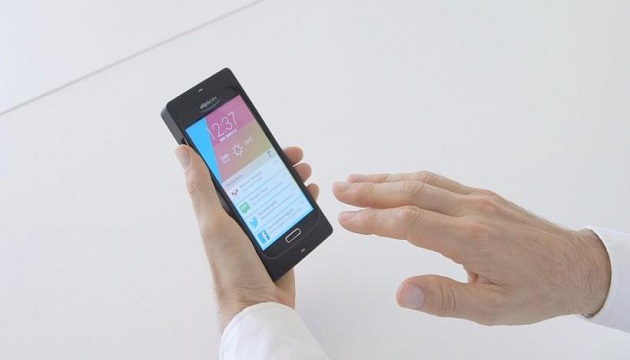
Whether for artificial intelligence, augmented reality or the Internet of Things – 5 billion people worldwide will be using smart devices to sense their environment next year. Infineon Technologies AG has developed a 60 GHz radar chip, which enables a new form of interaction between users and their devices. Using an integrated antenna system, it senses the presence and movement of people and objects with high precision or measures distances and speeds. This chip is the base for Google’s Soli technology and has now been integrated for the first time into a smartphone, so that it can also be controlled by gestures.
“With our radar technology devices become ‘context-aware’. This means that they can finally understand their environment and react much more purposefully,” says Andreas Urschitz, Division President for Power Management and Multimarket at Infineon Technologies AG. “The precise motion detection by the 60 GHz radar chip turns the Google Pixel 4 smartphone into a gesture control system. This is a revolution in the human-machine-interaction. At Infineon, we are furthermore working on the fusion of multiple sensors to simplify interaction and increase the usefulness of the devices.”




Infineon’s radar technology has its roots in the automotive sector. Radar sensors have been effectively measuring distances, speeds and movements while driving for decades. Infineon has further developed these functions for small devices. The 60 GHz chip is a complete radar system with antennas on a very small area
(5 x 6.5 mm) coupled with low power consumption. It can perceive movements in rooms or measure distances from objects in the millimetre range with utmost precision. With the appropriate software, the motion data is converted into functions, so that control via gestures is possible without touching the device.
Devices and buildings sense their environment as if with human senses
Infineon develops sensors and chips which, like the human senses, recognize the environment and process the data obtained. The aim is to enable effortless interaction and at the same time use smart functions that make life easier, safer and greener. The fusion of multiple sensors in a single device creates new solutions that measure and improve air quality or intelligently control burglary protection, for example. In addition to voice-controlled assistants, ‘intelligent’ household appliances or wearables, buildings, so-called smart buildings in particular, are becoming more interactive. Sensors detect the number of people in the rooms or can adjust the need for light sources to improve safety and energy efficiency.
For further information, visit at www.infineon.com

