
Contributes to higher efficiency in automotive electric compressors and inverters for industrial equipment
ROHM has developed automotive-grade AEC-Q101 qualified 4th Generation 1200V IGBTs that combine class-leading* low loss characteristics with high short-circuit resistance. This makes the devices ideal for vehicle electric compressors and HV heaters as well as industrial inverters. The current lineup includes four models – RGA80TRX2HR / RGA80TRX2EHR / RGA80TSX2HR / RGA80TSX2EHR – in two discrete package types (TO-247-4L and TO-247N), along with 11 bare chip variants – SG84xxWN – with plans to further expand the lineup in the future.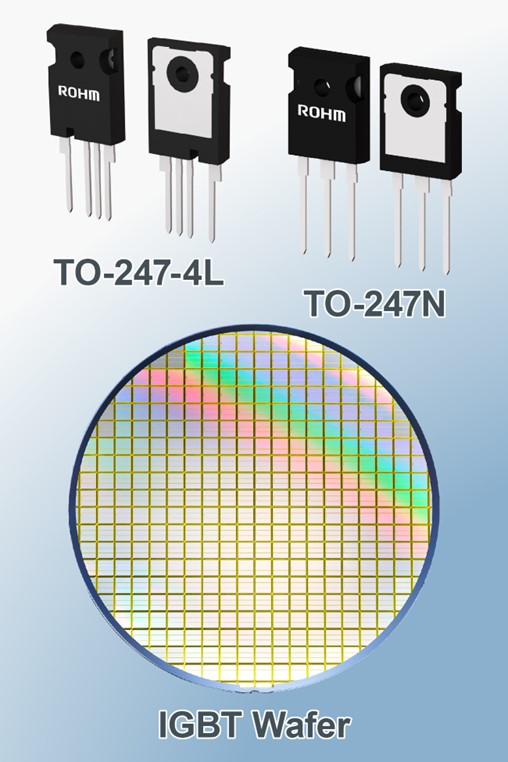




The increasing use of higher voltages in automotive systems and industrial equipment has led to a growing demand for power devices capable of handling high voltages in applications such as vehicle electric compressors, HV heaters, and inverters for industrial equipment. At the same time, there is a strong push for high efficiency power devices to improve energy conservation, simplified cooling mechanisms, and smaller form factors for a decarbonized society. Automotive electrical components must also comply with automotive reliability standards, while power devices for inverter and heater circuits are required to provide current interruption capabilities during short circuits, necessitating high short-circuit tolerance.
In response, ROHM redesigned the device structure and adopted an appropriate package to develop new 4th Generation IGBTs suitable for high voltage by delivering industry-low loss characteristics with superior short-circuit tolerance. These devices achieve an industry-leading* short-circuit withstand time of 10µs (Tj=25°C) together with low switching and conduction losses while maintaining a high withstand voltage of 1200V and meeting automotive standards by reviewing the device structure, including the peripheral design. At the same time, the new TO-247-4L package products, which feature 4 terminals, can accommodate an effective voltage of 1100V in a ‘Pollution Degree 2 environment’ by ensuring adequate creepage distance between pins. This enables support for higher voltage applications than conventional products.
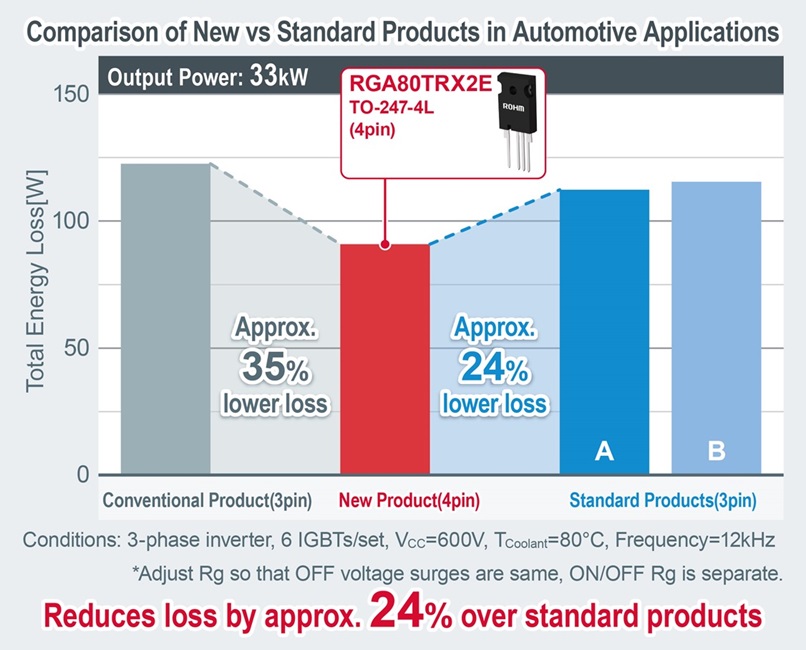
Implementing creepage distance measures on the device side alleviates the design burden for manufacturers. On top, the TO-247-4L package achieves high-speed switching by including a Kelvin emitter terminal, resulting in even lower losses. In fact, when comparing the efficiency of the new TO-247-4L packages with conventional and standard products in a 3-phase inverter, loss is reduced by about 24% compared to standard products and by 35% over conventional products – contributing to higher efficiency in drive applications.
ROHM will continue to expand its lineup of high-performance IGBTs that contribute to greater miniaturization and high efficiency drive in automotive and industrial equipment applications.
Terminology
AEC-Q101 Automotive Reliability Standard
AEC stands for Automotive Electronics Council, a reliability standard for automotive electronic components established by major automotive manufacturers and US electronic component makers. AEC-Q101 is a standard that specifically applies to discrete semiconductor products (i.e. transistors, diodes).
Short-Circuit Tolerance
The time that a power device can withstand a short-circuit without being destroyed.
IGBT (Insulated Gate Bipolar Transistor)
A power transistor that combines the high-speed switching characteristics of a MOSFET with the low conduction loss of a bipolar transistor.
Creepage Distance
The shortest distance along the surface of an insulator between two conductors. In semiconductor design, insulation measures with such creepage and space distances must be taken to prevent electric shocks, leakage currents, and short-circuits in semiconductor products.
Pollution Degree 2 Environment
Pollution Degree 2 corresponds to typical environments such as homes and offices where only dry, non-conductive contaminants are present. Pollution Degree is the grade of the environment that influences the determination of the spatial and creepage distances of components, classified from 1 to 4 according to the presence, amount, and condition of pollutants.
Kelvin Emitter Terminal
An emitter terminal dedicated to voltage measurement. By separating this from the emitter through which current flows, the effects of voltage drop during current flow can be minimized, allowing for fast, stable switching.

