
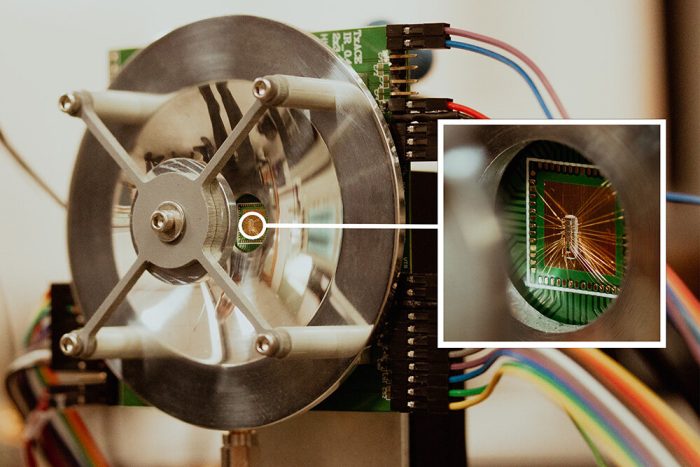
Researchers from The University of Texas at Dallas and Oklahoma State University have developed an innovative terahertz imager microchip that can enable devices to detect objects and create images through obstacles that include fog, smoke, dust, and snow.
The team is working on a device for industrial applications that require imaging up to 20 meters away. The technology could also be adapted for use in cars to help drivers or autonomous vehicle systems navigate through hazardous conditions that reduce visibility. On an automotive display, for example, the technology could show pixelated outlines and shapes of objects, such as another vehicle or pedestrians.




“The technology allows you to see in vision-impaired environments. In industrial settings, for example, devices using microchips could help with packaging inspections for manufacturing process control, monitoring moisture content, or seeing through steam. If you are a firefighter, it could help you see through smoke and fire,” said Dr. Kenneth K. O, professor of electrical and computer engineering and the Texas Instruments Distinguished University Chair in the Erik Jonsson School of Engineering and Computer Science.
Yukun Zhu, a doctoral candidate in electrical engineering, announced the imaging technology on Feb. 21 at the virtual International Solid-State Circuits Conference, sponsored by the Institute of Electrical and Electronics Engineers (IEEE) and its Solid-State Circuits Society.
The advance is the result of more than 15 years of work by O and his team of students, researchers, and collaborators. This latest effort is supported by Texas Instruments (TI) through its TI Foundational Technology Research Program.
“TI has been part of the journey through much of the 15 years,” said O, who is director of the Texas Analog Center of Excellence (TxACE) at UT Dallas. “The company has been a key supporter of the research.”
The microchip emits radiation beams in the terahertz range (430 GHz) of the electromagnetic spectrum from pixels no larger than a grain of sand. The beams travel through the fog, dust, and other obstacles that optical light cannot penetrate and bounce off objects and back to the microchip, where the pixels pick up the signal to create images. Without the use of external lenses, the terahertz imager includes a microchip and a reflector that increases the imaging distance and quality and reduces power consumption.
The researchers designed the imager using complementary metal-oxide semiconductor (CMOS) technology. This type of integrated circuit technology is used to manufacture the bulk of consumer electronics devices, which makes the imager affordable. O’s group was one of the first to show that CMOS technology was viable, and since then they have worked to develop a variety of new applications.
“The key thing about the terahertz imager is making the pixels small and low power. You need to integrate a transmitter, receiver, and antenna in such a small area,” said Dr. Wooyeol Choi, assistant professor of electrical and computer engineering at Oklahoma State University and former assistant research professor at UT Dallas, where he started the work on the technology with O.
“Another breakthrough result enabled through innovations that overcame fundamental active-gain limits of CMOS is that this imaging technology consumes more than 100 times less power than the phased arrays currently being investigated for the same imaging applications. This and the use of CMOS make consumer applications of this technology possible,” said O, a fellow of the IEEE.
“UT Dallas and Oklahoma State continue to discover technological innovations that will help shape the future,” said Dr. Swaminathan Sankaran, design director and Distinguished Member of Technical Staff at TI Kilby Labs. “What Dr. O and his research team were able to accomplish was truly remarkable with this terahertz monostatic reflection-mode imager work. Their research paves a path for improved raw angular resolution and low-power, cost system integration, and we are excited to see what applications and use cases this terahertz imaging technology will lead to.”

