

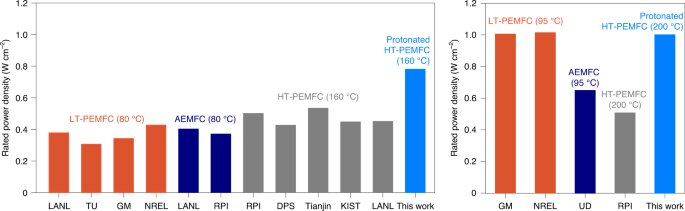
A new high-temperature polymer fuel cell that operates at 80–160 degrees Celsius, with a higher-rated power density than state-of-the-art fuel cells, solves the longstanding problem of overheating, one of the most significant technical barriers to using medium-and heavy-duty fuel cells in transportation vehicles such as trucks and buses.
Because current fuel cells operate at 60–80 degrees Celsius, they require large radiators and air intakes in order to stay cool enough to operate. To resolve this issue, Los Alamos National Laboratory scientists developed a new polymer fuel cell that operates at higher temperatures.



“Fuel cells are energy conversion devices that produce electricity by electrochemically combining hydrogen and oxygen from the air. Like other electric vehicles, fuel cell vehicles are zero-emission vehicles; they have no smog-related or greenhouse gas tailpipe emissions,” said Yu Seung Kim, of Los Alamos’ Materials Synthesis & Integrated Devices group. “Moreover, hydrogen can be produced from diverse domestic resources with the potential for zero greenhouse gas emissions.”
Hydrogen fuel cells are a good option for medium- and heavy-duty on-road transportation, including trucks and buses, and have marine, rail and aviation applications as well.
The electrification of future medium- and heavy-duty transportation—whether with batteries or hydrogen fuel cells—is required given global efforts to cut emissions in transport. Compared to battery-powered vehicles, fuel cells offer fast fueling and adequate fuel storage for long-range applications. Over several decades, researchers have explored fuel cells that can operate above 100 degrees Celsius that enable simpler fuel cell systems through better heat and water management. While additional work is needed to establish the durability required for heavy-duty applications, this research provides a solution to fabricate highly performing fuel cells under hot and dry conditions.
Advances to fuel cell technology also support the Intermountain West Energy Sustainability & Transitions (I-WEST) initiative, which is developing a technology roadmap to transition the western United States to an economically sustainable, carbon-neutral energy system. The roadmap will outline ways for the Intermountain West states to meet challenges, capitalize on opportunities, and build an equitable energy transition strategy.
How they work
Conventional high-temperature polymer electrolyte membrane fuel cells use phosphoric acid as an electrolyte at the electrode. In this research, the Los Alamos team designed a polymer electrolyte composed of a phosphonated polymer and a perfluorosulfonic acid. In this composite electrolyte structure, the team found that a proton from the perfluorosulfonic acid transfers to the phosphonated polymer and dramatically enhances proton conductivity. By implementing the composite polymer electrolyte, the researchers were able to achieve nearly 800 milliwatts per square centimeter rated power density of the fuel cell at 160 degrees Celsius, which is a 60 per cent improvement of the phosphoric acid-based fuel cells.

