
Superconductors are materials that can enter a state of no electrical resistance, through which magnetic fields cannot penetrate. Due to their interesting properties, many material scientists and engineers have been exploring the potential of these materials for a wide range of electronics applications.
A key advantage of superconductors is that they can transport electrical signals while preventing their dissipation, which is particularly useful when developing quantum computers. Controlling their states, as is commonly done with semiconductor technology, however, has so far proved to be challenging.




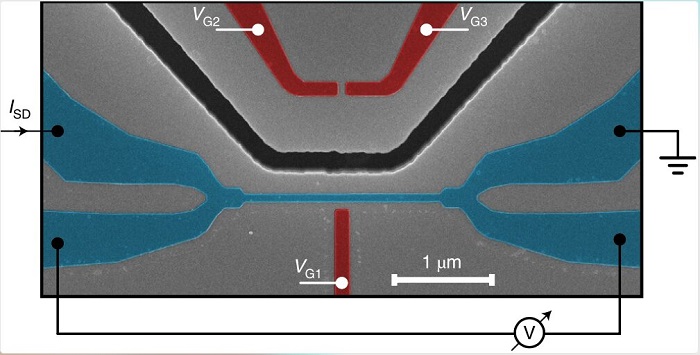
A few years ago, a study suggested the superconductivity of superconducting materials could be switched on and off. Researchers at IBM Research in Zurich have been investigating these results further, in the hope of explaining the switching mechanism unveiled by this previous study.
“Superconductors are, first of all, metals, and metals screen external electric fields very effectively,” Andreas Fuhrer and Fabrizio Nichele, two of the researchers who carried out the study, told Phys.org. “This fundamental concept, found in all physics textbooks, was put into question by a 2018 publication. In that work, the authors claimed to have turned on and off the superconductivity in a titanium nanowire via moderate electric fields applied by a nearby gate electrode.”
If confirmed, the findings gathered in 2018 by NEST and SPIN-CNR in Italy would enable the development of entirely new types of electronic and quantum computing devices based on superconductors. A few years ago, they thus set out to unveil the microscopic, physical mechanism occurring in nanometer-sized superconductors when electric fields are present.
In an initial paper published in 2021, the researchers outlined some initial hints about the possible origin of the observed suppressed superconductivity in titanium nanowires. Their new study builds on this paper, offering a more detailed explanation for the findings gathered by the team at NEST and SPIN-CNR.
“Our previous work showed that the suppression of superconductivity always went hand in hand with small leakage currents flowing from the gate electrode to the nanowire,” Fuhrer and Nichele explained. “Such currents were very small (a few pA or 0.000,000,000,001 Ampere), so they might have gone unnoticed in previous work. For us, it was reasonable to assume that such a current would be responsible for disrupting superconductivity, as the energy of each electron carried by the current was quite large (about 100,000 larger than the binding energy keeping the electrons in a metal in the superconducting state).”

