

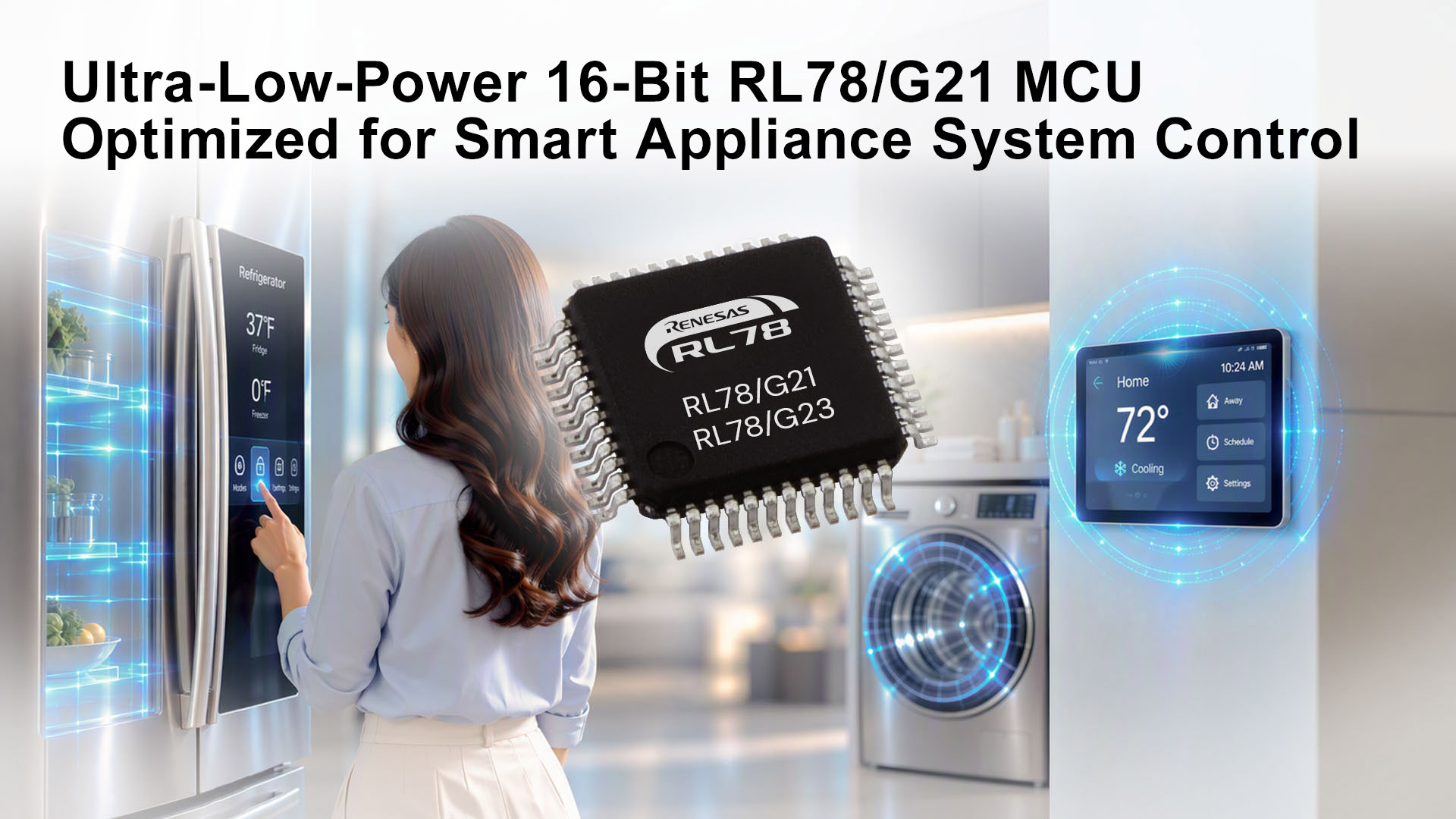
Renesas Electronics Corporation has introduced the RL78/G21, a new microcontroller (MCU) in its RL78 family. The company, which holds the leading global market share in 16-bit MCUs, has designed the new series for smart home appliances. The RL78/G21 combines low power consumption with built-in functions for efficient system control, helping manufacturers reduce energy use and product costs. It is designed for applications such as air conditioners, refrigerators, washing machines and microwave ovens.
Renesas has also expanded its RL78/G23 series with new microcontrollers that support more capacitive-touch inputs for advanced user interfaces. The RL78/G21 is designed for energy-efficient system control, while the RL78/G23 combines system control and user-interface functions in a single chip. This gives manufacturers more design options and can help reduce the overall cost of electronic components.



Ensuring Reliability, Security and Flexibility in Smart Appliances
For more than 15 years, the RL78 family has earned the trust of customers worldwide across a broad range of applications. The new RL78/G21 and RL78/G23 strengthen that foundation forward with enhanced security capabilities that help protect against physical threats, such as counterfeiting and cloning, as well as cyber threats, including unauthorized access, information leakage, tampering and spoofing. The RL78/G21’s high electrostatic discharge (ESD) tolerance of ±4 kV HBM contributes to higher reliability throughout manufacturing and assembly, as well as during operation of the end product. The RL78/G21 also adds the UARTA communication interface, an upgrade over the RL78/G13, enabling flexible system expansion such as the addition of sensors. Because the RL78/G21 is pin and function compatible with the existing RL78/G13 and RL78/G23, customers can transition designs seamlessly to the new devices with minimal redesign effort.
Ultra-Low-Power MCU Optimized for System Control
The RL78 family has demonstrated its ultra-low-power capabilities with products achieving top scores in the ULPMark-PeripheralProfile benchmark. Leveraging the advanced low-power technologies developed for the RL78 family, the RL78/G21 achieves an operating current of just 34 μA/MHz, nearly half that of the leading RL78/G13 MCU products. This helps reduce battery capacity, downsize power supply circuits and lower overall system costs. Optimization for system control also gives the device strong price competitiveness in the class of products with 128KB or 256KB of code flash memory. The integration of a high-speed on-chip oscillator (HOCO) with ±1.0% accuracy and 4KB of data flash eliminates the need for an external oscillator and EEPROM, reducing BOM costs.
Scalable Touch HMI Support
As demand for touch input grows with the increasing sophistication of human-machine interfaces (HMIs), Renesas expanded the RL78/G23 lineup with the RL78/G23 (R7F104G), which offers enhanced capacitive-touch sensing. Compared with the existing RL78/G23 (R7F100G), which provides 14 touch channels in the 44-pin version and 16 touch channels in the 48-pin version, the new devices significantly increase the number of touch channels to 24 and 25, respectively. Renesas provides common touch peripheral functionality and the QE for Capacitive Touch tool across the RL78, RX and RA families, enabling scalable HMI development ranging from simple user interfaces to advanced graphics displays.
“The RL78/G21 and RL78/G23 are built on the proven strengths of the RL78 family, delivering significant advances in low-power performance, reliability and security,” said Raji Mukhopadhyay, Business Division Manager, EP Mainstream MCU Business Division at Renesas. “The RL78/G21’s ±4 kV HBM ESD tolerance is a key differentiator. It further strengthens reliability, while its enhanced security capabilities address the growing need for more secure smart appliances.”
Additional Features
- Self-diagnostic functionality enabled by an IEC 60730-compliant self-test library
- Security features including flash read protection, flash shield window, Unique ID and Customer ID
- High ESD tolerance of ±4 kV HBM (Human Body Model) (RL78/G21 only)
- Pin and functional compatibility with the existing RL78/G13 and RL78/G23
- Wide operating voltage range from 1.6V to 5.5V
- Development support through Smart Configurator and the Fast Prototyping Board (FPB)
“Appliance makers are asking for more intelligence, better user experiences and stronger security without increasing cost or energy consumption,” added Mukhopadhyay. “With the RL78/G21’s ultra-low-power performance and enhanced security, alongside the RL78/G23’s expanded touch capabilities, customers can select the right MCU for their system control and HMI requirements and bring more efficient, reliable and secure smart appliances to market faster.”

