
By Shreya Bansal, Sub-Editor
STMicroelectronics introduced the Stellar P3E, a next-generation automotive microcontroller with embedded artificial intelligence (AI) acceleration, positioning it as a key enabler for software-defined vehicles (SDVs) and consolidated “X-in-1” electric vehicle architectures.




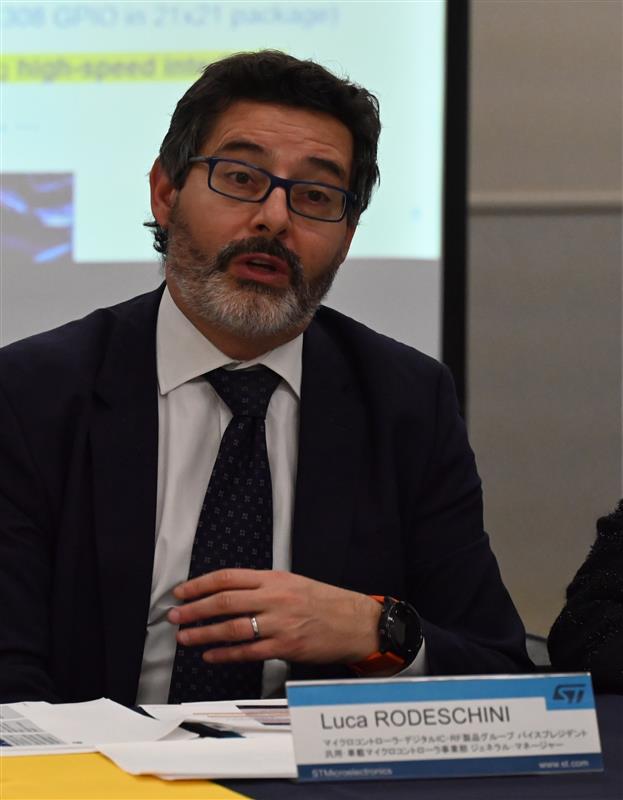
Announced during a media briefing, the Stellar P3E marks a significant step in integrating real-time AI with deterministic control, addressing the rising complexity of modern automotive systems driven by electrification and connectivity.
Powering the X-in-1 Transition
Automakers are increasingly shifting toward “X-in-1” architectures, which consolidate multiple functions, such as battery management, onboard charging, and power conversion into a single system. This reduces hardware redundancy, wiring, and overall system weight.
The Stellar P3E is designed to sit at the centre of this transition, combining high-performance computing, advanced analogue integration, and AI capabilities in a single chip.
Embedded AI for Real-Time Intelligence
A key highlight of the new MCU is its Neural ART Accelerator, a dedicated neural processing unit (NPU) that enables real-time AI inference at the edge. The accelerator is capable of significantly reducing inference time, up to 69 times faster than CPU-based implementations, while maintaining low power consumption.
This allows vehicles to process unstructured data, detect patterns, and adapt system behaviour dynamically, supporting applications such as predictive maintenance, intelligent sensing, and optimised energy management.
Addressing Industry-Wide Complexity
With vehicles evolving into software-driven platforms, the industry is facing unprecedented challenges, including exponential software growth, stricter safety and cybersecurity requirements, and ongoing supply chain uncertainties.
STMicroelectronics emphasised three key pillars behind the Stellar P3E:
- Reducing complexity and cost through hardware consolidation and software optimisation
- Enabling smarter systems with AI-driven algorithms
- Delivering high-performance computing with precise sensing and actuation
The MCU also complies with ISO 21434 cybersecurity standards and incorporates flexible safety configurations, including split-lock and lockstep modes.
High Performance, Rich Integration
The Stellar P3E delivers up to 8,000 CoreMark performance and features:
- Up to 19.5 MB of embedded non-volatile memory using phase-change memory (PCM)
- Over 300 GPIOs and more than 100 ADC channels
- Support for Gigabit Ethernet and CAN-XL communication
These capabilities enable integration of multiple powertrain components, including inverters, DC-DC converters, and battery systems within a unified architecture.
Industry Shift to Software-Defined Vehicles
The launch aligns with the broader move toward software-defined vehicles, where functionality is increasingly delivered through software updates rather than hardware changes. With support for over-the-air (OTA) updates and scalable memory, the Stellar P3E enables continuous feature upgrades over a vehicle’s lifecycle.
The company is targeting a $16 billion automotive MCU market opportunity by 2030, driven by electrification, ADAS, and SDVs.
Why 28nm Still Matters: ST Explains Its Node Strategy
When asked about ST’s decision to use a 28-nanometer process node at a time when competitors are pushing toward more advanced nodes, they clarified that while advanced nodes are typically optimised for maximum compute efficiency, they are not always cost-effective for automotive applications that require a balance of digital processing and analogue functionality.
The company stated that 28nm represents a “sweet spot” where both analogue performance and digital complexity can be efficiently integrated. It also highlighted its advantage in embedding large memory at this node, leveraging what it described as one of the densest technologies in the industry.
On the supply chain front, ST emphasised its vertically integrated manufacturing strategy. The 28nm technology used for Stellar P3E is produced at its high-capacity facility in Crolles, France, allowing the company to retain greater control over production.
Unlike reliance on external foundries, which are currently under pressure from AI-driven demand, ST’s in-house manufacturing enables it to prioritise automotive and industrial customers. The company also noted its dual-sourcing strategy for automotive MCUs at every stage of production to enhance resilience.

