

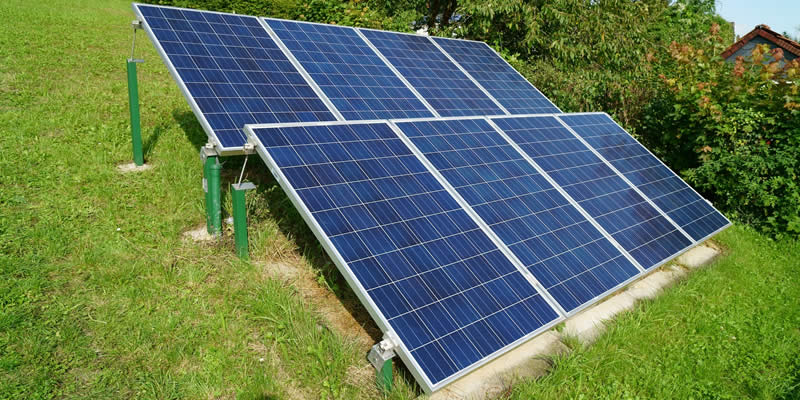
As the climate crisis looms, scientists are racing to find solutions to common clean energy problems, including solar energy storage. It is one of the best renewable resources we have, but it has challenges that prevent it from being widely adopted and replacing conventional energy sources. Because solar energy is variable throughout the day and throughout the year, it is important to have a robust storage system. Currently, solar is converted to electricity in solar cells, which cannot store the energy long-term, and separate battery storage systems are inconvenient and expensive. To solve this problem, researchers are trying to find ways to combine the power conversion and storage capacity needs of solar energy into one device.
Previous attempts to simplify solar energy conversion and storage put two different components together into a complicated device architecture, which was ultimately inefficient, expensive, and heavy. But significant progress has been made in combining these elements into a single device, which shares elements and significantly cuts down on the problems of previous designs.



“The amount of received solar energy on the Earth’s surface is up to 100,000 terawatt-hours, which completely meets the demand of the annual global energy consumption of 16 terawatts,” said paper author Hairong Xue, an assistant professor at the National Institute for Materials Science in Tsukuba, Japan. “However, like wind power, solar energy is intermittent due to fluctuations in isolation. To balance supply and demand, converted solar energy needs to be stored in other energy storage devices. Therefore, it is imperative to incorporate suitable energy storage technologies into solar cells, enabling effective energy utilization and delivering the produced electricity when needed.”
The progress in using six different types of photo-enhanced rechargeable metal batteries: lithium-ion, zinc-ion, lithium-sulfur, lithium-iodine, zinc-iodine, lithium-oxygen, zinc-oxygen, and lithium-carbon dioxide batteries. The authors detail the advantages and disadvantages of each kind of battery and how it can be applied to solar-to-electricity power conversion and storage. For example, rechargeable lithium-ion batteries, which we are all familiar with because they are used in many modern electronic devices, including laptops, phones, and electric vehicles, are efficient but would be difficult to scale for solar energy use because of their complicated structure.
Researchers point out that this technology is still in its early stages and there is more research to be done. Looking ahead to the future, they hope to take the next steps toward improving solar energy storage using photo-enhanced rechargeable metal batteries.
“It is necessary to explore more suitable electrode materials and optimize the device structure of the batteries,” Xue said. “For practical applications, stability and safety issues must be addressed and improved. Although the development of photo-enhanced rechargeable metal batteries is quite fact-based, most of the studies remain in an early stage of laboratory tests. By addressing some critical challenges involving working mechanism, electrode materials, and battery structure design, the goal is to demonstrate viable uses of photo-enhanced rechargeable batteries in electronic and optoelectronic devices.” The researchers also hope to explore how this technology could be applied to other types of energy conversion and storage systems.

