
Radio Frequency Identification (RFID) scanners have become a crucial tool in the ever-changing world of modern technology, completely changing the way we track and manage our assets. We’ll dive into the world of RFID scanners in this blog, looking at their types, features, uses, underlying technology, and benefits for different businesses.
What is an RFID Scanner?
An RFID scanner is a tool for reading and capturing data from RFID tags. RFID uses electromagnetic fields to convey data between a tag and a reader. It is a wireless communication technology. These tags, usually implanted in items or affixed to objects, have unique IDs that RFID readers may easily scan.




RFID Scanner Types
There are several types of RFID scanners, each designed for a particular need. RFID scanners come in two main types: portable and stationary. Because of their portability, handheld scanners are perfect for asset tracking and inventory management on the go. Conversely, fixed scanners are immovable and are frequently incorporated into automated tracking systems in manufacturing, retail, and logistics environments.
How RFID Scanners Work
The electromagnetic induction theory explains the operation of RFID scanners. An RFID tag activates when it comes into contact with a reader, which then records the information kept in the tag’s memory. Radiofrequency waves are used to communicate between the tag and the reader, enabling speedy and effortless data transfer.
RFID Scanner Uses
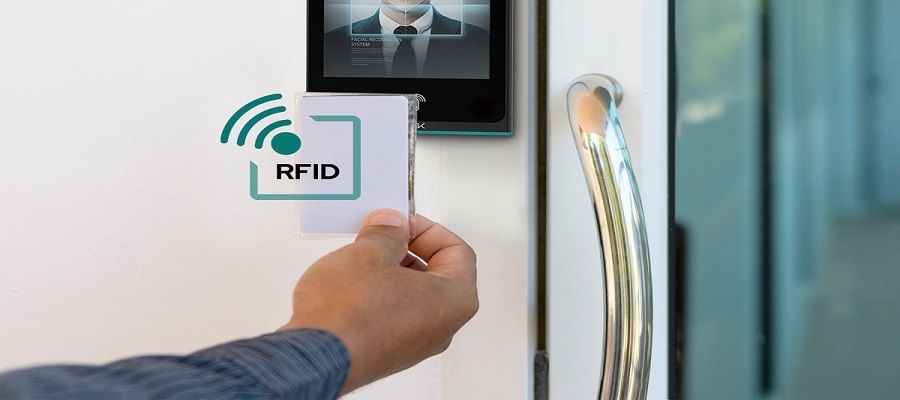
RFID scanners are being used in many different industries, and they have transformed operational efficiency. RFID scanners in retail simplify inventory management, cutting down on mistakes and improving stock level accuracy. These scanners help with real-time shipment tracking in logistics and supply chain management, guaranteeing accurate monitoring from warehouse to destination. RFID is used in healthcare to track medications and identify patients, and it is also used in access control systems to provide secure access in business settings.
RFID Scanner Technology
RFID readers function within one of the two frequency bands: ultra-high frequency (UHF) or high frequency (HF). Applications needing shorter read ranges, such as payment systems and access control, frequently use HF RFID. UHF RFID is preferred in retail, inventory management, and logistics settings due to its extended scan ranges.
RFID Scanner Advantages
There are lots of advantages to using RFID scanners. Efficiency is one important advantage. Since several tags may be read at once with RFID scanners, labour and time requirements for tasks like inventory counting are greatly reduced. Because RFID scanning is accurate, fewer mistakes are made, which improves decision-making and inventory visibility.
RFID technology’s automation possibilities are another benefit. Automating processes that formerly required human data entry can lower the possibility of human error and free up important resources for more strategic work.
In conclusion, RFID scanners are now considered essential in today’s business environment because they provide a strong solution for inventory control, asset tracking, and a wide range of other uses. The future of many sectors will surely be greatly influenced by the adaptability and effectiveness of RFID scanners as technology advances.

