

The development of communication networks has entered a revolutionary phase. As 5G continues to mature and 6G research gains momentum, the world stands at the cusp of a hyper-connected era driven by real-time intelligence, automation, and pervasive connectivity.
From autonomous mobility and telemedicine to smart manufacturing and immersive AR/VR, the success of these innovation rests on one invisible foundation trustworthy mobile network performance.




Behind this dependability lies mobile network testing the unseen but critical layer ensuring that every connection performs seamlessly.
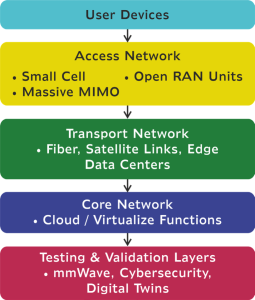
This diagram shows how data flows through a telecom network—from user devices to access technologies like Small Cells and Massive MIMO, through transport layers like fiber and edge data centers, into a cloud-based core network, and finally through testing layers using mmWave, cybersecurity, AI, and digital twins to ensure performance and reliability.
The Technology Behind Network Testing
- With mmWave, massive MIMO, network slicing, and Open RAN shaping 5G architecture, testing has become a complex science demanding unprecedented accuracy, flexibility, and speed.
- Today’s testing solutions are evolving with AI-powered analytics, cloud-based digital twins, and cybersecurity validation frameworks, enabling operators, equipment manufacturers, and researchers to ensure reliability across both physical and virtualized networks.
- As the world transitions toward 6G featuring terahertz (THz) frequencies, AI-native architectures, and intelligent automation network testing will remain the quiet enabler that keeps our connected future secure and scalable.
Innovations Powering Modern Network Testing
- Predictive Analytics Powered by AI
Machine learning is reshaping network validation by predicting faults before they affect service. AI models analyze vast datasets from live networks to predict congestion, optimize routing, and reduce downtime, turning testing from reactive to proactive.
- Cloud-Based Simulation & Digital Twins
Digital twins now simulate entire networks in the cloud from traffic behavior to mobility and interference patterns. This reduces field testing costs while improving accuracy, enabling virtual prototyping of real-world networks.
- Open RAN & Massive MIMO Validation
Open RAN drives multi-vendor interoperability but demands strict conformance testing for timing, synchronization, and RF performance between distributed and radio units. Testing tools ensure each vendor’s hardware performs harmoniously in shared environments.
- Cybersecurity & Resilience Testing
With 5G serving critical industries, penetration testing, vulnerability scanning, and cyberattack emulation are essential to preserve network integrity. The shift toward zero-trust architectures is also reshaping validation methodologies.
Industry Insights:
Some of the most significant advancements in mobile network testing are being led by industry pioneers like Anritsu and Keysight Technologies. Their innovative tools and forward-thinking approaches are not only addressing current 5G challenges but also laying the groundwork for the 6G era.
Anritsu Insight:
“5G came with big promises and bigger testing challenges,” says Madhukar Tripathi, Associate Director – Marketing & Business Development, Anritsu India.
“Technologies like mmWave, URLLC, and network slicing push testing boundaries. At Anritsu, our platforms like the MT8000A Radio Communication Test Set, Shockline VNA, and Network Master Pro MT1000A are enabling operators and manufacturers to validate performance at every stage — from R&D to deployment.”
Synchronization and interoperability are key challenges in Open RAN, where timing precision determines network reliability. “Our MT1000A and MS2850A test solutions perform PTP/SyncE and RF conformance tests to ensure accurate timing across multi-vendor O-RAN environments,” he adds.
AI-powered analytics further help in predictive fault detection. “By integrating data-driven insights into our instruments, we make spectrum analysis more intelligent — transforming network testing from a reactive process to a predictive one.”
“Synchronization is key for Open RAN. Test platforms emulate and measure time errors with atomic clock precision, ensuring reliable multi-vendor timing.”
Also advancing 6G research, collaborating globally on FR3 (7–24 GHz) and sub-THz frequencies. Tools like the VectorStar broadband VNA and Scenario Edit Environment Kit (SEEK) automate multi-domain testing, preparing networks for future intelligent connectivity.
— Madhukar Tripathi, Anritsu India
Keysight Insights:
“The transition from simulation to digital twinning is redefining how networks are designed and optimized,” says Mombasawala Mohmedsaeed, CTO, Keysight Technologies India.
With RaySim and EXata, Keysight provides an end-to-end digital twin ecosystem to model base stations, channels, and user equipment under realistic mobility and interference conditions. “Tools allow operators to virtually replicate entire cities or rural regions and optimize networks for energy efficiency and coverage before physical deployment.”
For Non-Terrestrial Networks (NTNs), tools like Propsim and UE Sim emulate satellite-based communications to ensure seamless coverage.
On the security front, Keysight’s CyPerf, BreakPoint, and Threat Simulator emulate real-world cyberattacks to test network resilience. The Software Bill of Materials (SBOM) and Riscure solutions add another layer by tracing vulnerabilities within semiconductor and IoT ecosystems.
“Performance validation alone isn’t enough anymore — continuous cybersecurity testing is critical to protect mission-critical networks,” Mohmedsaeed emphasizes.
“Digital twins and cybersecurity intelligence are twin pillars of modern network assurance.”
— Mombasawala Mohmedsaeed, Keysight Technologies India
The Road Ahead: Testing Beyond 5G

The future of network testing will revolve around network slicing, private 5G, and 6G prototyping. Ultra-low latency, massive device connectivity, and AI-native architectures will demand test automation, real-time data visualization, and cross-domain validation.
Furthermore, the convergence of terrestrial and satellite networks will require innovative methods to ensure reliability and performance even in remote and harsh environments.
As the digital horizon expands toward 6G, the invisible precision of network testing will be what keeps the hyper-connected world running flawlessly. Every autonomous car that drives safely, every remote surgery that succeeds, and every virtual experience that feels real will owe its reliability to the unseen rigor of testing.
In the race to the future, innovation may set the pace but precision testing ensures the world never loses connection.

