
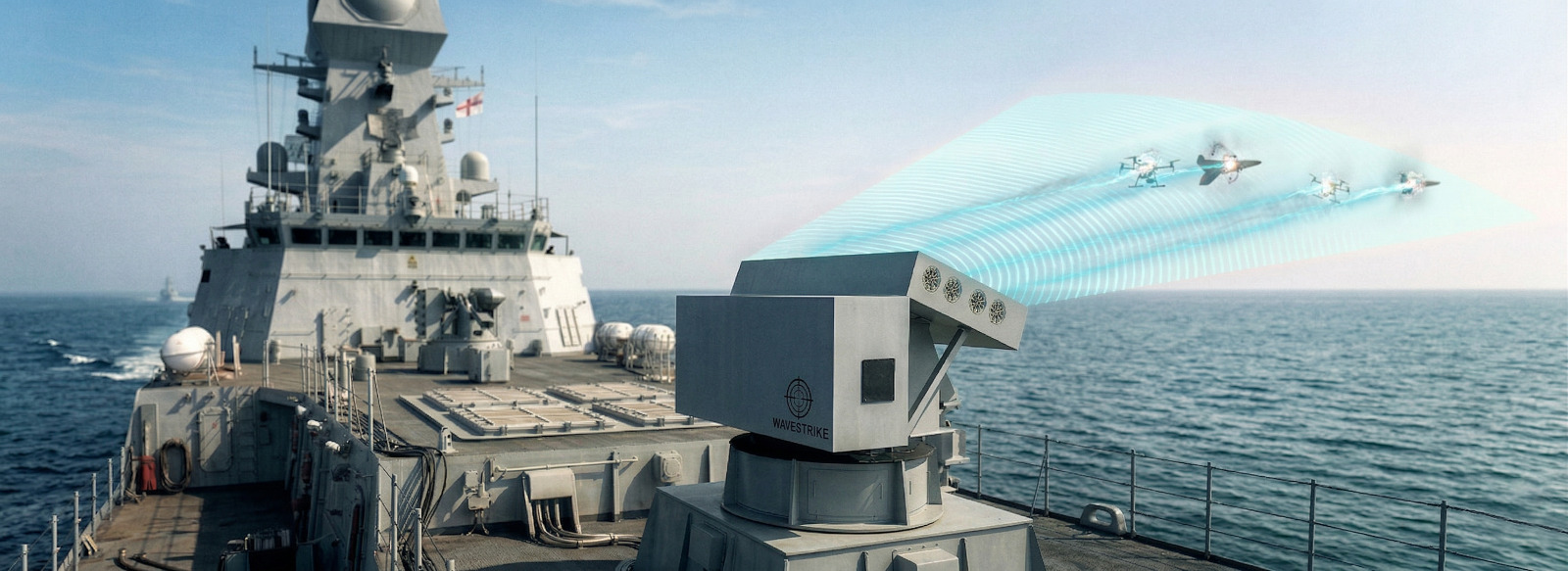
Defence technology company Tonbo Imaging receives an award and a contract from the Indian Navy under the ADITI 3.0 innovation framework to integrate and commission a High Power Microwave (HPM) system for naval platforms. The programme supports iDEX and the Defence Innovation Organisation (DIO) under the Ministry of Defence, Government of India. Within the scope of the engagement, Tonbo Imaging will undertake system integration and commissioning activities, followed by the supply of multiple production units upon successful development, validation, and acceptance.
High-power microwave systems represent a strategically significant direct-energy capability and are considered a strategic asset; only a limited number of countries possess them today. Such systems provide a non-kinetic means of disabling or degrading adversary electronics, sensors, and unmanned systems, and one of the few practical approaches to countering swarms of drones, making them increasingly relevant in modern maritime and asymmetric threat environments. The Indian Navy’s continued investment in this domain reflects a forward-looking approach to electromagnetic spectrum dominance and next-generation deterrence.




ADITI (Advanced Defence Technology Incubation) is a Government of India initiative to enable the maturation, integration, and validation of advance defence technologies before induction. The selection of Tonbo Imaging under ADITI 3.0 reflects the emphasis on indigenously developing strategic capabilities aligned with the Navy’s evolving operational requirements and long-term force modernisation plans.
Commenting on the development, Arvind Lakshmikumar, Managing Director and Chief Executive Officer, Tonbo Imaging India Limited, said, “This programme represents a significant responsibility to execute complex capability integration with discipline, rigour, and clear alignment to end-user operational needs. Over the past several years, Tonbo Imaging has invested substantially in the indigenous development of core building blocks of High Power Microwave technology, including critical sub-systems and vacuum tube sources. We are among the very few private organisations to own core intellectual property in vacuum-tube technologies that are fundamental to HPM systems, and this deep technology foundation has been a key factor in our selection for this naval programme. For the class of effects required in High Power Microwave applications, vacuum tube–based sources remain the practical path forward, as they can generate the extremely high peak power and energy levels necessary for effective target coupling. Solid-state RF sources, while well suited for many RF applications, cannot today achieve the required peak power and pulse energy levels within feasible size, weight, and efficiency envelopes for operational HPM systems.”
With this engagement, Tonbo Imaging’s role extends well beyond that of an imaging and electro-optics company, reinforcing its position as a defence technology company focused on the development and integration of advance defence systems. The programme underscores the company’s growing involvement in complex system-level integration, advanced electronics, embedded software, and emerging direct-energy and mission systems, in addition to its prevailing strengths in electro-optics. This evolution reflects Tonbo Imaging’s transition toward delivering integrated defence capabilities.
About Tonbo Imaging India Limited
Tonbo Imaging India Limited is a defence technology company that focuses on the design, development, and integration of advanced sensing, perception, and mission-critical systems for military and security applications. The company’s portfolio spans electro-optics, thermal imaging, situational awareness, advanced electronics, embedded software, and emerging directed-energy technologies, enabling the delivery of integrated defence solutions that support operational requirements across land, maritime, and air domains. Tonbo Imaging continues to evolve as a defence technology and systems company, investing in the development of next-generation directed-energy systems as well as advanced defence solutions such as loitering munitions and counter-unmanned aerial systems (C-UAS), reflecting its strategic focus on addressing emerging operational threats through indigenous capability development.

