
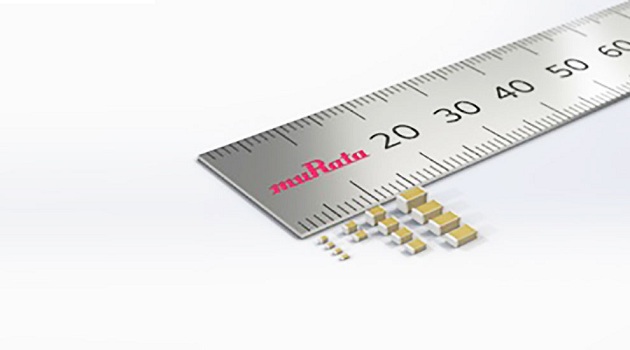
As the capacity of monolithic ceramic capacitors increases, the number of cases in which monolithic ceramic capacitors are being used in areas that were previously unconsidered is also on the increase.
In the marketplace, we are seeing practical applications being promoted to improve the efficiency of mainly electric power converters as a result of higher frequencies being applied to switching elements and these elements being driven at higher temperatures. In addition, monolithic ceramic capacitors are being adopted more and more for their impedance characteristics at high frequencies and compatibility at high temperatures.




Another key point in their adoption is that downsizing and cost reductions can be achieved due to their compatibility with surface-mounted products.
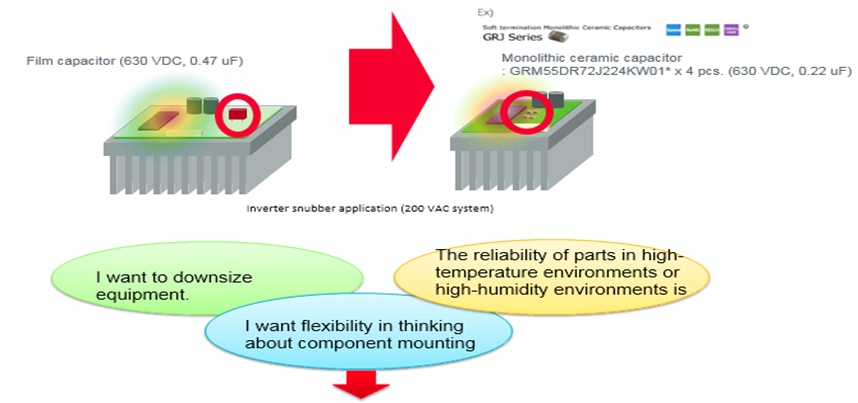
These materials provide actual examples of the differences between film capacitors and monolithic ceramic capacitors, and how downsizing and cost reductions can be achieved.
Tips to increasing design freedom:
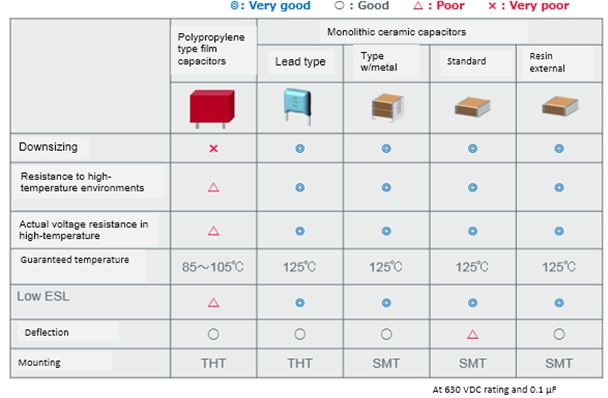
Key reasons for recommending monolithic ceramic capacitors
- Downsizing is possible
- Compatibility with high-temperature, high-humidity environments
- Surface-mounting compatibility
1) Downsizing
This table shows a comparison between monolithic ceramic capacitor and film capacitor products with the same voltage and capacity.
From this table, you can see that monolithic ceramic capacitors are considerably smaller. 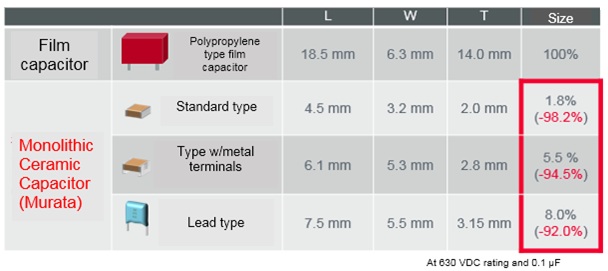
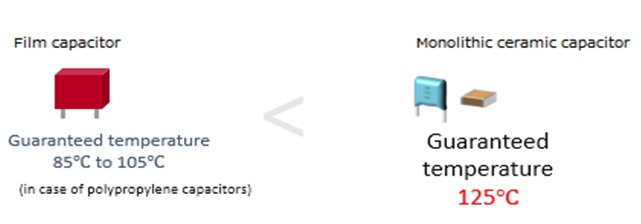
2) Resistance to high-temperature environments and high humidity
With monolithic ceramic capacitors, 125°C is set as the standard guaranteed temperature.
Also, the products are tested for humidity resistance in high 85% or 95% humidity environments in reliability tests.
Content guaranteed under standard temperature environments
Reliability items in high humidity environments for general monolithic ceramic capacitors
- Humidity: 95%; testing temperature: 60℃; rated voltage: 1000 hrs or
- Humidity: 85%; testing temperature: 85℃; rated voltage: 1000 hrs
3) Surface-mounting compatibility
There are a number of advantages in choosing monolithic ceramic capacitors: Components can be downsized, substrates can be downsized as a result of the high degree of freedom in the layout of mounted components, and humidity exclusion measures can be reduced as a result of their outstanding humidity resistance.
Example of replacement with a monolithic ceramic capacitor (general-purpose)
Design with a film capacitor After replacing with a monolith ceramic capacitor
Why not consider multi-layer ceramic capacitors?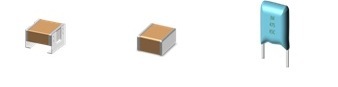
For more Information Visit: www.murata.com

