
HomeIndustryAutomotiveAldebaran5, Next Generation Autonomous Vehicle Computing Platform in a Single Chip

Aldebaran5, Next Generation Autonomous Vehicle Computing Platform in a Single Chip

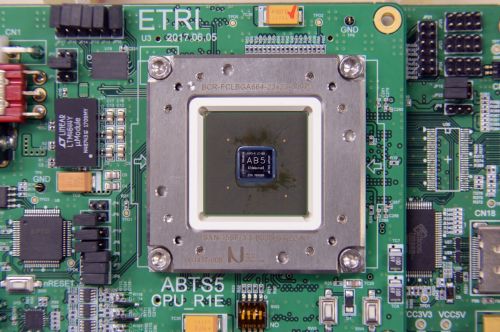
The Processor Research Group at ETRI has announced the development of Aldebaran5, a processor for self-driving cars. Aldebaran5 features 9 cores to provide high computing power as well as safety mechanisms to ensure reliability for automotive applications, while exhibiting industry leading power efficiency (~1 watt) and a tiny form factor (smaller than the size of a nail head.)

Codenamed Aldebaran5 after the brightest star in the constellation of Taurus, the chip is a significantly upgraded version of its predecessor. Nine cores provide ample computing power, 4 of which are dynamically programmable to operate for performance or for reliability. Safety features adhering to international standards ensure reliability with 99% detection coverage of faults and malfunctions and includes recovery mechanisms to mitigate potential negative effects.


Dedicated custom-designed acceleration circuitry for image recognition and HEVC (high efficiency video coding) as well as CAN bus communication hardware and an image signal processor (ISP) are integrated into the SoC, all combining to provide a robust and streamlined computing platform designed for autonomous vehicle applications.

A wide range of applications have been demonstrated on Aldebaran5 attesting to a powerful, efficient, robust, yet reliable computing platform tailor-made for autonomous vehicle applications. These include real time pedestrian and vehicle recognition, lane detection/warning/keeping system, ultra high definition black box functionality (dash cam), interfacing and processing of various sensor data (radar, GPS, etc) and vehicle maneuvering via CAN bus control, among others.

Research and development to integrate neural network acceleration hardware in order to provide artificial intelligence capabilities are near completion and expected to be announced within the year.

ELE Times Research Desk
ELE Times Research Deskhttps://www.eletimes.ai
ELE Times provides a comprehensive global coverage of Electronics, Technology and the Market. In addition to providing in depth articles, ELE Times attracts the industry’s largest, qualified and highly engaged audiences, who appreciate our timely, relevant content and popular formats. ELE Times helps you build awareness, drive traffic, communicate your offerings to right audience, generate leads and sell your products better.

Related News

Must Read

Upgrading Factory Power Safety with Silicon Carbide Semiconductors from Infineon and Siemens

Semiconductor circuit breakers are fast-acting, semiconductor-based electronic devices that...

Wide-Bandgap (WBG) Power Electronics: Transforming the Future of High-Efficiency Energy Systems

The global power electronics industry is undergoing a major...

What is the Future of Embedded Systems?

In the next five years, the embedded landscape will...

India Targets 50% Semiconductor Self-Sufficiency by FY35

In a major push toward technological sovereignty, India is...

Silicon Photonics: Breaking the Bandwidth Barrier in AI Computing

Introduction: When Data Movement Becomes the Bottleneck Artificial intelligence now...

PLC, PAC, and Industrial PC Architectures for Automation

Navigating the New Era of Industrial Control Systems Introduction Industrial automation...

Optics and Silicon Photonics: The Next Data Highway Inside Chips

For more than five decades, the semiconductor industry has...

Neuromorphic Engineering & Edge AI: The Future of Intelligent Computing

Artificial Intelligence is rapidly transforming industries, but traditional AI...

Ensuring Reliable AI in Safety-Critical Systems: Challenges and Engineering Solutions

Introduction: When AI Decisions Carry Real-World Consequences In safety-critical environments,...

Nanometer Nanotubes for Future Electronics

1nm molybdenum disulfide tubes expand nanotube science beyond carbon Researchers...

