
Creating cloud-connected applications traditionally can require significant time and resources for embedded designers to develop necessary expertise in communications protocols, security and hardware compatibility. Developers often overcome these challenges with large software frameworks and Real Time Operating Systems (RTOS), which results in increased development time, effort, cost and security vulnerabilities.
Microchip Technology Inc. has announced a new Internet of Things (IoT) rapid development board as part of an expanded partnership with Google Cloud, enabling designers to prototype connected devices within minutes. The solution combines a powerful AVR microcontroller (MCU), a CryptoAuthentication secure element IC and a fully certified Wi-Fi network controller to provide a simple and effective way to connect embedded applications. Once connected, Google Cloud IoT Core makes it easy to collect, process and analyse data to inform decisions at scale.




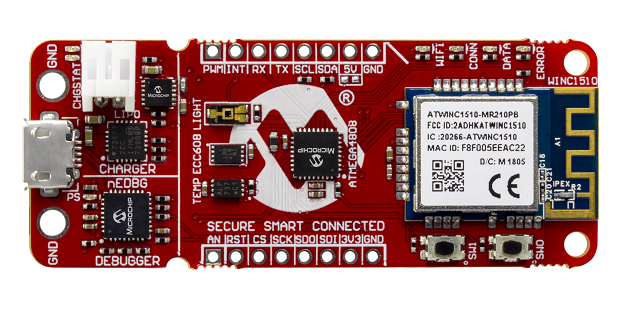
The AVR-IoT WG development board gives developers the ability to add Google Cloud connectivity to new and existing projects with a single click using a free online portal at AVR-IoT.com. Once connected, developers can use Microchip’s rapid development tools, MPLAB Code Configurator (MCC) and Atmel START, to develop and debug in the cloud. The board combines smart, connected and secure devices to enable designers to quickly connect IoT designs to the cloud, including:
· Powerful AVR microcontroller (MCU) with integrated peripherals: The ATmega4808 8-bit MCU brings the processing power and simplicity of the AVR architecture with added advanced sensing and robust actuation features. With the latest Core Independent Peripherals (CIPs) that decrease power consumption, it provides cutting-edge performance in real-time sensing and control applications.
· Secure element to protect the root of trust in hardware: The ATECC608A CryptoAuthentication device provides a trusted and protected identity for each device that can be securely authenticated. ATECC608A devices come pre-registered on Google Cloud IoT Core and are ready for use with zero touch provisioning.
· Wi-Fi connectivity to Google Cloud – The ATWINC1510 is an industrial-grade, fully certified IEEE 802.11 b/g/n IoT network controller that provides an easy connection to an MCU of choice via a flexible SPI interface. The module relieves designers from needing expertise in networking protocols.
“Designing secure, cloud-connected systems does not have to be an exhaustive process, and our expanded offerings with Google Cloud provide a simplified development process to bring IoT designs to market quickly,” said Steve Drehobl, vice president of Microchip’s 8-bit MCU business unit. “Because the board is supported by both MCC and Atmel START, designers can accelerate development using their preferred tool.”
Among the benefits of connecting devices to Google Cloud IoT Core’s infrastructure are the powerful data and analytics that enable designers to make better, smarter products. As part of the infrastructure, embedded designs can better take advantage of, and respond to, rapidly changing conditions across many sensor nodes.
“Microchip’s solutions enable Google Cloud IoT customers to build or migrate their applications with speed and scale, without compromising on security,” said Antony Passemard, Head of Product Management for Google Cloud IoT. “Combined with Google Cloud Platform’s network infrastructure and Google’s IoT services, the simplicity of the board makes powerful analytics tools and unique machine learning capabilities accessible to anyone.”
Development Tools
As announced earlier, AVR devices are now supported in the MPLAB X Integrated Development Environment (IDE), giving designers the option to choose between MCC or Atmel START when developing with the AVR-IoT development board. The board is compatible with more than 450 MikroElektronika Click boards that expand sensors and actuator options. Developers who purchase the kit will have access to an online portal for immediate visualisation of their sensors’ data being published.

