

HomeNewsIndia NewsFlexibility of Crystal Surfaces is revealed by the Real-Time imaging

Flexibility of Crystal Surfaces is revealed by the Real-Time imaging

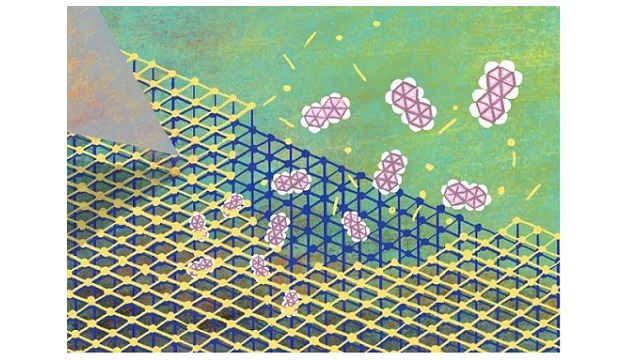
Images taken using an atomic force microscope have enabled researchers from Kyoto University’s Institute for Integrated Cell-Material Sciences (iCeMS) to observe, for the first time, the flexible and dynamic changes that occur on the surfaces of porous coordination polymer (PCP) crystals when biphenyl guest molecules are introduced.

The atomic force microscope was formed using a tiny probe at the end of a cantilever. The probe’s movements over the surface of the material were recorded, providing an image of the material’s topography.


The surface of the coordination polymer crystal, which was made of zinc clusters and two types of ligands, was first examined in solution under stable conditions. The metal-organic lattices on the surface were tetragonal in shape. A biphenyl solution was then added to the crystal with a gradually increasing concentration. Images were taken every 13 seconds.

The team found that the lattices changed to a rhombic shape within 10 minutes as the biphenyl concentration reached a maximum of 500 millimoles per liter (mmol/L) of solution, due to the molecule’s combination with the crystalline surface. Decreasing the concentration led to removal of the biphenyl from the material’s surface and a rapid return of the lattices’ tetragonal shapes. Further studies showed that the surface changes barely affected the rest of the crystal’s structure.

According to the researchers, the highly responsive nature of the porous coordination polymer surface, captured in great detail, could help guide materials development.

“We were surprised to find that the porous coordination polymer surface is exceptionally flexible and constantly fluctuating in solution, contrary to the common perception that the crystal is hard and immobile,” said researcher Nobuhiko Hosono.

ELE Times Research Desk
ELE Times Research Deskhttps://www.eletimes.ai
ELE Times provides a comprehensive global coverage of Electronics, Technology and the Market. In addition to providing in depth articles, ELE Times attracts the industry’s largest, qualified and highly engaged audiences, who appreciate our timely, relevant content and popular formats. ELE Times helps you build awareness, drive traffic, communicate your offerings to right audience, generate leads and sell your products better.

Related News

Must Read

Delivering Policy-based Runtime Authorization for AI Agents

​AI model providers have converged on a consistent principle:...

Building a Robust Platform That Scales with AI Infrastructure Expansion: Tam Do, Microchip

Prominent semiconductor technology supplier Microchip has been working steadily...

Indian Auto Industry: Driving Innovation via e-Mobility and Connected Vehicle Technology

Anwesh Koley, Executive Editor, ELE Times The automotive industry is...

LoRa-Based Wireless Sensor Technology Enables Long-Range Industrial Position Monitoring

Modern industry automation depends on connective technologies, artificial intelligence,...

Building Scalable Data Infrastructure for the Future of Enterprise AI

Scaling cloud-native data platforms supports growing workloads, though operating...

Fuel Cell Technology: The Key to Sustainable Mobility for the Future

Anwesh Koley, Executive Editor, ELE Times Alternate technology and materials...

TDK to Showcase EV Technologies and Made-in-India Components at Auto EV Bharat 2026

TDK Corporation will showcase its electric mobility technologies and...

Infineon Introduces 4Tx/4Rx CTRX8144FS Radar Chip for Advanced Automotive ADAS

Infineon Technologies AG has introduced the RASIC CTRX8144FS, a...

Nuvoton MA35 Family Enables Redfish-Based Remote Management for Industrial IoT Edge Devices

Nuvoton Technology Corporation has introduced a remote management platform...

Electronic Design Automation Market Size Estimated to Reach $43.07 Billion By 2034

The global Electronic Design Automation (EDA) market is undergoing...
