
A liquid electret material has been developed by researchers, which is capable of semi-permanently retaining static electricity. They subsequently combined this material with soft electrodes to create the first bendable, stretchable vibration-powered device in the world. Because this device is highly deformable and capable of converting very subtle vibrations into electrical signals, it may be applicable to the development of healthcare-devices, such as self-powered heartbeat and pulse sensors.
NIMS and AIST developed a liquid electret material capable of semi-permanently retaining static electricity. They subsequently combined this material with soft electrodes to create the first bendable, stretchable vibration-powered device in the world. Because this device is highly deformable and capable of converting very subtle vibrations into electrical signals, it may be applicable to the development of healthcare-devices, such as self-powered heartbeat and pulse sensors.




An electret material capable of semi-permanently retaining an electrical charge can generate voltage as its distance to the associated electrode changes. Because of this property, electret materials may be applicable to the development of vibration-powered (piezoelectric) devices and sensors capable of converting externally applied vibration and pressure into electrical signals. However, conventional electret materials are solid or in film form, and as such are inflexible and incapable of deformation into complex shapes, making them unsuitable for use in the development of wearable heartbeat and pulse sensors. A great deal of interest therefore exists in the development of bendable and stretchable vibration-powered devices that can be processed into a variety of shapes and used as such sensors.
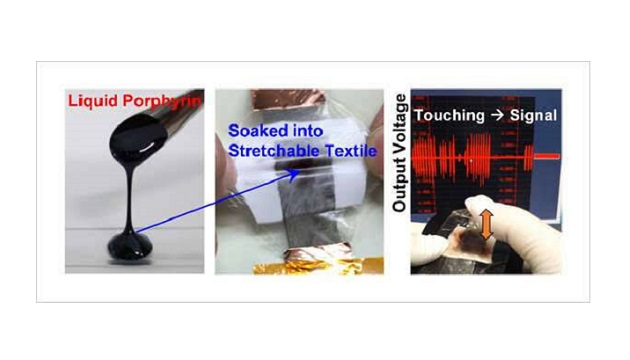
This research group shielded porphyrin, an organic compound, with a flexible yet insulating structure (i.e., branched alkyl chains), thereby developing a liquid material at room temperature which is able to stably retain static charge on the porphyrin unit. The group subsequently developed a bendable and stretchable vibration-powered device. First, a high voltage was applied to this liquid material, thereby electrically charging it. The liquid material was then allowed to soak into a stretchable textile and the soaked textile was then sandwiched between soft, polyurethane electrodes integrated with silver-plated fibers as a wiring material. When the surface of the device is pressed with a fingertip, it generates a voltage in a range of ±100-200 mV and operates stably for at least 1.5 months.
In future research, the group hopes to achieve healthcare use of this device by enhancing the ability of the liquid electret material to retain static electricity and making modifications to the processing techniques applied to the device. The group will also pursue potential use of this vibration-powered device as a power source for IoT devices by combining it with a voltage-current conversion system and capacitor, etc.

