
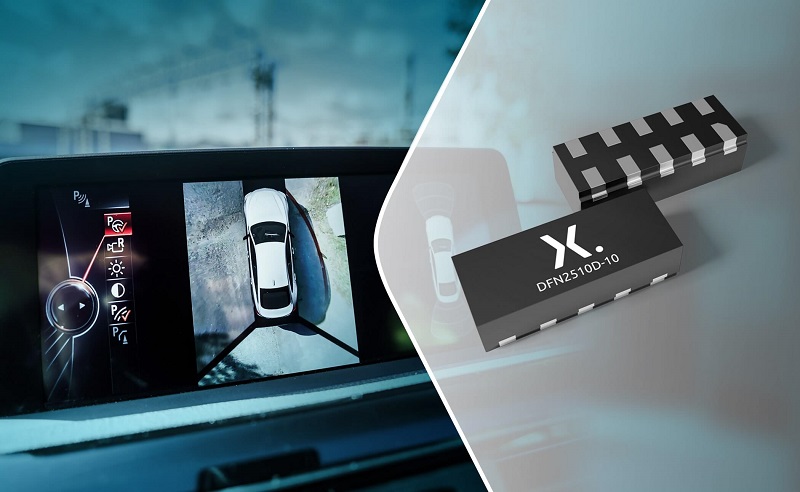
A new range of ESD protection devices aimed specifically at protecting the ever-increasing number of high-speed interfaces found in automotive applications, especially the in-vehicle networks (IVN) associated with infotainment and vehicle communications.
As data rates increase and vehicles feature more electric content, the need for EMC protection becomes more critical, and providing the correct type of protection is a challenge for design engineers. Nexperia’s TrEOS technology optimizes the three pillars of ESD protection (Signal Integrity, System Protection, and Robustness) to deliver devices with the ideal combination of low capacitance, low clamping voltage, and high ESD robustness.



The new PESD4USBx series comprises a total of twelve high-performance 4-channel ESD protection devices that incorporate TrEOS technology. Signal integrity is ensured by the very low line capacitance for each channel (as low as 0.25 pF) and the sub-0.05 pF line matching capacitance. All devices offer deep snapback combined with a low resistance of 0.4 Ohm. With ESD protection up to 15 kV, the PESD4USBx series meets IEC61000-4-2 level 4 and ISO10605. This is the highest level of ESD protection currently available in this package size making the devices ideal for modern, densely packed, automotive designs.
A wide range of interface standards is supported including USB 2.0, Superspeed USB at 10 Gbps, HDMI 2.0, HDBaseT, and the increasing number of automotive A/V monitor displays and cameras found in vehicles. PESD4USBx devices also support video links (SerDes): GMSL, FPD-Link and LVDS.
Specifically engineered for automotive applications, the devices exceed the needs of AEC-Q101 by a factor of two. Furthermore, in Nexperia’s state-of-the-art DFN2510D packages (SOT1165D and SOT1176D), side-wettable flanks (SWF) are available as standard, allowing the use of automatic optical inspection (AOI), thereby enhancing assembly quality for customers.
Commenting on the product launch, Lukas Droemer, Nexperia product manager said: “The electronic content is growing rapidly throughout the vehicle and, coupling this with the need for high data rates, interfaces commonly found in high-end A/V applications are becoming prevalent. With the heavy electrical content, vehicles are electrically noisy environments and these sensitive interfaces need high-performance ESD protection. Our new PESD4USBx series combines strong TrEOS performance with automotive-grade quality specifically for demanding automotive multimedia applications.”
For more information, visit www.nexperia.com

