
As smartwatches are increasingly able to monitor the vital signs of health, including what’s going on when we sleep, a problem has emerged: Those wearable, wireless devices are often disconnected from our body overnight, being charged at the bedside.
Assistant professor in the University of Massachusetts Amherst College of Information and Computer Sciences and director of the Advanced Human Health Analytics Laboratory tells, “Quality of sleep and its patterns contain a lot of important information about patients’ health conditions”.




But that information can’t be tracked on smartwatches if the wearable devices are being charged as users sleep, which prior research has shown is frequently the case. Lee adds, “The main reason users discontinue the long-term use of wearable devices is because they have to frequently charge the on-device battery.”
Pondering this problem, Researcher brainstormed with UMass Amherst wearable computing engineer to find a solution to continuously recharge these devices on the body so they can monitor the user’s health 24/7.
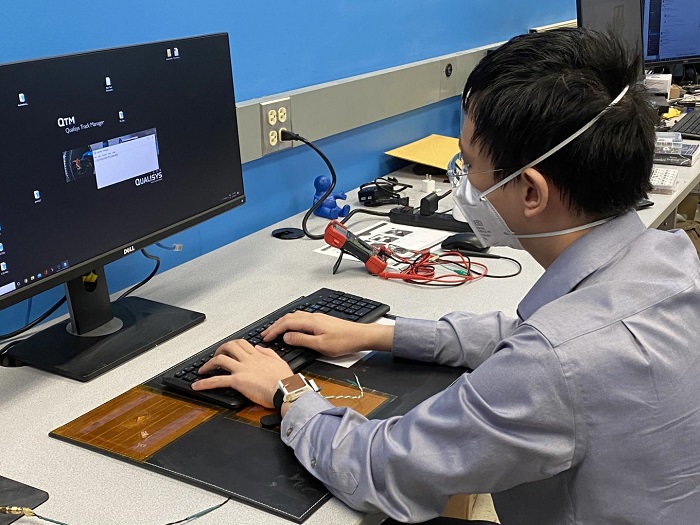
The scientists’ aha moment came when they realized “human skin is a conductible material, Why can’t they instrument daily objects, such as the office desk, chair and car steering wheel, so they can seamlessly transfer power through human skin to charge up a watch or any wearable sensor while the users interact with them? Like, using human skin as a wire.
Then they can motivate people to do things like sleep tracking because they never have to take their watch off to charge it.
Interactive Mobile, Wearable and Ubiquitous Technologies, Researchers lay out the technical groundwork and showcase its feasibility. They are hopeful that this will open a lot of possibilities toward the development of battery-less wearable devices both for consumer and clinical applications.
The UMass Amherst team received a $598,720 grant from the National Science Foundation to continue to develop the system’s hardware and software.
Assistant professor of electrical and computer engineering, explains how the technology uses human tissue as a transfer medium for power. In the device they have electrode that couples to the human body, which you could think of as the red wire. if you’re thinking of a traditional battery with a pair of red and black wires.

