
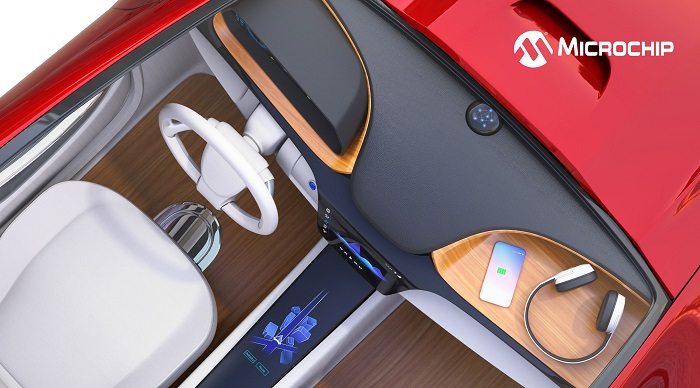
The Wireless Power Consortium (WPC) has recently released the Qi 1.3 specification that requires authentication for improved safety when transmitting up to 15W of power between a transmitter and a receiver.
To meet the requirements of the specification, Microchip Technology Inc. announced today a new Qi 1.3 wireless charging reference design providing developers of wireless charging systems for automotive and consumer applications with the necessary tools and support for the seamless integration and certification of new-generation product designs.




For wireless charging system developers launching certified Qi 1.3 transmitters under tight timelines, Microchip’s three-coil Qi 1.3 reference design provides a head start for product development. The reference design fully integrates secure storage subsystem software with the wireless power microcontroller (MCU) and is a flexible solution, enabling custom topologies and foreign object detection (FOD) implementation.
As a regular member in the Wireless Power Consortium (WPC), which sets global standards for wireless charging of mobile devices, Microchip provided expertise during development of the recently released Qi 1.3 specification. Qi 1.3 is a significant update from Qi 1.2.4 and mandates hardware-based authentication between transmitter and receiving devices for power transfer above 5W. By adhering to the new authentication standard, designers can ensure phones receiving 15W are receiving it from a Qi-certified authenticated transmitter to ensure safety.
“Wireless charging makes it easy and convenient for consumers to charge devices and, as a result, demand for these systems in the automotive and consumer segments is on the rise,” said Joe Thomsen, vice president, MCU16 business unit. “Microchip’s Qi 1.3 reference design, tools and support help engineers to meet rapidly evolving development requirements and enable easy certification of the new Qi 1.3 transmitter designs, speeding time to market and easing end-product certification.”
Included in Microchip’s reference design solution for wireless charging systems are all required elements: Qi controller, Qi application software, provisioned authentication controller that is a WPC-approved secure storage subsystem and crypto software libraries that execute on the Qi controller. The reference design includes complete schematics, bill of materials, software and design guidelines. Microchip is partnering with Avnet to make evaluation boards for the Qi reference design available to qualified customers around the world.
To support its Qi 1.3 wireless power solution, Microchip provides the dsPIC33C family of devices to run the Qi application software and the ECC608/TA100 secure storage subsystem provisioned by Microchip as a licensed WPC Manufacturing Certificate Authority. As a total system solution, this reference design also incorporates MIC4605 and MCP14700 gate drivers, MCP16331 and MCP1725 regulators, an MCP6C02 current sense device, an ATA6563 CAN transceiver and an MCP9700 temperature sensor.
Pricing and Availability
Microchip’s Qi 1.3 wireless charging transmitter reference design are available for demonstrations and evaluations for qualified customers. The company will provide a license agreement to access the reference design software. Evaluation boards for these reference design will be available for purchase for qualified customers through Avnet in August 2021.
For more information, visit www.microchip.com

