
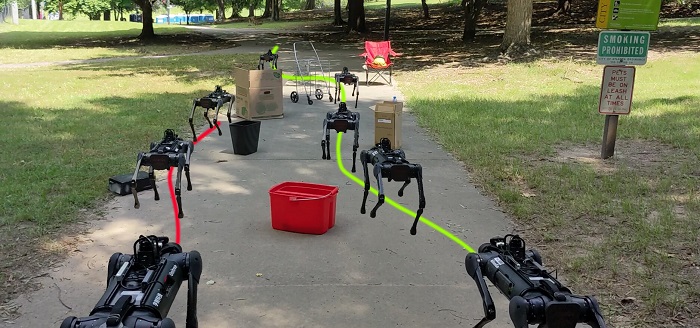
To operate efficiently in urban environments, mobile robots and other autonomous systems should be able to move safely on sidewalks and avoid collisions with pedestrians or other obstacles. This is particularly true for delivery robots or systems that are specifically programmed to patrol urban environments.
Researchers at the Georgia Institute of Technology and Stanford University have recently developed AlienGo, a quadruped robot that can follow specific routes generated by public map services while remaining on sidewalks and avoiding collisions with obstacles or humans. This robot, presented in a paper pre-published on arXiv, is based on a new, highly performing two-staged learning framework for safe sidewalk navigation.




“As part of this project, we developed intelligent quadrupedal robots that can navigate sidewalks in the real world,” Sehoon Ha, one of the researchers who carried out the study, told TechXplore. “Our work is inspired by two stems of the existing work: Autonomous driving and indoor robot navigation. However, as outdoor sidewalk navigation typically takes place in unstructured environments with a wide variety of pedestrians and obstacles without any guide lanes, we also proposed a set of learning techniques and algorithms to solve these specific challenges.”
Initially, the team trained an artificial neural network to navigate simple sidewalk environments in simulations. This first algorithm, dubbed the “expert,” was trained using a high-speed salient world simulator and was given access to the so-called “privileged state” of the simulation.
Subsequently, this “expert” network transferred the behavior it learned to a “student” algorithm in a high-fidelity simulation. Ultimately, this “student” network produced realistic sensor observations that resembled real-world sidewalk images.
“The ‘student’ uses a custom-trained semantic feature network to generate abstractions that are later used to control the robot,” Maks Sorokin, another researcher involved in the study. “This approach is based on our experience that the desired behavior is hard to obtain using naive end-to-end training, simply because the problem is way too hard.”
Using the two-stage learning framework they developed, Ha, Sorokin, and their colleagues were able to attain an effective policy using “privileged’ information in simulation and then transfer the behaviors acquired by the framework to a real four-legged robot. When the team evaluated the framework, they found that it outperformed other state-of-the-art models for sidewalk navigation. They then also tested their framework in a real-world setting, by applying it to the AlienGo robot as it navigated sidewalks in Atlanta.
“In addition to performance gains from using two-stage learning with the abstract world, it was surprising to see how easy the transfer to the real world was with our data augmentation/data curation,” Sorokin added. “Given that during training the robot has never seen any real-world sidewalk images and given all of the complexities of the real world, the performance without any adaptation was notable, to say the least. Our findings could imply that a lot of recent work robotics learning could be transferred to the real world, and hopefully practically used to benefit humanity.”
In the future, the quadrupedal robot developed by this team of researchers could be used to complete a variety of tasks, such as delivering parcels or monitoring urban environments. In addition, the framework they developed could be applied to other existing or emerging mobile robots to improve their ability to move to navigate sidewalks.
“While we made a lot of progress in sim-to-real transfer for navigation, there are still many challenges remaining,” Sorokin said. “Some of the challenges related to navigation that we still need to overcome include road crossing, dynamic obstacle handling, and interaction with real-world objects and humans, However, our approach is not limited to navigation, it could potentially be applied in many robotic applications, such as manipulation, locomotion, and others. We are excited to see its applications in adjacent research areas.”

